Wu Aozhou, Coresh Josef, Selvin Elizabeth, Tanaka Hirofumi, Heiss Gerardo, Hirsch Alan T, Jaar Bernard G, Matsushita Kunihiro
Johns Hopkins University, Baltimore, MD.
University of Texas at Austin, TX.
J Am Heart Assoc. 2017 Jan 20;6(1):e004519. doi: 10.1161/JAHA.116.004519.
Evidence regarding the association of lower extremity peripheral arterial disease with quality of life (QOL) is mainly from selected clinical populations or relatively small clinical cohorts. Thus, we investigated this association in community-derived populations.
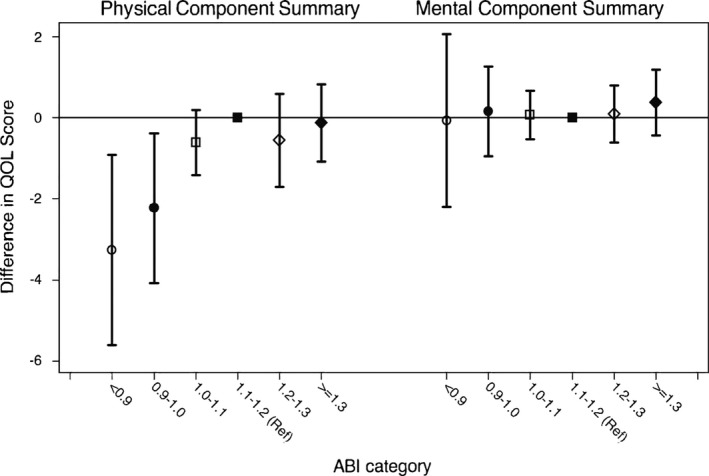
Using data of 5115 participants aged 66 to 90 years from visit 5 (2011-2013) of the Atherosclerosis Risk in Communities Study, we quantified the associations of ankle-brachial index (ABI) with several QOL parameters, including 12-item Short-Form Health Survey (SF-12), after accounting for potential confounders using linear and logistic regression models. Peripheral arterial disease defined by an ABI <0.90 (n=402), was independently associated with a low SF-12 Physical Component Summary score (-3.26 [95% CI -5.60 to -0.92]), compared to the ABI reference 1.10 to 1.19 (n=1900) but not with the Mental Component Summary score (-0.07 [-2.21 to 2.06]). A low ABI was significantly associated with poorer status of all SF-12 physical domains (physical functioning, role-physical, bodily pain, and general health) but only vitality out of 4 mental domains. Similarly, low ABI values were more consistently associated with other physically related QOL parameters (leisure-time exercise/activity/walking) than mentally related parameters (significant depressive symptoms and hopeless feeling). Lower physical QOL was observed even in individuals with borderline low ABI (0.90 to 0.99; n=426).
Low ABI (even borderline) was independently associated with poor QOL, especially for physical components, in community-dwelling older adults. QOL is a critical element for older adults, and thus, further studies are warranted to assess whether peripheral arterial disease-specific management can improve QOL in older populations.
关于下肢外周动脉疾病与生活质量(QOL)之间关联的证据主要来自特定临床人群或相对较小的临床队列。因此,我们在社区人群中研究了这种关联。
利用社区动脉粥样硬化风险研究第5次随访(2011 - 2013年)中5115名年龄在66至90岁参与者的数据,我们在使用线性和逻辑回归模型考虑潜在混杂因素后,量化了踝臂指数(ABI)与几个生活质量参数的关联,包括12项简短健康调查(SF - 12)。与ABI参考值1.10至1.19(n = 1900)相比,ABI < 0.90定义的外周动脉疾病(n = 402)与低SF - 12身体成分汇总评分独立相关(-3.26 [95% CI -5.60至-0.92]),但与精神成分汇总评分无关(-0.07 [-2.21至2.06])。低ABI与所有SF - 12身体领域(身体功能、角色 - 身体、身体疼痛和总体健康)的较差状态显著相关,但在4个精神领域中仅与活力相关。同样,低ABI值与其他身体相关的生活质量参数(休闲时间锻炼/活动/步行)的关联比与精神相关参数(显著抑郁症状和绝望感)更一致。即使在ABI临界低值(0.90至0.99;n = 426)的个体中也观察到较低的身体生活质量。
在社区居住的老年人中,低ABI(即使是临界值)与较差的生活质量独立相关,尤其是身体方面。生活质量是老年人的关键要素,因此,有必要进一步研究评估外周动脉疾病特异性管理是否能改善老年人群的生活质量。