Zhong Chao, Zhu Jinfang
Molecular and Cellular Immunoregulation Unit, Laboratory of Immunology, National Institute of Allergy and Infectious Diseases, National Institutes of Health, Bethesda, MD, 20892, USA.
Institute of Systems Biomedicine, School of Basic Medical Sciences, Peking University Health Science Center, Beijing, 100191, China.
Protein Cell. 2017 Apr;8(4):242-254. doi: 10.1007/s13238-017-0369-7. Epub 2017 Jan 20.
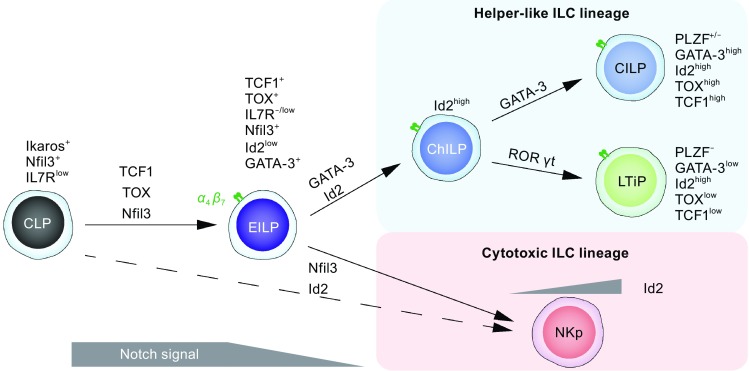
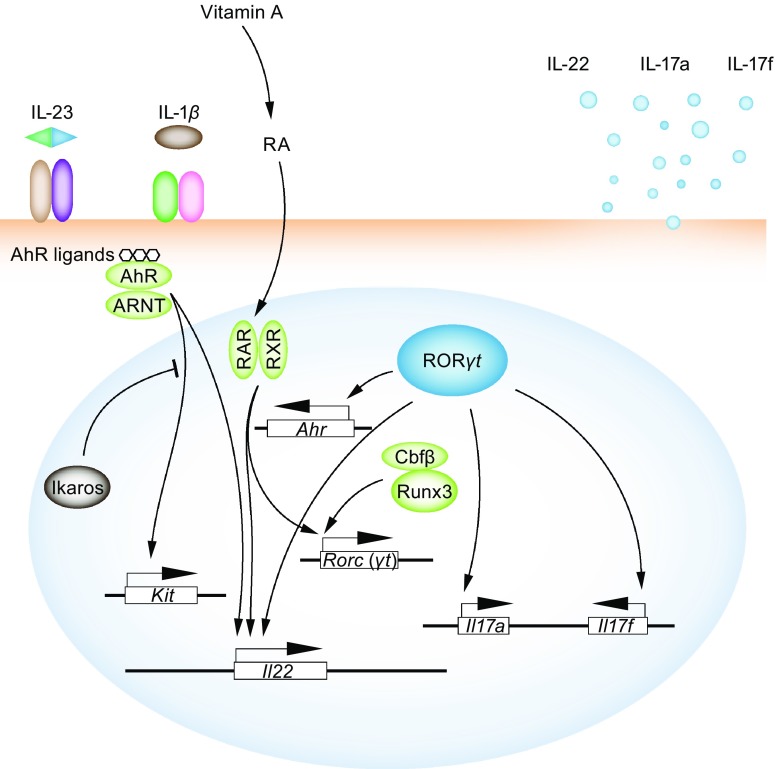
Research on innate lymphoid cells (ILC) has recently been a fast paced topic of immunological research. As ILCs are able to produce signature Th cytokine, ILCs have garnered considerable attention and have been described to represent the innate counterpart of the CD4 T helper (Th) cells. The development and function of ILCs are precisely regulated by a network of crucial transcription factors, which are also involved in the development or differentiation of conventional natural killer (cNK) cells and T cells. In this review, we will summarize the key transcriptional regulators and their functions through each phases of ILC development. With the phase of ILC lineage commitment, we will focus in particular on the roles of the transcription regulators Id2 and GATA-3, which in collaboration with other transcriptional factors, are critically involved in the generation of ILC fate determined progenitors. Once an ILC lineage has been established, several other transcription factors are required for the specification and functional regulation of distinct mature ILC subsets. Thus, a comprehensive understanding of the interactions and regulatory mechanisms mediated by these transcription factors will help us to further understand how ILCs exert their helper-like functions and bridge the innate and adaptive immunity.
近年来,对固有淋巴细胞(ILC)的研究一直是免疫学研究中一个快速发展的热门话题。由于ILC能够产生标志性的Th细胞因子,它们已引起了广泛关注,并被认为是CD4辅助性T(Th)细胞的固有对应物。ILC的发育和功能受到关键转录因子网络的精确调控,这些转录因子也参与了传统自然杀伤(cNK)细胞和T细胞的发育或分化。在这篇综述中,我们将总结关键转录调节因子及其在ILC发育各阶段的功能。在ILC谱系定向阶段,我们将特别关注转录调节因子Id2和GATA-3的作用,它们与其他转录因子协同作用,对决定ILC命运的祖细胞的产生至关重要。一旦建立了ILC谱系,还需要其他几种转录因子来对不同成熟ILC亚群进行特异性分化和功能调节。因此,全面了解这些转录因子介导的相互作用和调节机制,将有助于我们进一步理解ILC如何发挥其类似辅助细胞的功能,以及如何在固有免疫和适应性免疫之间架起桥梁。