
转化生长因子-β1/信号转导分子Smad3信号通路抑制脑缺血性中风大鼠的细胞凋亡
TGF-β1/Smad3 Signaling Pathway Suppresses Cell Apoptosis in Cerebral Ischemic Stroke Rats.
作者信息
Zhu Haiping, Gui Qunfeng, Hui Xiaobo, Wang Xiaodong, Jiang Jian, Ding Lianshu, Sun Xiaoyang, Wang Yanping, Chen Huaqun
机构信息
Department of Neurosurgery, The First People's Hospital of Changshou City, Changshou, Jiangsu, China (mainland).
Department of Neurosurgery, Yancheng Third People's Hospital, The affiliated Yancheng Hospital of Southeast University Medical College, Yancheng, Jiangsu, China (mainland).
出版信息
Med Sci Monit. 2017 Jan 22;23:366-376. doi: 10.12659/msm.899195.
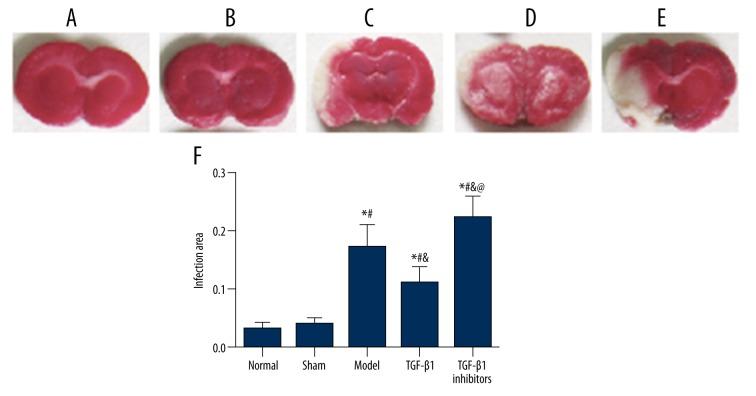
BACKGROUND We desired to observe the changes of transforming growth factor-β1/drosophila mothers against decapentaplegic protein (TGF-β1/Smad3) signaling pathway in the hippocampus region of cerebral ischemic stroke rats so that the effects of this pathway on nerve cells can be investigated. MATERIAL AND METHODS The ischemic stroke models were built by middle cerebral artery occlusion (MCAO) in vivo and oxygen-glucose deprivation (OGD) in vitro. TGF-β1 and TGF-β1 inhibitors were injected into rat models while TGF-β1, TGF-β1 siRNA, Smad3, and Smad3 siRNA were transfected into cells. Infarct sizes were measured using triphenyltetrazolium chloride (TTC) staining, while the apoptosis rate of cells were calculated by Annexin V-fluorescein isothiocyanate/propidium iodide (Annexin V-FITC/PI) staining. Levels of TGF-β1, Smad3, and Bcl-2 were examined by real-time polymerase chain reaction (RT-PCR), immunohistochemical, and Western blot analysis. RESULTS The expressions of TGF-β1/Smad3 signal pathway were significantly increased in both model rats and BV2 cells, whereas the expression of Bcl-2 was down-regulated (P<0.05). The TGF-β1/Smad3 signal pathway exhibited protective effects, including the down-regulation of infarction size in cerebral tissues and the down-regulation of apoptosis rate of BV2 cells by increasing the expression of Bcl-2 (P<0.05). In addition, these effects could be antagonized by the corresponding inhibitors and siRNA (P<0.05). CONCLUSIONS The TGF-β1/Smad3 signaling pathway was up-regulated once cerebral ischemic stroke was simulated. TGF-β1 may activate the expression of Bcl-2 via Smad3 to suppress the apoptosis of neurons.
背景 我们希望观察脑缺血性中风大鼠海马区转化生长因子-β1/果蝇抗五聚体蛋白(TGF-β1/Smad3)信号通路的变化,以便研究该通路对神经细胞的影响。
材料与方法 通过体内大脑中动脉闭塞(MCAO)和体外氧糖剥夺(OGD)建立缺血性中风模型。将TGF-β1和TGF-β1抑制剂注入大鼠模型,同时将TGF-β1、TGF-β1小干扰RNA(siRNA)、Smad3和Smad3 siRNA转染到细胞中。使用氯化三苯基四氮唑(TTC)染色测量梗死面积,通过膜联蛋白V-异硫氰酸荧光素/碘化丙啶(Annexin V-FITC/PI)染色计算细胞凋亡率。通过实时聚合酶链反应(RT-PCR)、免疫组织化学和蛋白质印迹分析检测TGF-β1、Smad3和Bcl-2的水平。
结果 在模型大鼠和BV2细胞中,TGF-β1/Smad3信号通路的表达均显著增加,而Bcl-2的表达下调(P<0.05)。TGF-β1/Smad3信号通路具有保护作用,包括通过增加Bcl-2的表达下调脑组织梗死面积和BV2细胞凋亡率(P<0.05)。此外,这些作用可被相应的抑制剂和siRNA拮抗(P<0.05)。
结论 模拟脑缺血性中风后,TGF-β1/Smad3信号通路被上调。TGF-β1可能通过Smad3激活Bcl-2的表达以抑制神经元凋亡。



 Zotero 插件