Richardson Liana J, Brown Tyson H
Department of Sociology, University of North Carolina at Chapel Hill, 155 Hamilton Hall, CB #3210, Chapel Hill, NC 27599-3210, Tel: 919-966-1559; ; Carolina Population Center, 206 W. Franklin Street, CB #8120, Chapel Hill, NC 27516-2524, Tel: 919-962-6167; Fax: 919-445-0740.
Department of Sociology, Vanderbilt University, 315 Garland Hall, PMB 351811, Nashville, TN 37235-1811, Tel: 352-682-5864.
SSM Popul Health. 2016 Dec;2:425-435. doi: 10.1016/j.ssmph.2016.04.011. Epub 2016 May 10.
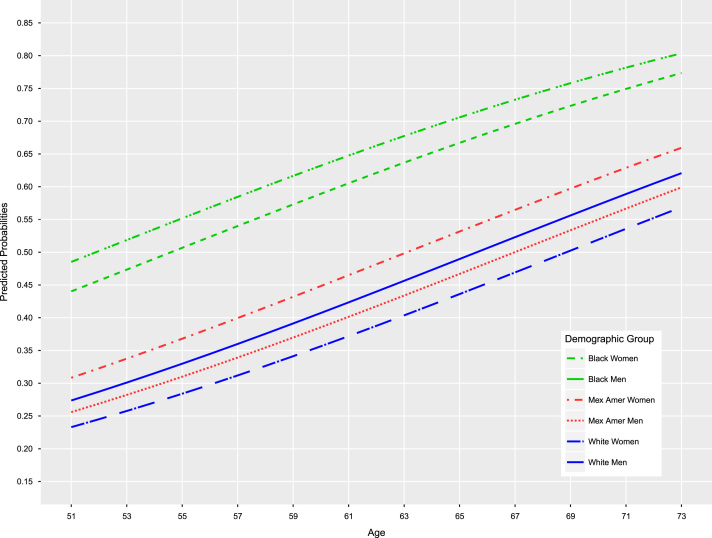
Historically, intersectionality has been an underutilized framework in sociological research on racial/ethnic and gender inequalities in health. To demonstrate its utility and importance, we conduct an intersectional analysis of the social stratification of health using the exemplar of hypertension-a health condition in which racial/ethnic and gender differences have been well-documented. Previous research has tended to examine these differences separately and ignore how the interaction of social status dimensions may influence health over time. Using seven waves of data from the Health and Retirement Study and multilevel logistic regression models, we found a multiplicative effect of race/ethnicity and gender on hypertension risk trajectories, consistent with both an intersectionality perspective and persistent inequality hypothesis. Group differences in past and contemporaneous socioeconomic and behavioral factors did not explain this effect.
从历史上看,交叉性在关于健康方面种族/族裔和性别不平等的社会学研究中一直是一个未得到充分利用的框架。为了证明其效用和重要性,我们以高血压为例对健康的社会分层进行交叉性分析——高血压是一种种族/族裔和性别差异已有充分记录的健康状况。以往的研究往往分别考察这些差异,而忽略了社会地位维度之间的相互作用如何可能随着时间的推移影响健康。利用来自健康与退休研究的七轮数据以及多层次逻辑回归模型,我们发现种族/族裔和性别对高血压风险轨迹具有相乘效应,这与交叉性视角和持续不平等假说均相符。过去和同时期社会经济及行为因素的群体差异并不能解释这一效应。