Institute of Plant Protection, Fujian Academy of Agricultural Sciences, Fuzhou 350013, China.
Fujian Key Laboratory for Monitoring and Integrated Management of Crop Pests, Fuzhou 350001, China.
Sci Rep. 2017 Jan 23;7:40803. doi: 10.1038/srep40803.
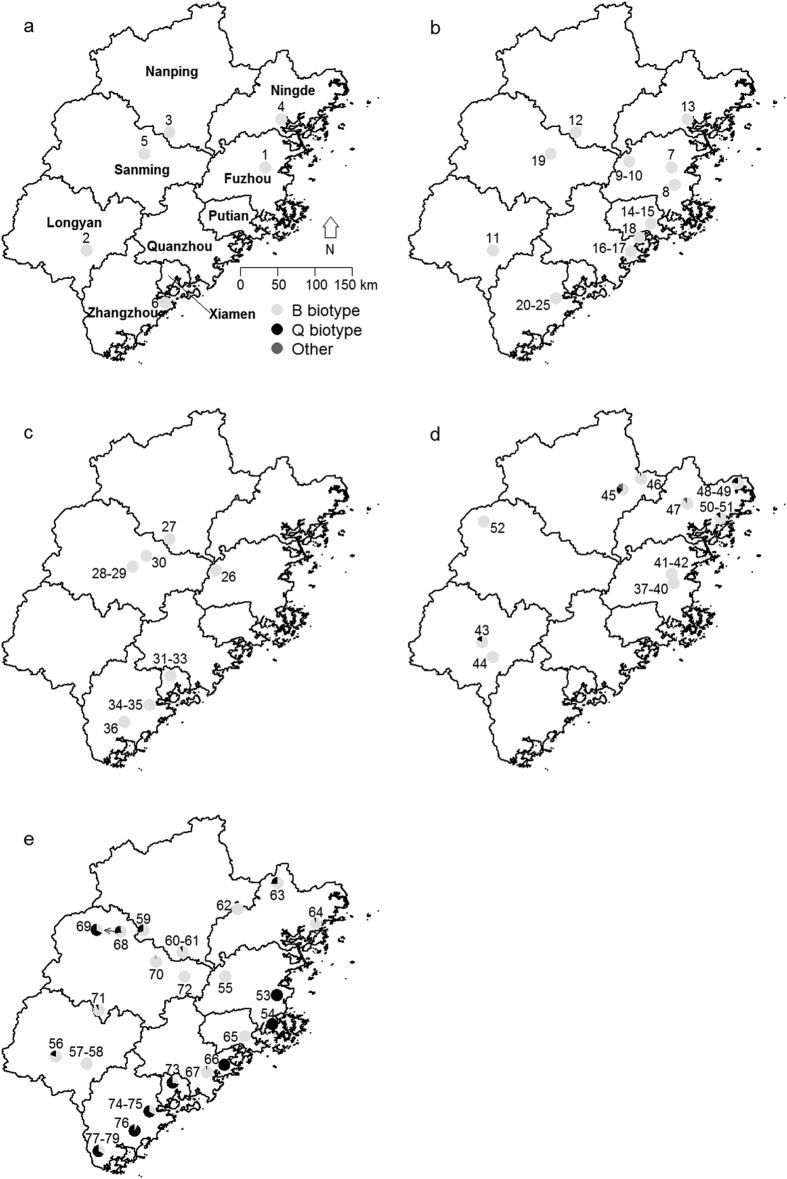
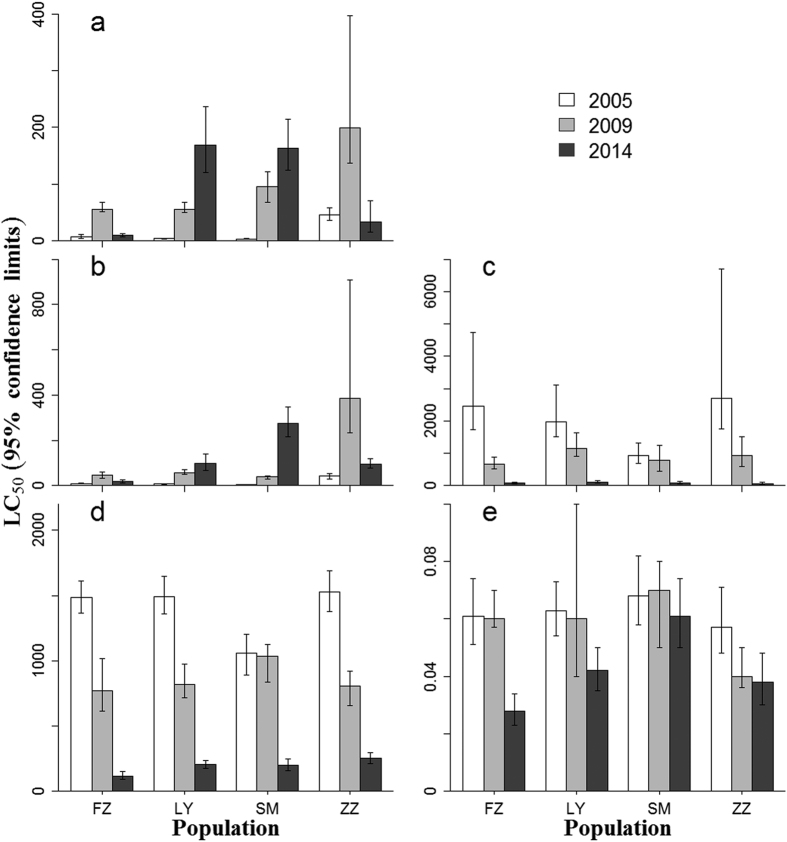
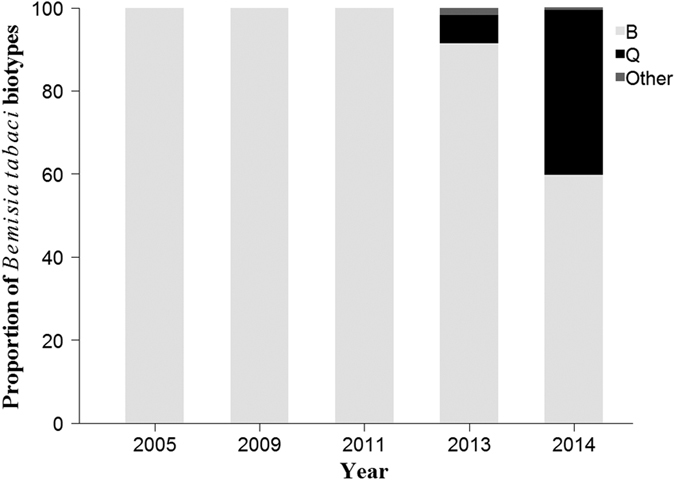
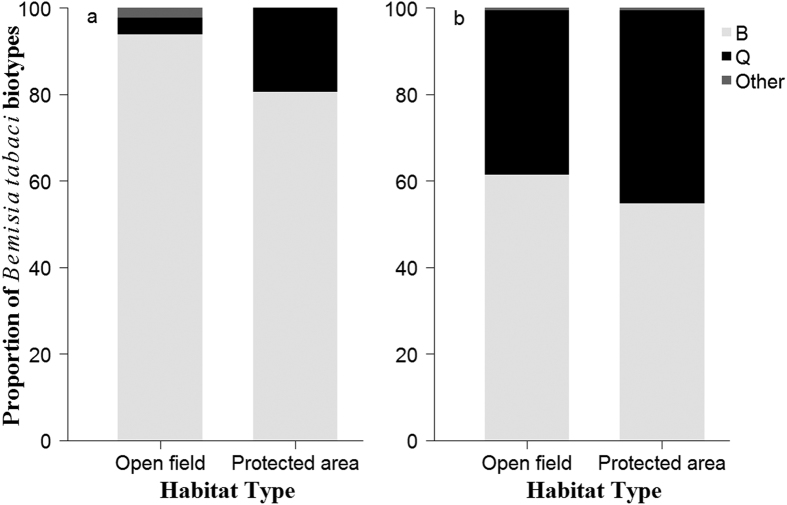
The whitefly Bemisia tabaci (Gennadius) is an important agricultural insect pest worldwide. The B and Q biotypes are the two most predominant and devastating biotypes prevalent across China. However, there are few studies regarding the occurrence of the Q biotype in Fujian Province, China, where high insecticide resistance has been reported in the B biotype. Differences in some biological characteristics between the B and Q biotypes, especially insecticide resistance, are considered to affect the outcome of their competition. Extensive surveys in Fujian revealed that the B biotype was predominant during 2005-2014, whereas the Q biotype was first detected in some locations in 2013 and widely detected throughout the province in 2014. Resistance to neonicotinoids (that have been used for more than 10 years) exhibited fluctuations in open fields, but showed a continual increasing trend in protected areas. Resistance to lambda-cyhalothrin, chlorpyrifos, and abamectin exhibited a declining trend. Resistance to novel insecticides, such as nitenpyram, pymetrozine, sulfoxaflor, and cyantraniliprole, in 2014 was generally below a moderate level. A decline in insecticide resistance in the B biotype and the rapid buildup of protected crops under global temperature increase may have promoted the establishment of the Q biotype in Fujian.
烟粉虱(Bemisia tabaci)是一种世界性的重要农业害虫。B 和 Q 生物型是在中国流行的两种最主要和最具破坏性的生物型。然而,在中国福建省,关于 Q 生物型的发生情况的研究较少,而在该省,B 生物型已经报道了很高的抗药性。B 和 Q 生物型之间的一些生物学特性的差异,特别是抗药性,被认为会影响它们竞争的结果。在福建省进行的广泛调查显示,B 生物型在 2005-2014 年期间占主导地位,而 Q 生物型在 2013 年首次在一些地区被检测到,并在 2014 年在全省范围内广泛检测到。新烟碱类杀虫剂(已使用 10 多年)的田间抗性呈波动趋势,但在保护区内呈持续上升趋势。对氯氰菊酯、毒死蜱和阿维菌素的抗性呈下降趋势。2014 年,新型杀虫剂如吡虫啉、吡丙醚、噻虫啉和氰氟虫腙的抗性一般处于中等水平以下。B 生物型的抗药性下降和全球气温升高下保护作物的快速增加,可能促进了 Q 生物型在福建的建立。