Rahman Shah Md Mostafizur, Zhang Zhongkai, Hu Jian, Gaber Ahmed, Hossain Akbar
Ministry of Agriculture Key Lab of Southwestern Crop Gene Resources and Germplasm Innovation, Yunnan Provincial Key Lab of Agricultural Biotechnology, Biotechnology and Germplasm Resources Institute, Yunnan Academy of Agricultural Sciences, 650223, Kunming, China.
Division of Entomology, Bangladesh Wheat and Maize Research Institute, Dinajpur, 5200, Bangladesh.
Heliyon. 2023 Sep 12;9(9):e20077. doi: 10.1016/j.heliyon.2023.e20077. eCollection 2023 Sep.
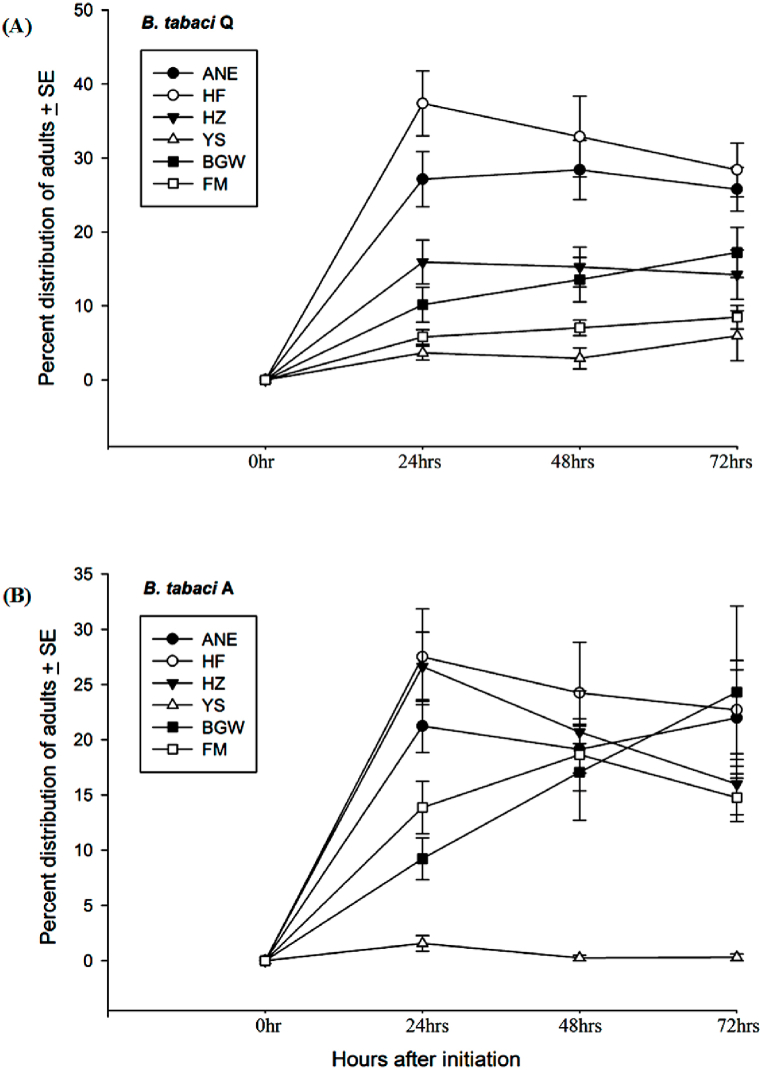
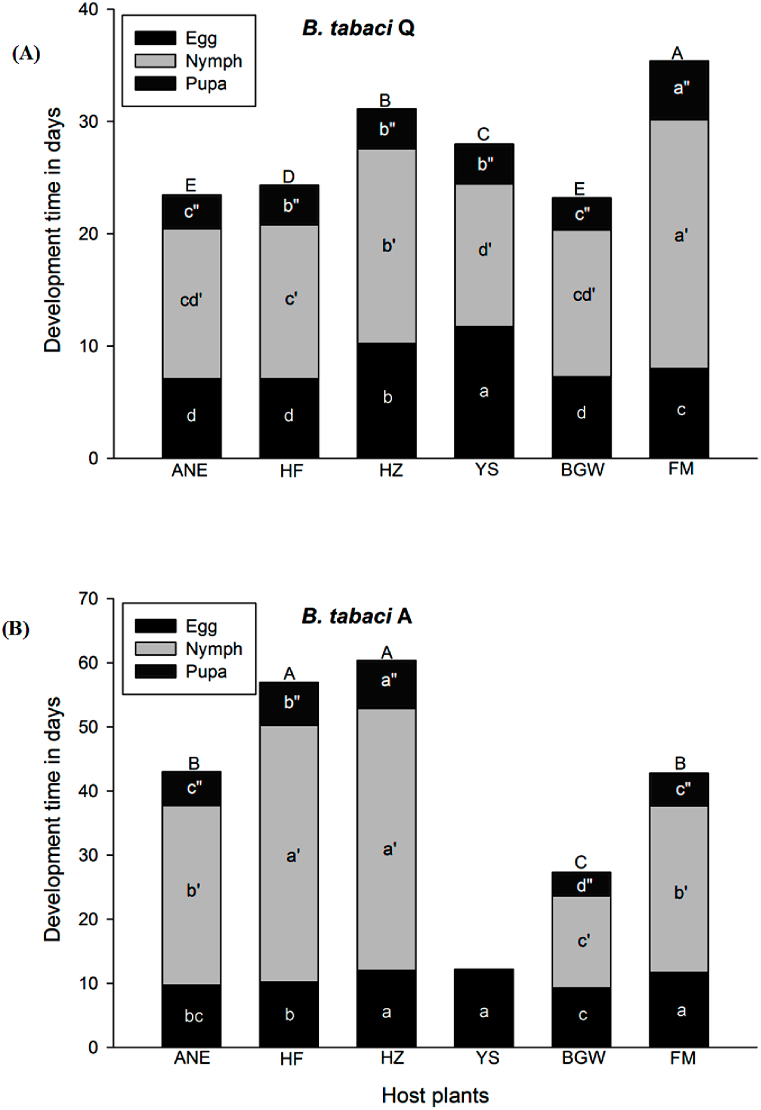
The whiteflies of complex, composed of >44 cryptic species, are economically important pests of tomatoes for their direct feeding and virus transmission. The present study aimed to evaluate the impact of leaf trichomes on the host selection and development of whitefly; comparative invasiveness between Q and A cryptic species; and the ability of weeds as hosts of the population of insect whitefly. We carried out our investigation through adult host selection and oviposition in multi-choice conditions, immature development and survival, and adult survival and oviposition in no-choice conditions. We investigated leaf trichomes type and densities on the leaves of four tomato varieties and two weed species. Results showed that the leaf trichomes of tomatoes and weeds impact the host selection and immature development differently on the cryptic species Q and A. In the multi-choice case, Q adults preferred tomato varieties Ao-Ni-Er and He-Fen for both settling and oviposition whereas A preferred Ao-Ni-Er, He-Fen, and Billy-Goat-Weed for settling but oviposited more eggs on both weed species Billy-Goat-Weed and False-Mallow. Both Q and A adults refused Ye-Sheng either settling or oviposition. In the case of immature development, Q developed faster than A. Concerning plant, Q developed faster on Ao-Ni-Er, He-Fen and Billy-Goat-Weed but A on Billy-Goat-Weed, False-Mallow and Ao-Ni-Er. The immature survival of Q was higher than that of A. Immature of Q survived well (68.6-86.8%) on all plants except Ye-Sheng (49.3%) but A survived very less (0-17.6%) on any tomatoes where 70.4% on Billy-Goat-Weed and 60.5% on False-Mallow. After seven days of adult infestation, both Q and A died on Ye-Sheng where 52.5-78.1% survivorships were observed on other plants. In seven days, Q laid more eggs compared to A. Considering the plants, both species laid more eggs on Ao-Ni-Er, He-Fen and False-Mallow, whereas the lowest number was laid on Ye-Sheng. The highest number of glandular trichome Type IV was observed on Ye-Sheng which showed resistance against both Q and A cryptic species. The cryptic species Q showed a wider range adaptation ability on plants than that of A. Weeds can play a significant role as an infestation source of whiteflies to tomatoes and other crops. These findings suggest that glandular trichomes may be used in plant breeding programmes for the development of whitefly-resistant crop cultivars.
粉虱复合体由44种以上的隐种组成,因其直接取食和传播病毒,是番茄的重要经济害虫。本研究旨在评估叶片毛状体对粉虱寄主选择和发育的影响;Q和A隐种之间的相对入侵性;以及杂草作为粉虱种群寄主的能力。我们通过成体在多选择条件下的寄主选择和产卵、未成熟个体的发育和存活以及成体在无选择条件下的存活和产卵来进行调查。我们研究了四个番茄品种和两种杂草叶片上的毛状体类型和密度。结果表明,番茄和杂草的叶片毛状体对Q和A隐种的寄主选择和未成熟个体发育有不同影响。在多选择情况下,Q成虫在定居和产卵时都更喜欢奥尼儿和合粉这两个番茄品种,而A成虫在定居时更喜欢奥尼儿、合粉和假马唐,但在假马唐和野西瓜苗这两种杂草上产卵更多。Q和A成虫都拒绝在叶盛上定居或产卵。在未成熟个体发育方面,Q比A发育得快。就植株而言,Q在奥尼儿、合粉和假马唐上发育得更快,而A在假马唐、野西瓜苗和奥尼儿上发育得更快。Q未成熟个体的存活率高于A。Q的未成熟个体在除叶盛(49.3%)外的所有植株上存活率都很高(68.6 - 86.8%),但A在任何番茄上的存活率都很低(0 - 17.6%),而在假马唐上为70.4%,在野西瓜苗上为60.5%。成虫侵染七天后,Q和A在叶盛上都死亡,而在其他植株上观察到的存活率为52.5 - 78.1%。七天内,Q比A产卵更多。就植株而言,两个物种在奥尼儿、合粉和野西瓜苗上产卵更多,而在叶盛上产卵最少。在叶盛上观察到的IV型腺毛数量最多,它对Q和A隐种都有抗性。隐种Q在植物上表现出比A更广泛的适应能力。杂草可作为粉虱侵染番茄和其他作物的重要来源。这些发现表明,腺毛可用于植物育种计划,以培育抗粉虱的作物品种。