Henderson Clark M, Bollinger James G, Becker Jessica O, Wallace Jennifer M, Laha Thomas J, MacCoss Michael J, Hoofnagle Andrew N
Department of Laboratory Medicine, University of Washington, Seattle, WA, USA.
Departments of Genome Sciences, University of Washington, Seattle, WA, USA.
Proteomics Clin Appl. 2017 Jul;11(7-8). doi: 10.1002/prca.201600103. Epub 2017 Mar 6.
Proteomic analysis of blood proteins in dried blood spots (DBS) is gaining attention as a possible replacement for measurements in plasma/serum collected by venipuncture. We aimed to develop and provisionally validate a nanoflow LC-PRM-MS method for clinical use.
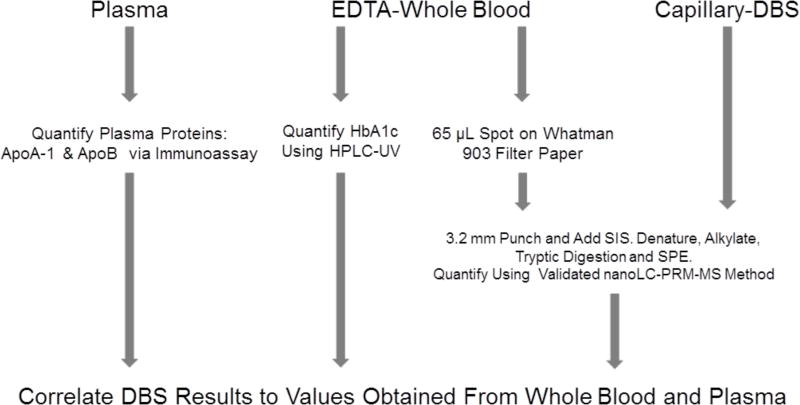
We used Skyline to develop a nanoflow LC-PRM-MS method to quantify glycated hemoglobin-β, apolipoprotein A-I, and apolipoprotein B in DBS. Precision, linearity, interferences, and stability were determined and the method was used to analyze samples from 36 human volunteers. The method was compared with clinically validated measurements in paired blood collected via venipuncture.
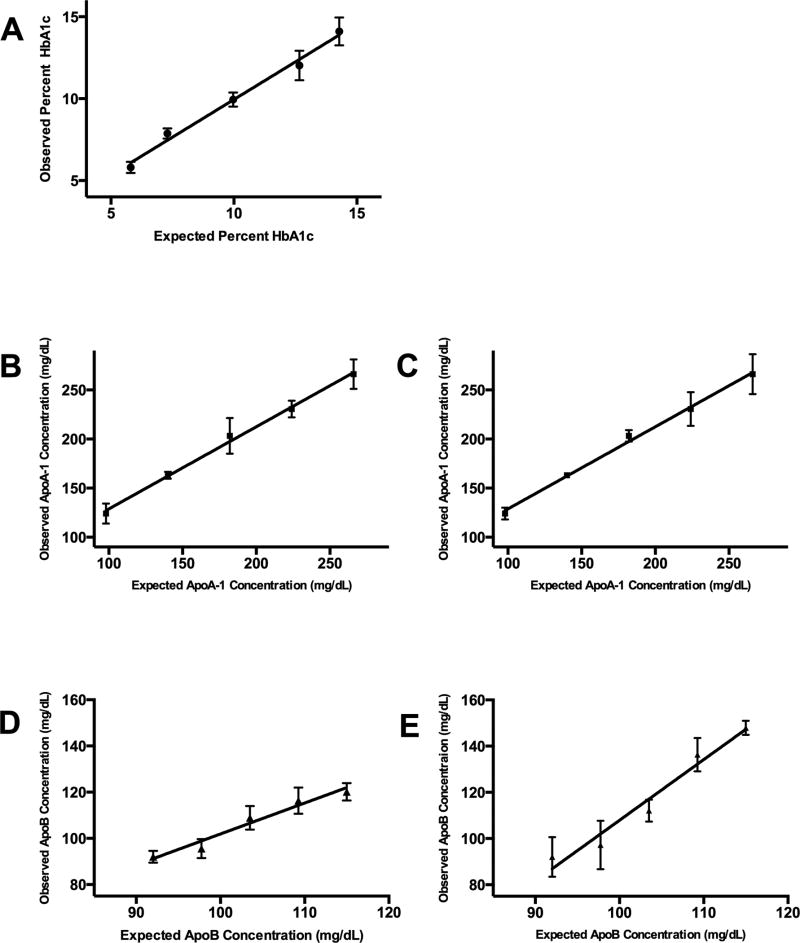
The method was relatively precise for these proteins (10-11% CV) and linear across the normal concentration ranges of these proteins. Interference from high total serum protein concentration (>8 g/dL) was noted for apolipoprotein A-I and apolipoprotein B. Proteins in DBS were stable for 14 days at temperatures below 25°C and trypsinized samples were stable for 48 h at 7°C. There was moderate correlation with clinical methods (r = 0.783-0.858) and significant bias in individual samples.
Although the method had adequate precision and linearity for a biomarker, the accuracy compared with clinically validated assays raises concerns regarding the use of DBS compared with venipuncture for clinical use.
干血斑(DBS)中血液蛋白质的蛋白质组学分析作为静脉穿刺采集血浆/血清检测的一种可能替代方法正受到关注。我们旨在开发并初步验证一种用于临床的纳流液相色谱-平行反应监测-质谱法。
我们使用Skyline开发了一种纳流液相色谱-平行反应监测-质谱法,用于定量DBS中的糖化血红蛋白-β、载脂蛋白A-I和载脂蛋白B。测定了精密度、线性、干扰和稳定性,并使用该方法分析了36名人类志愿者的样本。将该方法与通过静脉穿刺采集的配对血液中经过临床验证的检测结果进行比较。
该方法对这些蛋白质具有相对较高的精密度(变异系数为10 - 11%),并且在这些蛋白质的正常浓度范围内呈线性。注意到高总血清蛋白浓度(>8 g/dL)对载脂蛋白A-I和载脂蛋白B存在干扰。DBS中的蛋白质在低于25°C的温度下可稳定保存14天,经胰蛋白酶消化的样本在7°C下可稳定保存48小时。与临床方法存在中度相关性(r = 0.783 - 0.858),且个别样本存在显著偏差。
尽管该方法对于生物标志物具有足够的精密度和线性,但与经过临床验证的检测方法相比,其准确性引发了对于在临床应用中使用DBS与静脉穿刺相比的担忧。