Zhou Chengxin, Robert Marie-Claude, Kapoulea Vassiliki, Lei Fengyang, Stagner Anna M, Jakobiec Frederick A, Dohlman Claes H, Paschalis Eleftherios I
Boston Keratoprosthesis Laboratory, Department of Ophthalmology, Massachusetts Eye and Ear and Schepens Eye Research Institute, Boston, Massachusetts, United States 2Harvard Medical School, Boston, Massachusetts, United States.
Department of Ophthalmology, Université de Montreal, Montreal, Quebec, Canada 4Centre Hospitalier de l'Université de Montreal, Hospital Notre-Dame, Montreal, Quebec, Canada.
Invest Ophthalmol Vis Sci. 2017 Jan 1;58(1):96-105. doi: 10.1167/iovs.16-20339.
Tumor necrosis factor (TNF)-α is upregulated in eyes following corneal alkali injury and contributes to corneal and also retinal damage. Prompt TNF-α inhibition by systemic infliximab ameliorates retinal damage and improves corneal wound healing. However, systemic administration of TNF-α inhibitors carries risk of significant complications, whereas topical eye-drop delivery is hindered by poor ocular bioavailability and the need for patient adherence. This study investigates the efficacy of subconjunctival delivery of TNF-α antibodies using a polymer-based drug delivery system (DDS).
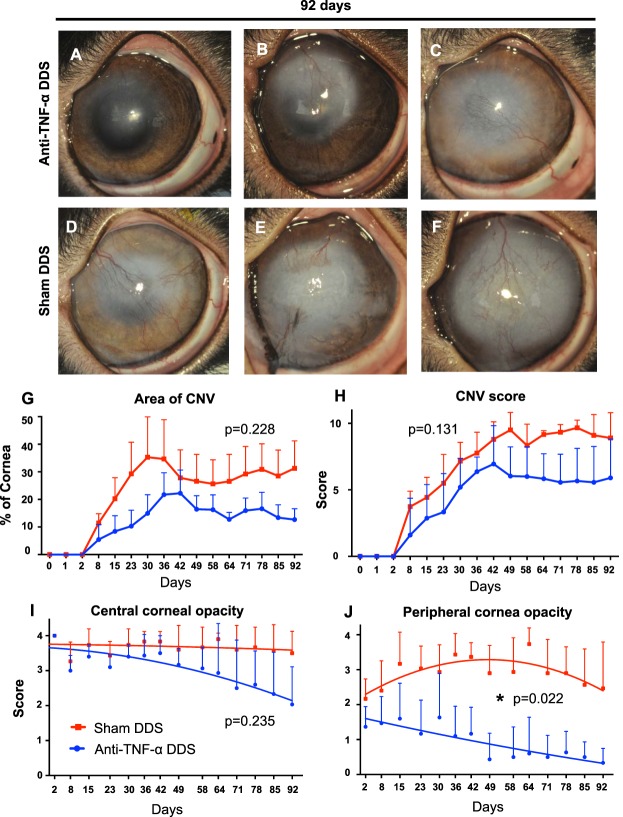
The drug delivery system was prepared using porous polydimethylsiloxane/polyvinyl alcohol composite fabrication and loaded with 85 μg of infliximab. Six Dutch-belted pigmented rabbits received ocular alkali burn with NaOH. Immediately after the burn, subconjunctival implantation of anti-TNF-α DDS was performed in three rabbits while another three received sham DDS (without antibody). Rabbits were followed with photography for 3 months.
After 3 months, the device was found to be well tolerated by the host and the eyes exhibited less corneal damage as compared to eyes implanted with a sham DDS without drug. The low dose treatment suppressed CD45 and TNF-α expression in the burned cornea and inhibited retinal ganglion cell apoptosis and optic nerve degeneration, as compared to the sham DDS treated eyes. Immunolocalization revealed drug penetration in the conjunctiva, cornea, iris, and choroid, with residual infliximab in the DDS 3 months after implantation.
This reduced-risk biologic DDS improves corneal wound healing and provides retinal neuroprotection, and may be applicable not only to alkali burns but also to other inflammatory surgical procedures such as penetrating keratoplasty and keratoprosthesis implantation.
角膜碱烧伤后,肿瘤坏死因子(TNF)-α在眼内上调,会导致角膜及视网膜损伤。通过全身给予英夫利昔单抗迅速抑制TNF-α可改善视网膜损伤并促进角膜伤口愈合。然而,全身应用TNF-α抑制剂存在严重并发症风险,而局部滴眼给药则因眼部生物利用度差和患者依从性问题受到阻碍。本研究使用基于聚合物的药物递送系统(DDS)研究结膜下递送TNF-α抗体的疗效。
采用多孔聚二甲基硅氧烷/聚乙烯醇复合材料制备药物递送系统,并装载85μg英夫利昔单抗。六只荷兰带色素兔接受NaOH眼部碱烧伤。烧伤后立即对三只兔进行抗TNF-α DDS结膜下植入,另外三只接受假DDS(不含抗体)。对兔子进行3个月的摄影随访。
3个月后,发现宿主对该装置耐受性良好,与植入不含药物的假DDS的眼睛相比,这些眼睛的角膜损伤较小。与假DDS治疗的眼睛相比,低剂量治疗可抑制烧伤角膜中CD45和TNF-α的表达,并抑制视网膜神经节细胞凋亡和视神经变性。免疫定位显示药物可渗透到结膜、角膜、虹膜和脉络膜,植入3个月后DDS中仍有残留的英夫利昔单抗。
这种低风险的生物DDS可促进角膜伤口愈合并提供视网膜神经保护,不仅适用于碱烧伤,也适用于其他炎症性手术,如穿透性角膜移植术和角膜假体植入术。