Edgar Kevin S, Galvin Orla M, Collins Anthony, Katusic Zvonimir S, McDonald Denise M
Centre for Experimental Medicine, Queen's University Belfast, United Kingdom.
Department of Anesthesiology and Pharmacology, Mayo Clinic, Minnesota, United States.
Invest Ophthalmol Vis Sci. 2017 Jan 1;58(1):230-241. doi: 10.1167/iovs.16-20523.
Endothelial nitric oxide synthase (eNOS)-derived nitric oxide (NO) has important vasoprotective functions that are compromised in the vasodegenerative phase of retinopathy of prematurity, owing to hyperoxia-induced depletion of the essential NOS cofactor BH4. Because modulating eNOS function can be beneficial or detrimental, our aim was to investigate the effect of BH4 supplementation on eNOS function and vascular regression in hyperoxia.
Endothelial-specific eNOS-green fluorescent protein (GFP) overexpressing mice at postnatal day 7 (P7) were exposed to hyperoxia for 48 hours in the presence or absence of supplemental BH4, achieved by administration of sepiapterin, a stable BH4 precursor. Tissue was collected either for retinal flat mounts that were stained with lectin to determine the extent of vessel coverage or for analysis of BH4 by high-performance liquid chromatography, nitrotyrosine (NT) marker by Western blotting, VEGF expression by ELISA, and NOS activity by arginine-to-citrulline conversion. Primary retinal microvascular endothelial cells (RMEC) were similarly treated, and hyperoxia-induced damage was determined.
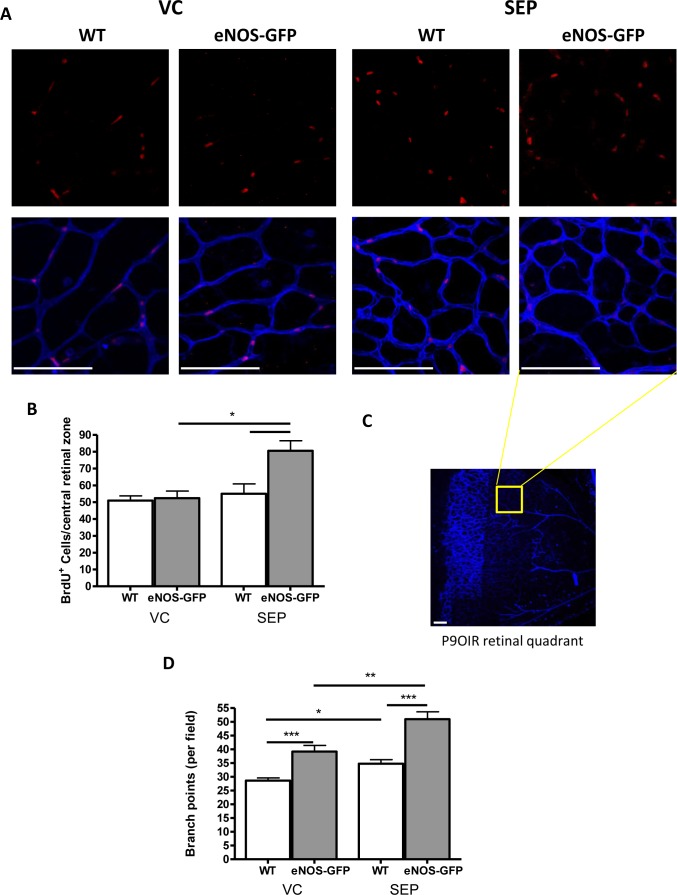
Sepiapterin effectively enhanced BH4 levels in hyperoxia-exposed retinas and brains, elevated NOS activity, and reduced NT-modified protein, leading to reversal of the exacerbated vasoregression observed in the presence of eNOS overexpression. In RMECs, hyperoxia-mediated depletion of BH4 dysregulated the redox balance by reducing nitrite and elevating superoxide and impaired proliferative ability. BH4 supplementation restored normal RMEC proliferation in vitro and also in vivo, providing a mechanistic link with the enhanced vascular coverage in eNOS-GFP retinas.
These results demonstrate that BH4 supplementation corrects hyperoxia-induced RMEC dysfunction and preserves vascular integrity by enhancing eNOS function.
内皮型一氧化氮合酶(eNOS)衍生的一氧化氮(NO)具有重要的血管保护功能,在早产儿视网膜病变的血管退行性变阶段,由于高氧诱导必需的一氧化氮合酶辅因子四氢生物蝶呤(BH4)耗竭,这些功能受到损害。由于调节eNOS功能可能有益也可能有害,我们的目的是研究补充BH4对高氧环境下eNOS功能和血管消退的影响。
出生后第7天(P7)的内皮特异性eNOS-绿色荧光蛋白(GFP)过表达小鼠,在有或没有补充BH4(通过给予稳定的BH4前体蝶呤实现)的情况下暴露于高氧环境48小时。收集组织用于视网膜平铺片,用凝集素染色以确定血管覆盖范围,或用于通过高效液相色谱分析BH4、通过蛋白质印迹分析硝基酪氨酸(NT)标记物、通过酶联免疫吸附测定分析血管内皮生长因子(VEGF)表达以及通过精氨酸向瓜氨酸转化分析一氧化氮合酶活性。对原代视网膜微血管内皮细胞(RMEC)进行类似处理,并测定高氧诱导的损伤。
蝶呤有效地提高了暴露于高氧环境的视网膜和大脑中的BH4水平,提高了一氧化氮合酶活性,并减少了NT修饰的蛋白质,导致在eNOS过表达情况下观察到的血管过度消退得到逆转。在RMEC中,高氧介导的BH4耗竭通过减少亚硝酸盐和增加超氧化物来失调氧化还原平衡,并损害增殖能力。补充BH4在体外和体内均恢复了RMEC的正常增殖,为eNOS-GFP视网膜中血管覆盖增加提供了机制联系。
这些结果表明,补充BH4可纠正高氧诱导的RMEC功能障碍,并通过增强eNOS功能来维持血管完整性。