Cardiovascular Research Unit, IRCCS MultiMedica, 20138 Milan, Italy.
IRCCS Neuromed, Pozzilli, 86077 Isernia, Italy.
Int J Mol Sci. 2018 Oct 19;19(10):3229. doi: 10.3390/ijms19103229.
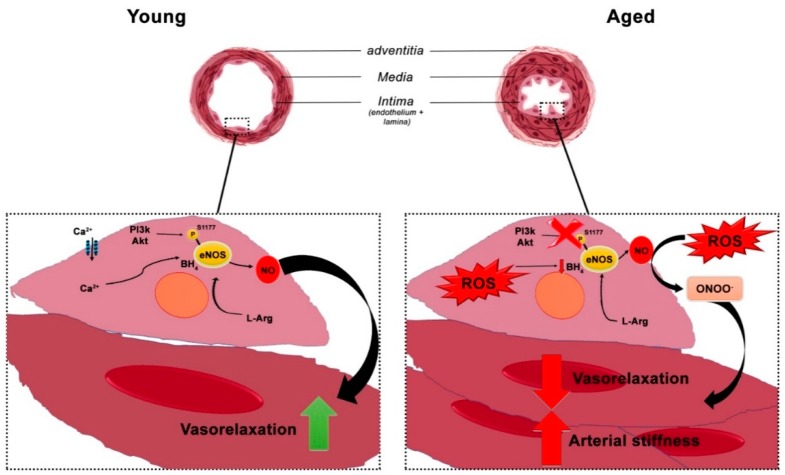
Evolutionary forces select genetic variants that allow adaptation to environmental stresses. The genomes of centenarian populations could recapitulate the evolutionary adaptation model and reveal the secrets of disease resistance shown by these individuals. Indeed, longevity phenotype is supposed to have a genetic background able to survive or escape to age-related diseases. Among these, cardiovascular diseases (CVDs) are the most lethal and their major risk factor is aging and the associated frailty status. One example of genetic evolution revealed by the study of centenarians genome is the four missense Single Nucleotide Polymorphisms (SNPs) haplotype in bactericidal/permeability-increasing fold-containing family B, member 4 (BPIFB4) locus that is enriched in long living individuals: the longevity associated variant (LAV). Indeed, LAV-BPIFB4 is able to improve endothelial function and revascularization through the increase of endothelial nitric oxide synthase (eNOS) dependent nitric oxide production. This review recapitulates the beneficial effects of LAV-BPIFB4 and its therapeutic potential for the treatment of CVDs.
进化力量选择允许适应环境压力的遗传变异。百岁人群的基因组可以再现进化适应模型,并揭示这些个体表现出的疾病抵抗力的秘密。事实上,长寿表型应该有一个能够生存或逃避与年龄相关的疾病的遗传背景。在这些疾病中,心血管疾病(CVDs)是最致命的,其主要风险因素是衰老和相关的脆弱状态。通过对百岁老人基因组的研究揭示的遗传进化的一个例子是杀菌/通透性增加折叠家族 B 成员 4(BPIFB4)基因座中的四个错义单核苷酸多态性(SNP)单倍型,该基因座在长寿个体中富集:与长寿相关的变异(LAV)。事实上,LAV-BPIFB4 通过增加内皮型一氧化氮合酶(eNOS)依赖性一氧化氮的产生,能够改善内皮功能和血管生成。这篇综述总结了 LAV-BPIFB4 的有益作用及其在治疗 CVDs 方面的治疗潜力。