Chan Aileen Wk, Yu Doris Sf, Choi K C
The Nethersole School of Nursing, Faculty of Medicine, The Chinese University of Hong Kong, Shatin, NT, Hong Kong SAR.
Clin Interv Aging. 2017 Jan 5;12:85-96. doi: 10.2147/CIA.S124604. eCollection 2017.
To test the feasibility and preliminary effectiveness of a tai chi qigong program with the assistance of elderly neighborhood volunteers in strengthening social networks and enhancing the psychosocial well-being of hidden elderly.
"Hidden elderly" is a term used to describe older adults who are socially isolated and refuse social participation. This pilot randomized controlled trial recruited 48 older adults aged 60 or above who did not engage in any social activity. They were randomized into tai chi qigong (n=24) and standard care control (n=24) groups. The former group underwent a three-month program of two 60-minute sessions each week, with the socially active volunteers paired up with them during practice. Standard care included regular home visits by social workers. Primary outcomes were assessed by means of the Lubben social network and De Jong Gieveld loneliness scales, and by a revised social support questionnaire. Secondary outcomes were covered by a mental health inventory and the Rosenberg self-esteem scale, and quality of life by using the 12-Item Short Form Health Survey. Data was collected at baseline, and at three and six months thereafter.
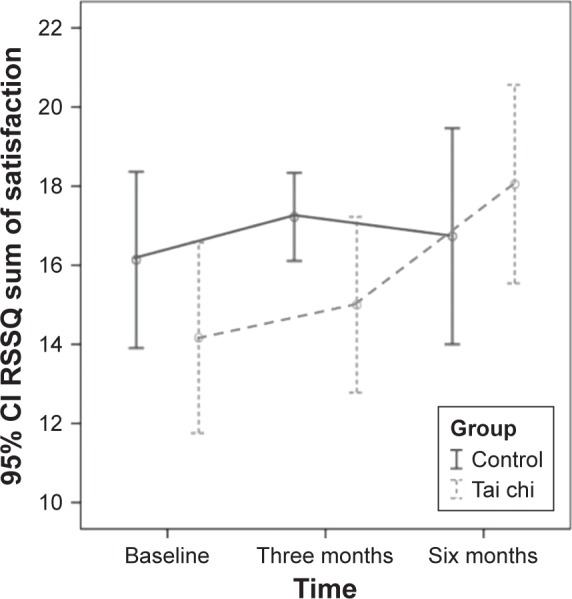
The generalized estimating equations model revealed general improvement in outcomes among participants on the tai chi qigong program. In particular, participants reported a significantly greater improvement on the loneliness scale (=-1.32, 95% confidence interval [CI] -2.54 to -0.11, =0.033) and the satisfaction component of the social support questionnaire (=3.43, 95% CI 0.10-6.76, =0.044) than the control group.
The pilot study confirmed that tai chi qigong with elderly neighborhood volunteers is a safe and feasible social intervention for hidden elderly. Its potential benefits in improving social and psychological health suggest the need for a full-scale randomized controlled trial to reveal its empirical effects.
在老年邻里志愿者的协助下,测试太极气功项目在加强社交网络和提升隐匿老年人心理社会幸福感方面的可行性和初步效果。
“隐匿老年人”是一个用于描述社会孤立且拒绝社会参与的老年人的术语。这项试点随机对照试验招募了48名60岁及以上且未参与任何社会活动的老年人。他们被随机分为太极气功组(n = 24)和标准护理对照组(n = 24)。前一组接受为期三个月的项目,每周进行两次60分钟的课程,练习期间由积极参与社交活动的志愿者与他们结对。标准护理包括社会工作者定期家访。主要结局通过鲁本社交网络和德容·吉维尔德孤独量表以及一份修订后的社会支持问卷进行评估。次要结局涵盖心理健康量表和罗森伯格自尊量表,生活质量则通过12项简短健康调查问卷进行评估。数据在基线时以及此后的三个月和六个月时收集。
广义估计方程模型显示,参与太极气功项目的参与者的结局总体有所改善。特别是,与对照组相比,参与者在孤独量表(β = -1.32,95%置信区间[CI] -2.54至-0.11,P = 0.033)和社会支持问卷的满意度部分(β = 3.43,95% CI 0.10 - 6.76,P = 0.044)上的改善显著更大。
该试点研究证实,有老年邻里志愿者参与的太极气功对隐匿老年人是一种安全可行的社会干预措施。其在改善社会和心理健康方面的潜在益处表明需要进行一项全面的随机对照试验来揭示其实际效果。