Qin Yue, Li Suning, Zhao Gan, Fu Xuanhao, Xie Xueping, Huang Yiyi, Cheng Xiaojing, Wei Jinbin, Liu Huagang, Lai Zefeng
Pharmaceutical College, Guangxi Medical University.
Department of Pharmacy, The Maternal and Child Health Hospital of Guangxi Zhuang Autonomous Region.
Int J Nanomedicine. 2016 Dec 30;12:263-277. doi: 10.2147/IJN.S123839. eCollection 2017.
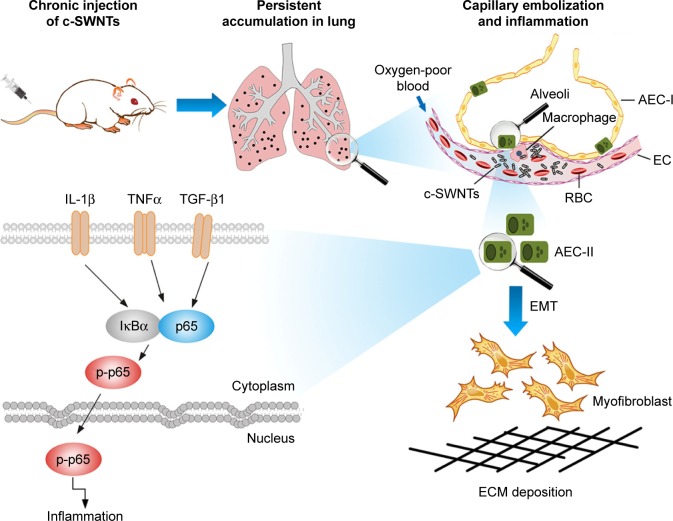
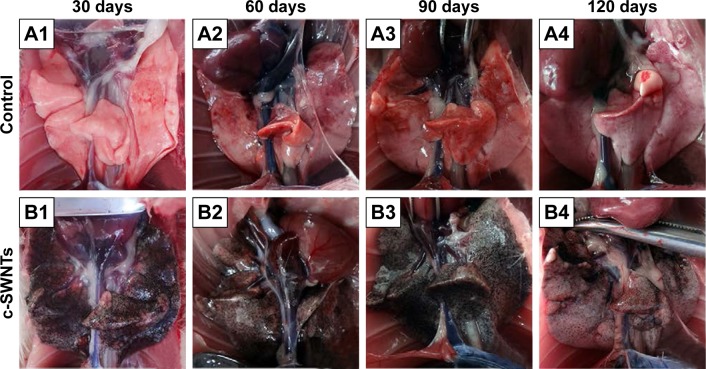
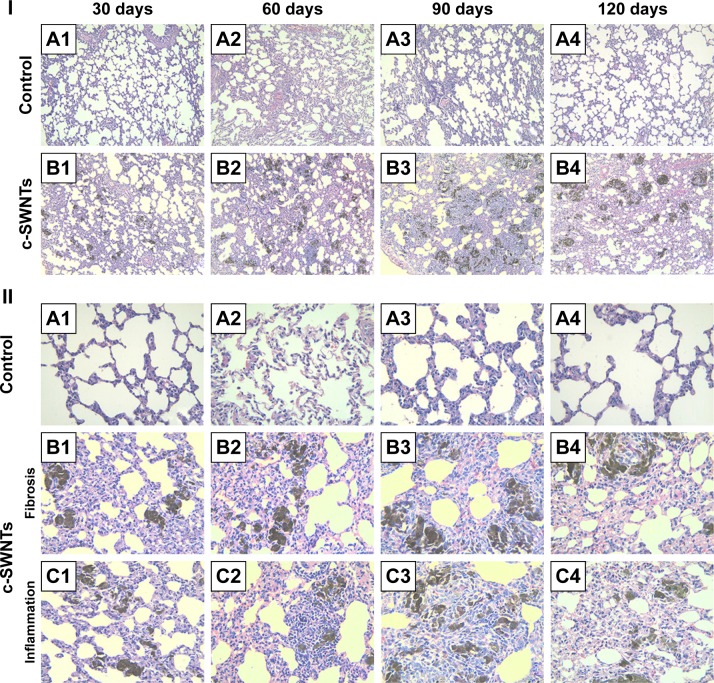
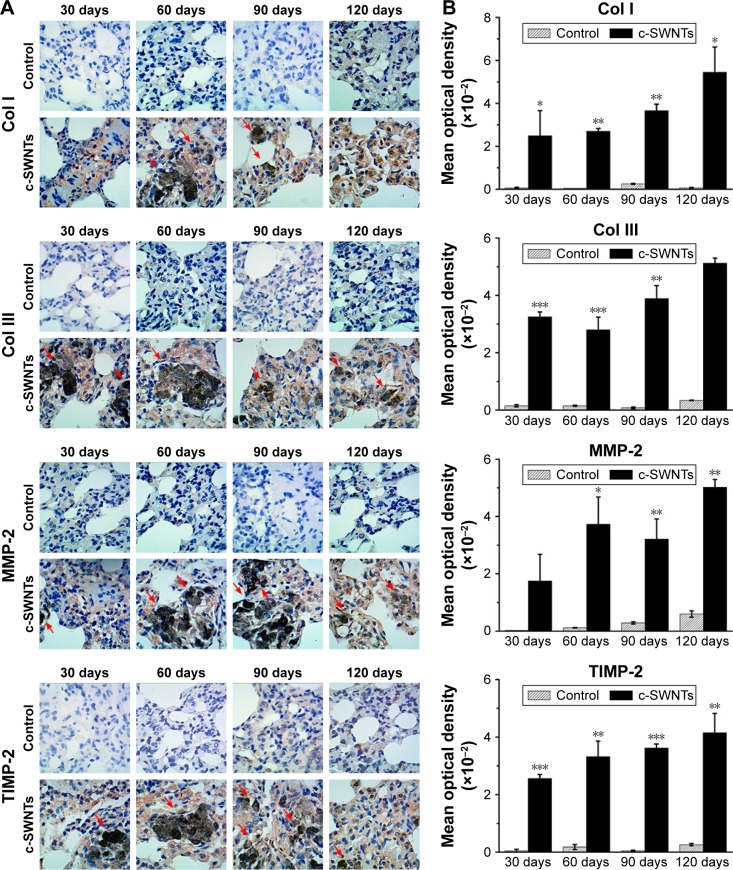
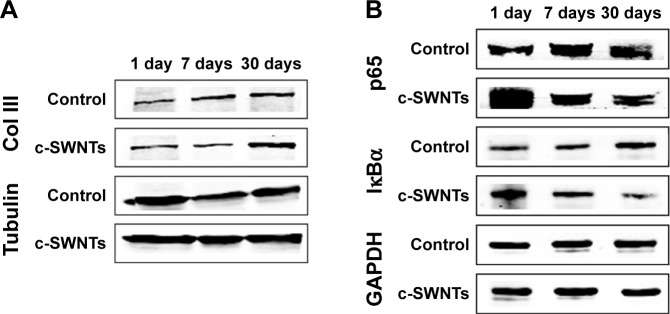
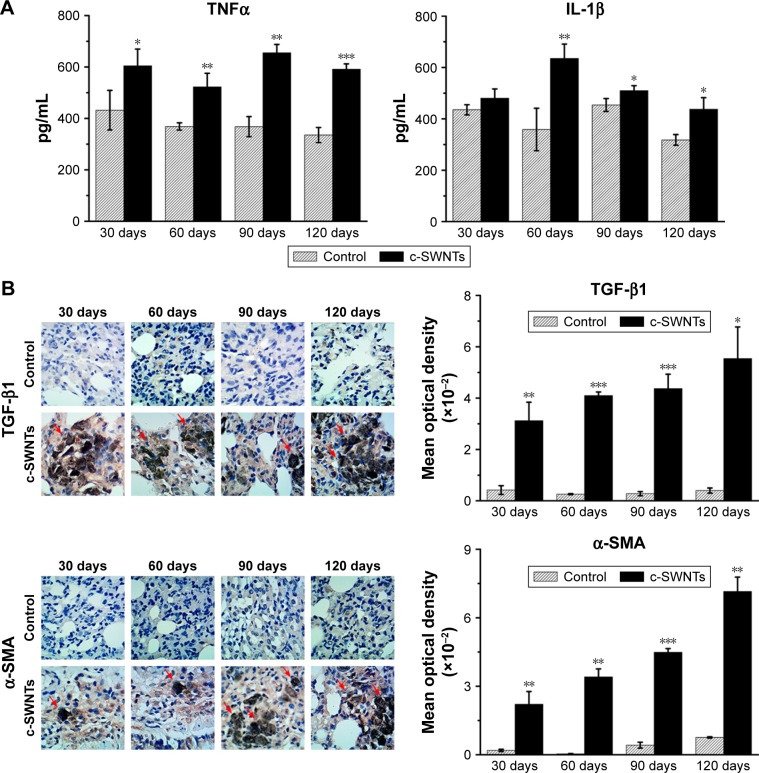
Numerous studies have demonstrated promising application of single-walled carbon nanotubes (SWNTs) in drug delivery, diagnosis, and targeted therapy. However, the adverse health effects resulting from intravenous injection of SWNTs are not completely understood. Studies have shown that levels of "pristine" or carboxylated carbon nanotubes are very high in mouse lungs after intravenous injection. We hypothesized that long-term and repeated intravenous administration of carboxylated SWNTs (c-SWNTs) can result in persistent accumulation and induce histopathologic changes in rat lungs. Here, c-SWNTs were administered repeatedly to rats via tail-vein injection for 90 days. Long-term intravenous injection of c-SWNTs caused sustained embolization in lung capillaries and granuloma formation. It also induced a persistent inflammatory response that was regulated by the nuclear factor-kappa B signaling pathway, and which resulted in pulmonary fibrogenesis. c-SWNTs trapped within lung capillaries traversed capillary walls and injured alveolar epithelial cells, thereby stimulating production of pro-inflammatory cytokines (tumor necrosis factor-alpha and interleukin-1 beta) and pro-fibrotic growth factors (transforming growth factor-beta 1). Protein levels of type-I and type-III collagens, matrix metalloproteinase-2, and the tissue inhibitor of metalloproteinase-2 were upregulated after intravenous exposure to c-SWNTs as determined by immunohistochemical assays and Western blotting, which suggested collagen deposition and remodeling of the extracellular matrix. These data suggest that chronic and cumulative toxicity of nanomaterials to organs with abundant capillaries should be assessed if such nanomaterials are applied via intravenous administration.
大量研究已证明单壁碳纳米管(SWNTs)在药物递送、诊断和靶向治疗方面具有广阔的应用前景。然而,静脉注射SWNTs对健康产生的不良影响尚未完全明确。研究表明,静脉注射后,小鼠肺部“原始”或羧化碳纳米管的含量非常高。我们推测,长期反复静脉注射羧化SWNTs(c-SWNTs)会导致大鼠肺部持续蓄积并诱发组织病理学变化。在此,通过尾静脉注射将c-SWNTs反复给予大鼠,持续90天。长期静脉注射c-SWNTs导致肺毛细血管持续栓塞和肉芽肿形成。它还诱导了由核因子-κB信号通路调节的持续炎症反应,进而导致肺纤维化。被困在肺毛细血管内的c-SWNTs穿过毛细血管壁并损伤肺泡上皮细胞,从而刺激促炎细胞因子(肿瘤坏死因子-α和白细胞介素-1β)和促纤维化生长因子(转化生长因子-β1)的产生。通过免疫组织化学分析和蛋白质印迹法测定,静脉暴露于c-SWNTs后,I型和III型胶原蛋白、基质金属蛋白酶-2以及金属蛋白酶组织抑制剂-2的蛋白水平上调,这表明存在胶原蛋白沉积和细胞外基质重塑。这些数据表明,如果通过静脉给药应用此类纳米材料,则应评估纳米材料对具有丰富毛细血管的器官的慢性和累积毒性。