Bechteler Julia, Schäfer-Verwimp Alfons, Lee Gaik Ee, Feldberg Kathrin, Pérez-Escobar Oscar Alejandro, Pócs Tamás, Peralta Denilson F, Renner Matthew A M, Heinrichs Jochen
Department of Biology I, Systematic Botany and Mycology GeoBio-Center University of Munich (LMU) Munich Germany.
Herdwangen-Schönach Germany.
Ecol Evol. 2016 Dec 20;7(2):638-653. doi: 10.1002/ece3.2656. eCollection 2017 Jan.
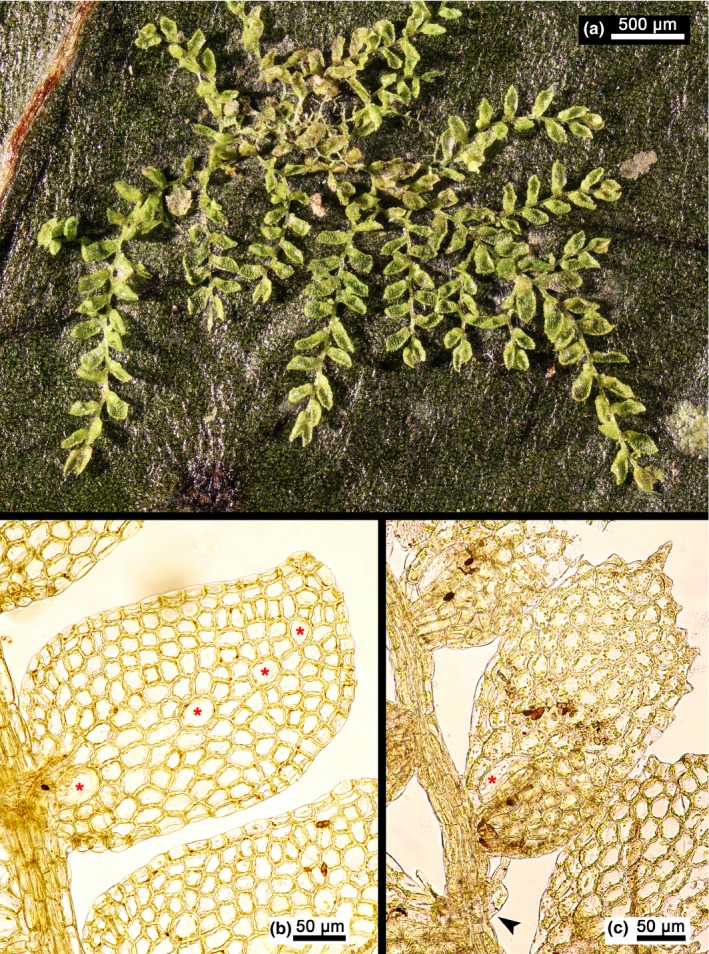
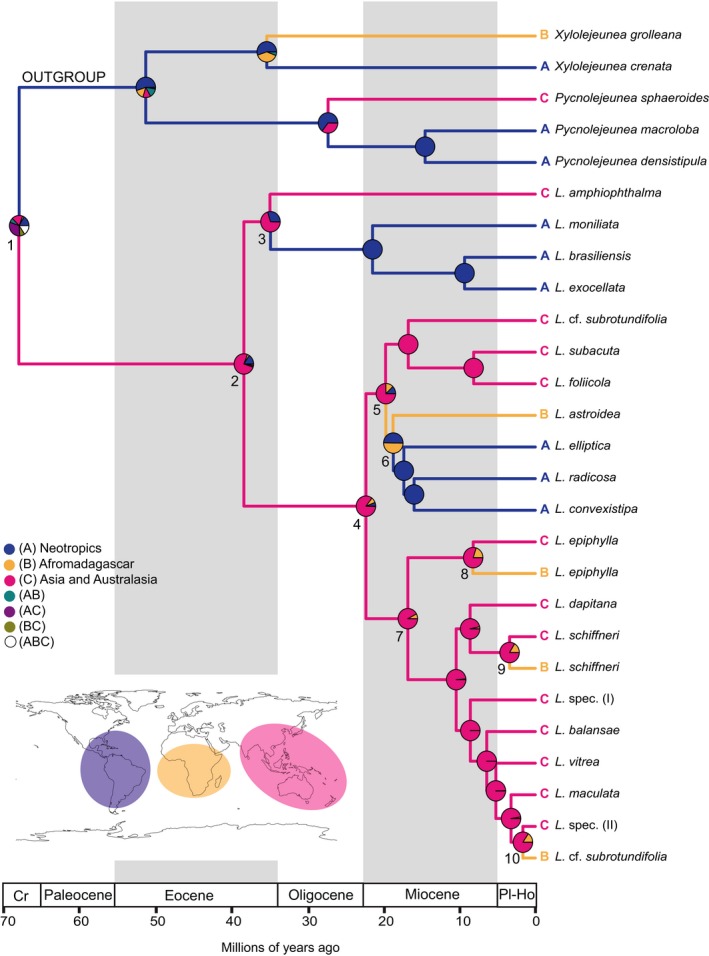
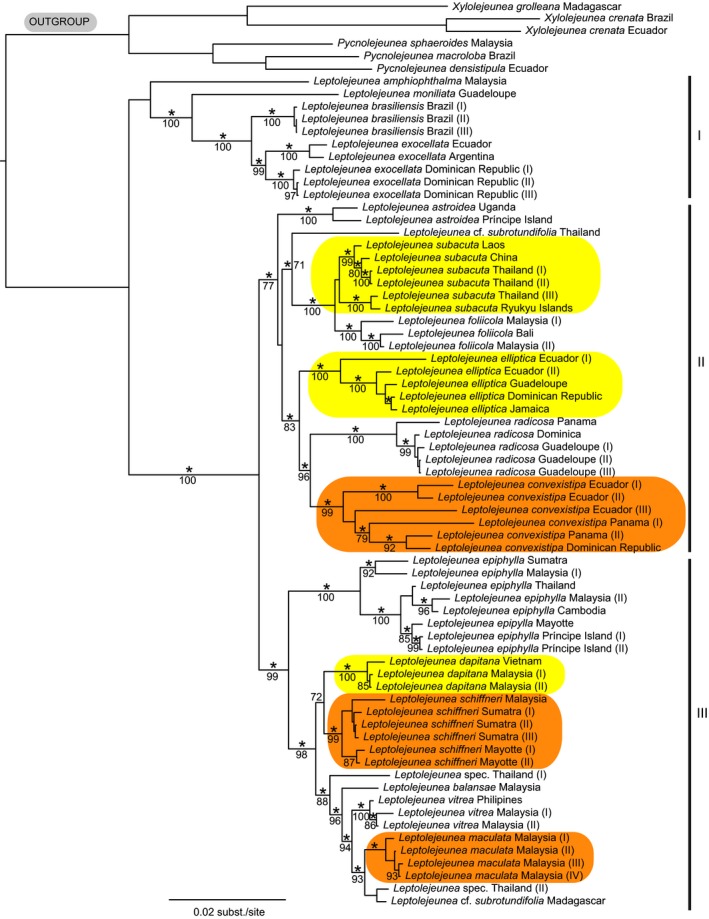
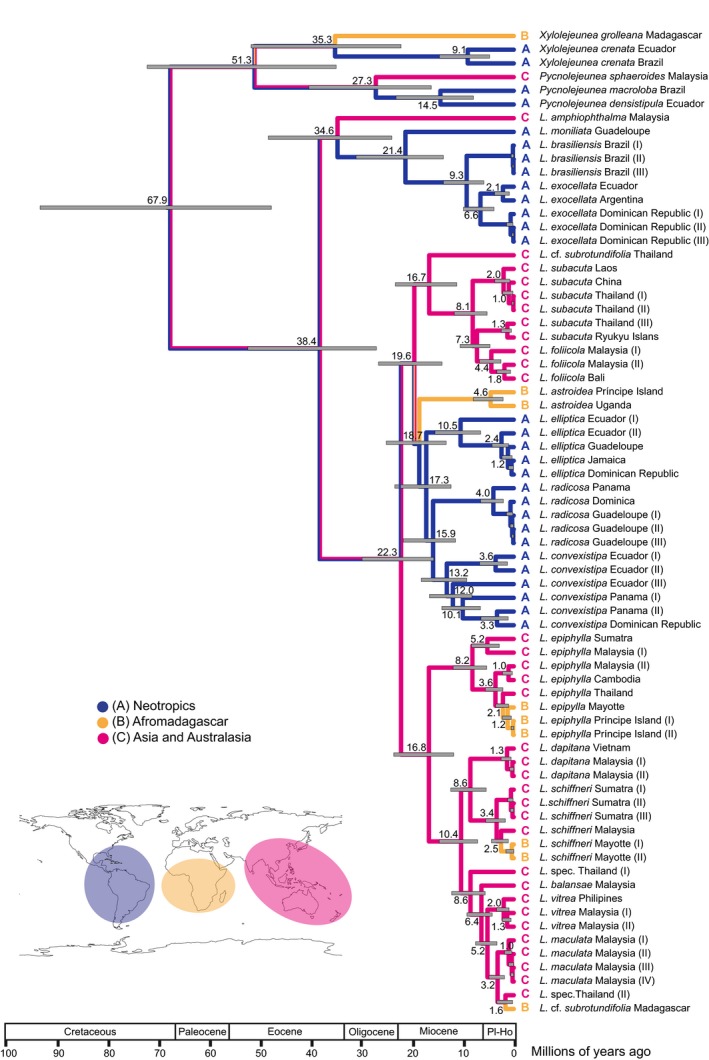
The evolutionary history and classification of epiphyllous cryptogams are still poorly known. is a largely epiphyllous pantropical liverwort genus with about 25 species characterized by deeply bilobed underleaves, elliptic to narrowly obovate leaf lobes, the presence of ocelli, and vegetative reproduction by cladia. Sequences of three chloroplast regions (L, L-F, A) and the nuclear ribosomal ITS region were obtained for 66 accessions of and six outgroup species to explore the phylogeny, divergence times, and ancestral areas of this genus. The phylogeny was estimated using maximum-likelihood and Bayesian inference approaches, and divergence times were estimated with a Bayesian relaxed clock method. likely originated in Asia or the Neotropics within a time interval from the Early Eocene to the Late Cretaceous (67.9 Ma, 95% highest posterior density [HPD]: 47.9-93.7). Diversification of the crown group initiated in the Eocene or early Oligocene (38.4 Ma, 95% HPD: 27.2-52.6). Most species clades were established in the Miocene. and originated in Asia and colonized African islands during the Plio-Pleistocene. Accessions of supposedly pantropical species are placed in different main clades. Several monophyletic morphospecies exhibit considerable sequence variation related to a geographical pattern. The clear geographic structure of the crown group points to evolutionary processes including rare long-distance dispersal and subsequent speciation. may have benefitted from the large-scale distribution of humid tropical angiosperm forests in the Eocene.
叶附生隐花植物的进化历史和分类仍然鲜为人知。是一个主要为叶附生的泛热带苔类植物属,约有25个物种,其特征为叶下裂片深深二裂、叶裂片椭圆形至狭倒卵形、具单眼以及通过分枝进行营养繁殖。获取了该属66个样本以及6个外类群物种的三个叶绿体区域(L、L-F、A)和核糖体ITS区域的序列,以探究该属的系统发育、分歧时间和祖先分布区。使用最大似然法和贝叶斯推断法估计系统发育,并使用贝叶斯宽松时钟法估计分歧时间。该属可能在早始新世到晚白垩世的时间间隔内起源于亚洲或新热带地区(6790万年,95%最高后验密度[HPD]:4790 - 9370万年)。冠群的多样化始于始新世或早渐新世(3840万年,95% HPD:2720 - 5260万年)。大多数物种分支在中新世形成。和起源于亚洲,并在晚上新世至更新世期间殖民非洲岛屿。所谓泛热带物种的样本被置于不同的主要分支中。几个单系形态物种表现出与地理模式相关的显著序列变异。该属冠群清晰的地理结构指向包括罕见的长距离扩散和随后物种形成在内的进化过程。该属可能受益于始新世潮湿热带被子植物森林的大规模分布。