Research Center for Advanced Science and Technology (RCAST), The University of Tokyo, 4-6-1 Komaba, Meguro-ku, Tokyo, Japan.
Department of Chemistry and Biotechnology, Graduate School of Engineering, The University of Tokyo, 7-3-1 Hongo, Bunkyo-ku, Tokyo 113-8656, Japan.
Sci Rep. 2017 Jan 24;7:41007. doi: 10.1038/srep41007.
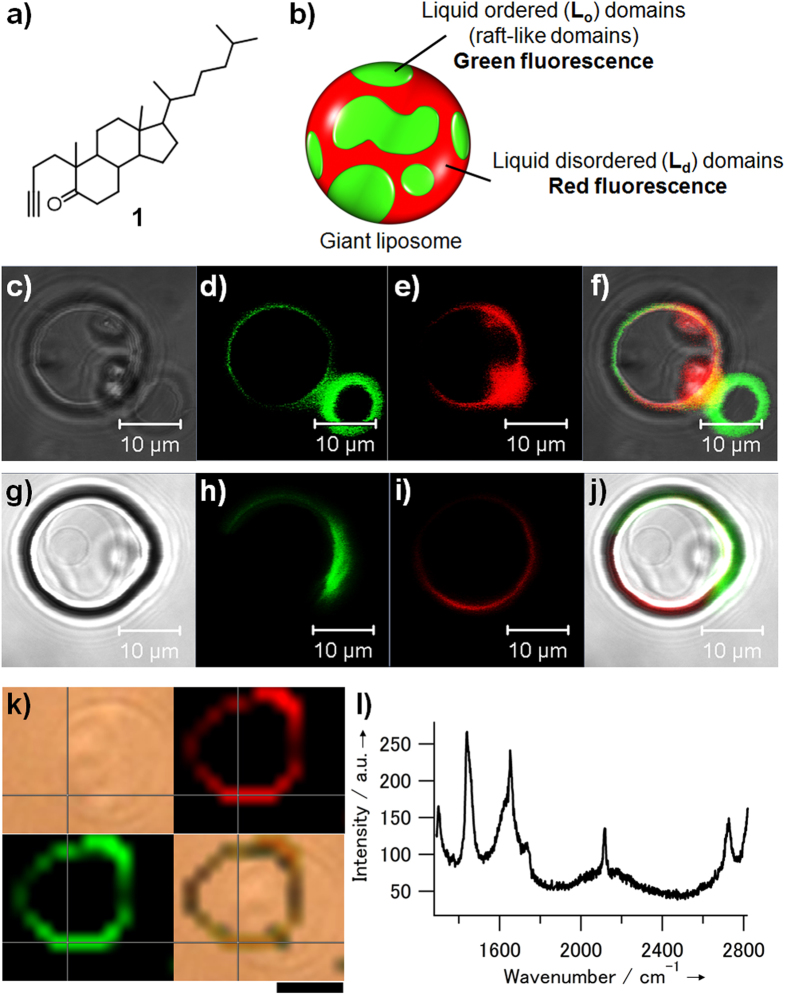
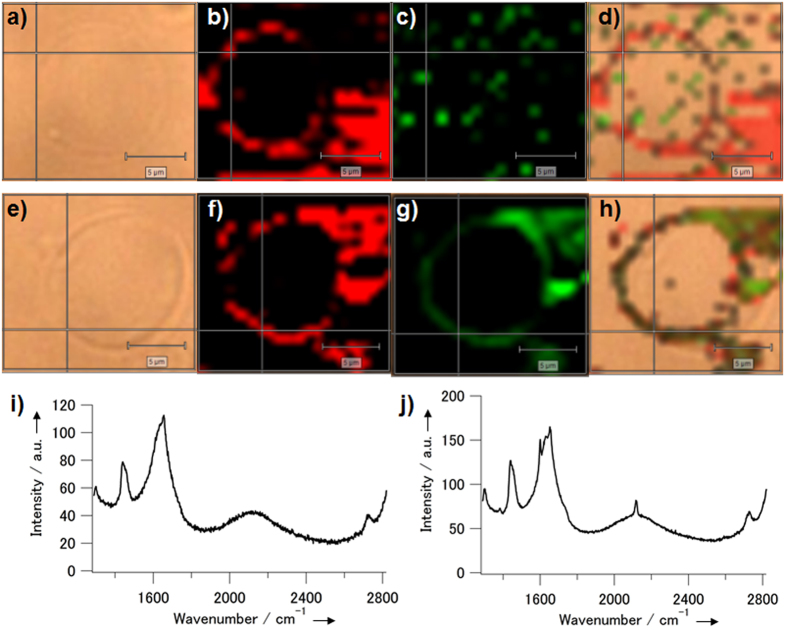
A chemically-activatable alkynyl steroid analogue probe has been synthesized for visualizing the lipid raft membrane domains by Raman microscopy. The Raman probe, in which ring A of its steroid backbone is replaced with an alkynyl group, was designed to enable activation of the alkyne signal through the Eschenmoser-Tanabe fragmentation reaction of the oxidized cholesterol precursor in lipid bilayer membranes. The alkynyl steroid analogue was observed to form liquid-ordered raft-like domains on a model giant-liposome system in a similar manner as cholesterol, and the large alkyne signal of the accumulated probe at 2120 cm was mapped on the microdomains with a Raman microscope. The alkyne moiety of the probe was confirmed to be converted from the α,β-epoxy ketone group of its precursor by reaction with p-toluensulfonyl hydrazine under a mild condition. Through the reaction, the alkyne signal of the probe was activated on the lipid bilayer membrane of liposomes. Furthermore, the signal activation of the probe was also detected on living cells by stimulated Raman scattering microscopy. The ring-A-opened alkyne steroid analogue, thus, provides a first chemically-activatable Raman probe as a promising tool for potentially unravelling the intracellular formation and trafficking of cholesterol-rich microdomains.
一种化学可激活的炔基甾体类似物探针已被合成,用于通过拉曼显微镜可视化脂质筏膜结构域。该拉曼探针的甾体主链的 A 环被炔基取代,其设计目的是通过脂质双层膜中氧化胆固醇前体的 Eschenmoser-Tanabe 断裂反应来激活炔基信号。该炔基甾体类似物被观察到以类似于胆固醇的方式在模型巨脂质体系统上形成液体有序筏状结构域,并且在微域上用拉曼显微镜对积累探针的大炔基信号进行了映射。探针的炔基部分被证实通过在温和条件下与对甲苯磺酰肼反应,从其前体的α,β-环氧化酮基转化而来。通过该反应,探针的炔基信号在脂质体的脂质双层膜上被激活。此外,还通过受激拉曼散射显微镜在活细胞上检测到探针的信号激活。因此,开环 A 的炔基甾体类似物提供了第一个化学可激活的拉曼探针,作为一种有前途的工具,用于潜在地揭示富含胆固醇的微域的细胞内形成和运输。