Spies M, Kraus C, Geissberger N, Auer B, Klöbl M, Tik M, Stürkat I-L, Hahn A, Woletz M, Pfabigan D M, Kasper S, Lamm C, Windischberger C, Lanzenberger R
Department of Psychiatry and Psychotherapy, Medical University of Vienna, Vienna, Austria.
MR Center of Excellence, Center for Medical Physics and Biomedical Engineering, Medical University of Vienna, Vienna, Austria.
Transl Psychiatry. 2017 Jan 24;7(1):e1008. doi: 10.1038/tp.2016.265.
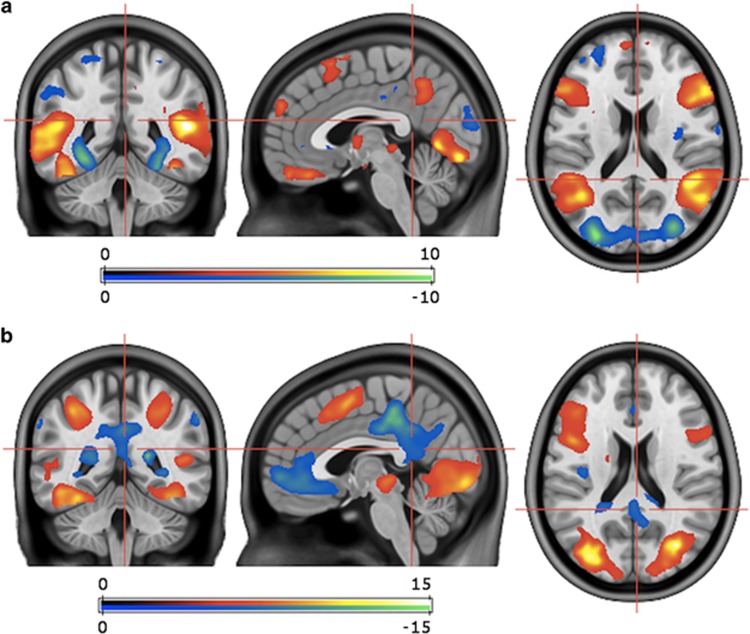
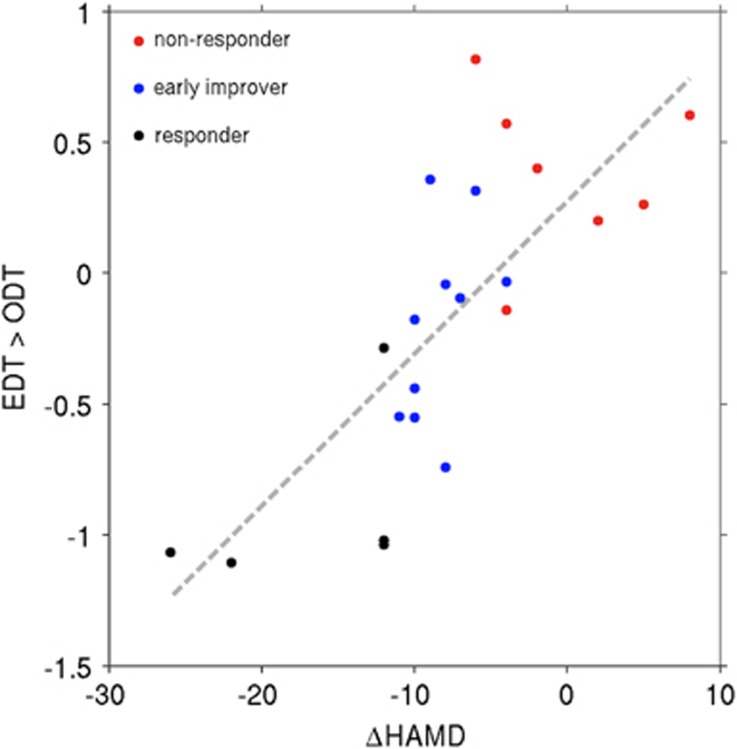
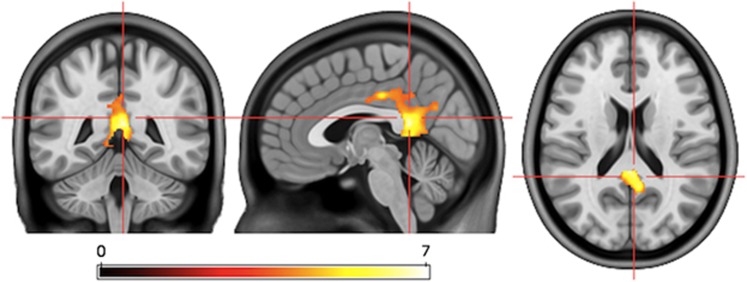
Several previous functional magnetic resonance imaging (fMRI) studies have demonstrated the predictive value of brain activity during emotion processing for antidepressant response, with a focus on clinical outcome after 6-8 weeks. However, longitudinal studies emphasize the paramount importance of early symptom improvement for the course of disease in major depressive disorder (MDD). We therefore aimed to assess whether neural activity during the emotion discrimination task (EDT) predicts early antidepressant effects, and how these predictive measures relate to more sustained response. Twenty-three MDD patients were investigated once with ultrahigh-field 7T fMRI and the EDT. Following fMRI, patients received Escitalopram in a flexible dose schema and were assessed with the Hamilton Depression Rating Scale (HAMD) before, and after 2 and 4 weeks of treatment. Deactivation of the precuneus and posterior cingulate cortex (PCC) during the EDT predicted change in HAMD scores after 2 weeks of treatment. Baseline EDT activity was not predictive of HAMD change after 4 weeks of treatment. The precuneus and PCC are integral components of the default mode network (DMN). We show that patients who exhibit stronger DMN suppression during emotion processing are more likely to show antidepressant response after 2 weeks. This is, to our knowledge, the first study to show that DMN activity predicts early antidepressant effects. However, DMN deactivation did not predict response at 4 weeks, suggesting that our finding is representative of early, likely treatment-related, yet unspecific symptom improvement. Regardless, early effects may be harnessed for optimization of treatment regimens and patient care.
先前的几项功能磁共振成像(fMRI)研究已经证明了情绪加工过程中大脑活动对抗抑郁反应的预测价值,重点关注6-8周后的临床结果。然而,纵向研究强调了早期症状改善对重度抑郁症(MDD)病程的至关重要性。因此,我们旨在评估情绪辨别任务(EDT)期间的神经活动是否能预测早期抗抑郁效果,以及这些预测指标与更持久反应之间的关系。对23名MDD患者进行了一次超高场7T fMRI和EDT检查。fMRI检查后,患者接受灵活剂量方案的艾司西酞普兰治疗,并在治疗前、治疗2周和4周后用汉密尔顿抑郁量表(HAMD)进行评估。EDT期间楔前叶和后扣带回皮质(PCC)的失活预测了治疗2周后HAMD评分的变化。基线EDT活动不能预测治疗4周后HAMD的变化。楔前叶和PCC是默认模式网络(DMN)的组成部分。我们发现,在情绪加工过程中表现出更强DMN抑制的患者在2周后更有可能出现抗抑郁反应。据我们所知,这是第一项表明DMN活动可预测早期抗抑郁效果的研究。然而,DMN失活并不能预测4周时的反应,这表明我们的发现代表了早期的、可能与治疗相关的但非特异性的症状改善。无论如何,早期效果可用于优化治疗方案和患者护理。