Luo Ping, Liu Xue-Fang, Wang Ying-Chao, Li Nan-Di, Liao Shen-Jun, Yu Ming-Xia, Liang Chun-Zi, Tu Jian-Cheng
Department of Clinical Laboratory Medicine & Center for Gene Diagnosis, Zhongnan Hospital of Wuhan University, Wuhan, China.
Oncotarget. 2017 Apr 4;8(14):23927-23936. doi: 10.18632/oncotarget.14760.
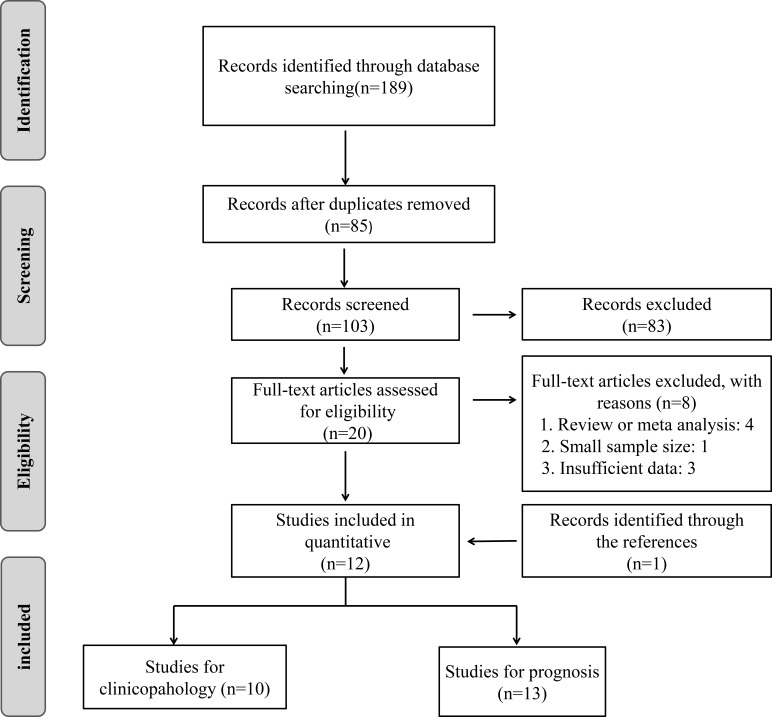
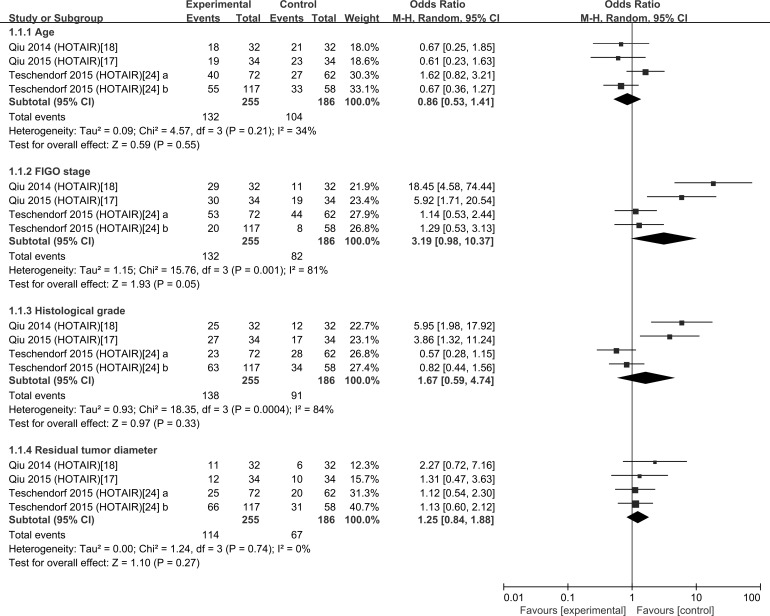
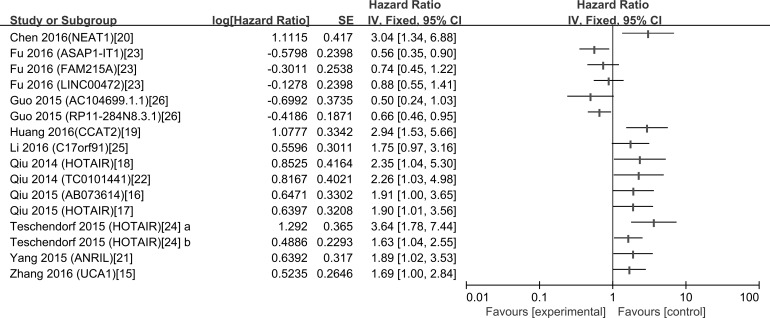
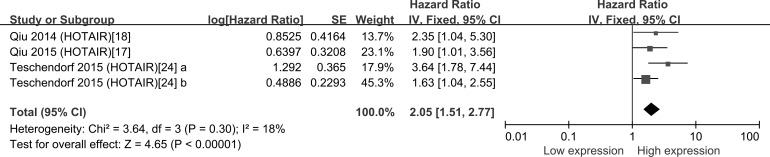
Ovarian cancer (OC) is the most deadly gynecological cancer and it is urgently needed to find a new marker for the progress of OC. Many long noncoding RNAs (lncRNAs) have been reported to be aberrantly expressed in ovarian carcinoma, and may serve as prognostic markers. Therefore, we conducted this meta-analysis to gain a better understanding of the prognostic value of lncRNAs in patients with varian carcinoma. We systematically searched PubMed, EMBASE, and Web of Science. A total of 13 eligible studies, including 10 on clinicopathological features, 13 on prognosis were identified. Pooled hazard ratios (HRs) or odds ratios (OR) and 95% confidence intervals (95% CIs) were calculated using random- or fixed-effects models. Our results revealed that the increased expressions of 8 lncRNAs were associated with poor prognosis and the decreased expressions of 5 lncRNAs were related to poor prognosis in ovarian carcinoma. High HOTAIR expression was associated with shorter overall survival in ovarian cancer (pooled HR: 2.05, 95% CI: 1.51-2.77, P < 0.001). In conclusion, our meta-analysis suggested that LncRNAs could function as potential prognostic markers for ovarian cancer patients and high expression HOTAIR was associated with shorter overall survival in ovarian cancer.
卵巢癌(OC)是最致命的妇科癌症,迫切需要找到一种新的卵巢癌进展标志物。许多长链非编码RNA(lncRNAs)已被报道在卵巢癌中异常表达,并可能作为预后标志物。因此,我们进行了这项荟萃分析,以更好地了解lncRNAs在卵巢癌患者中的预后价值。我们系统地检索了PubMed、EMBASE和科学网。共鉴定出13项符合条件的研究,其中10项关于临床病理特征,13项关于预后。使用随机或固定效应模型计算合并风险比(HRs)或比值比(OR)以及95%置信区间(95% CIs)。我们的结果显示,8种lncRNAs的表达增加与卵巢癌预后不良相关,5种lncRNAs的表达降低与卵巢癌预后不良相关。高HOTAIR表达与卵巢癌患者较短的总生存期相关(合并HR:2.05,95% CI:1.51 - 2.77,P < 0.001)。总之,我们的荟萃分析表明,lncRNAs可作为卵巢癌患者潜在的预后标志物,高表达的HOTAIR与卵巢癌患者较短的总生存期相关。