Wei Hao, Hu Jie Hong, Angelov Stoyan N, Fox Kate, Yan James, Enstrom Rachel, Smith Alexandra, Dichek David A
Department of Medicine, University of Washington, Seattle, WA.
Department of Medicine, University of Washington, Seattle, WA
J Am Heart Assoc. 2017 Jan 24;6(1):e004968. doi: 10.1161/JAHA.116.004968.
Marfan syndrome (MFS) is caused by mutations in the gene encoding fibrillin-1 (FBN1); however, the mechanisms through which fibrillin-1 deficiency causes MFS-associated aortopathy are uncertain. Recently, attention was focused on the hypothesis that MFS-associated aortopathy is caused by increased transforming growth factor-β (TGF-β) signaling in aortic medial smooth muscle cells (SMC). However, there are many reasons to doubt that TGF-β signaling drives MFS-associated aortopathy. We used a mouse model to test whether SMC TGF-β signaling is perturbed by a fibrillin-1 variant that causes MFS and whether blockade of SMC TGF-β signaling prevents MFS-associated aortopathy.
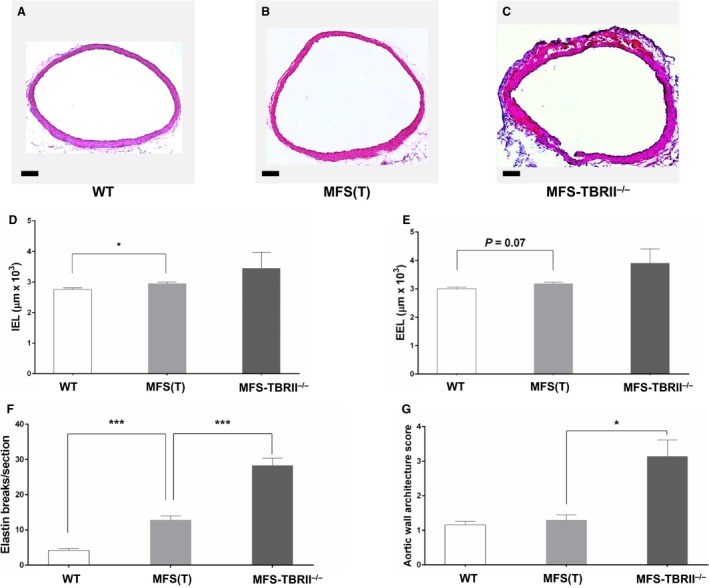
MFS mice (Fbn1 genotype) were genetically modified to allow postnatal SMC-specific deletion of the type II TGF-β receptor (TBRII; essential for physiologic TGF-β signaling). In young MFS mice with and without superimposed deletion of SMC-TBRII, we measured aortic dimensions, histopathology, activation of aortic SMC TGF-β signaling pathways, and changes in aortic SMC gene expression. Young Fbn1 mice had ascending aortic dilation and significant disruption of aortic medial architecture. Both aortic dilation and disrupted medial architecture were exacerbated by superimposed deletion of TBRII. TGF-β signaling was unaltered in aortic SMC of young MFS mice; however, SMC-specific deletion of TBRII in Fbn1 mice significantly decreased activation of SMC TGF-β signaling pathways.
In young Fbn1 mice, aortopathy develops in the absence of detectable alterations in SMC TGF-β signaling. Loss of physiologic SMC TGF-β signaling exacerbates MFS-associated aortopathy. Our data support a protective role for SMC TGF-β signaling during early development of MFS-associated aortopathy.
马凡综合征(MFS)由编码原纤维蛋白-1(FBN1)的基因突变引起;然而,原纤维蛋白-1缺乏导致MFS相关主动脉病变的机制尚不清楚。最近,人们将注意力集中在这样一种假说上,即MFS相关主动脉病变是由主动脉中膜平滑肌细胞(SMC)中转化生长因子-β(TGF-β)信号增强所致。然而,有许多理由怀疑TGF-β信号驱动MFS相关主动脉病变。我们使用小鼠模型来测试导致MFS的FBN1变体是否会扰乱SMC的TGF-β信号,以及阻断SMC的TGF-β信号是否能预防MFS相关主动脉病变。
对MFS小鼠(Fbn1基因型)进行基因改造,使其在出生后特异性缺失II型TGF-β受体(TBRII;生理TGF-β信号传导所必需)。在有或没有叠加SMC-TBRII缺失的年轻MFS小鼠中,我们测量了主动脉尺寸、组织病理学、主动脉SMC中TGF-β信号通路的激活情况以及主动脉SMC基因表达的变化。年轻的Fbn1小鼠出现升主动脉扩张和主动脉中膜结构的显著破坏。TBRII的叠加缺失加剧了主动脉扩张和中膜结构破坏。年轻MFS小鼠主动脉SMC中的TGF-β信号未改变;然而,Fbn1小鼠中SMC特异性缺失TBRII显著降低了SMC中TGF-β信号通路的激活。
在年轻的Fbn1小鼠中,主动脉病变在SMC的TGF-β信号未检测到改变的情况下发生。生理性SMC的TGF-β信号缺失会加剧MFS相关主动脉病变。我们的数据支持SMC的TGF-β信号在MFS相关主动脉病变早期发展过程中具有保护作用。