Basso Pauline, Ragno Michel, Elsen Sylvie, Reboud Emeline, Golovkine Guillaume, Bouillot Stephanie, Huber Philippe, Lory Stephen, Faudry Eric, Attrée Ina
University of Grenoble Alpes, Grenoble, France.
CNRS, ERL5261, Grenoble, France.
mBio. 2017 Jan 24;8(1):e02250-16. doi: 10.1128/mBio.02250-16.
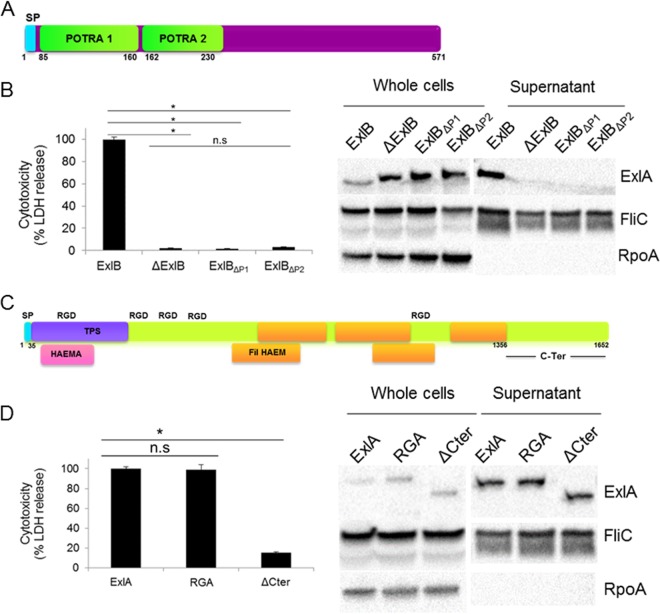
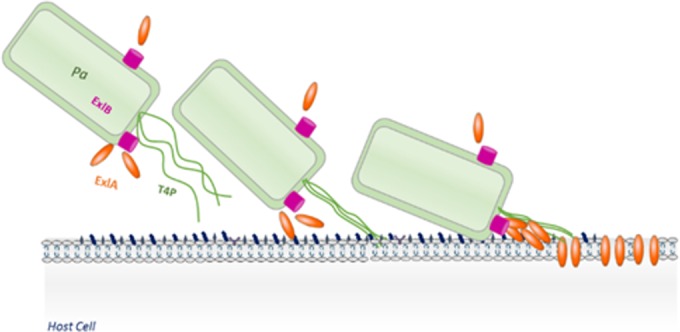
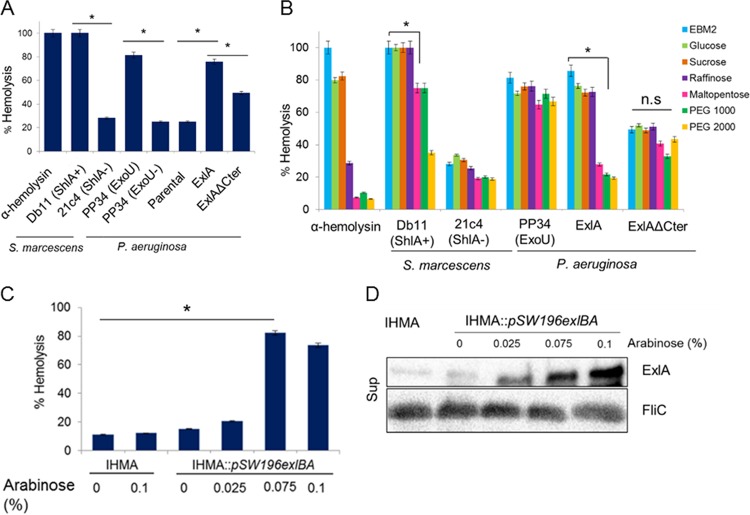
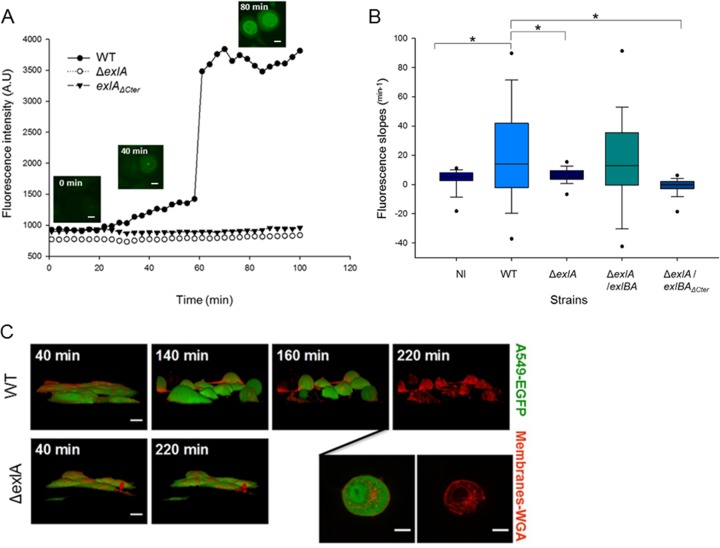
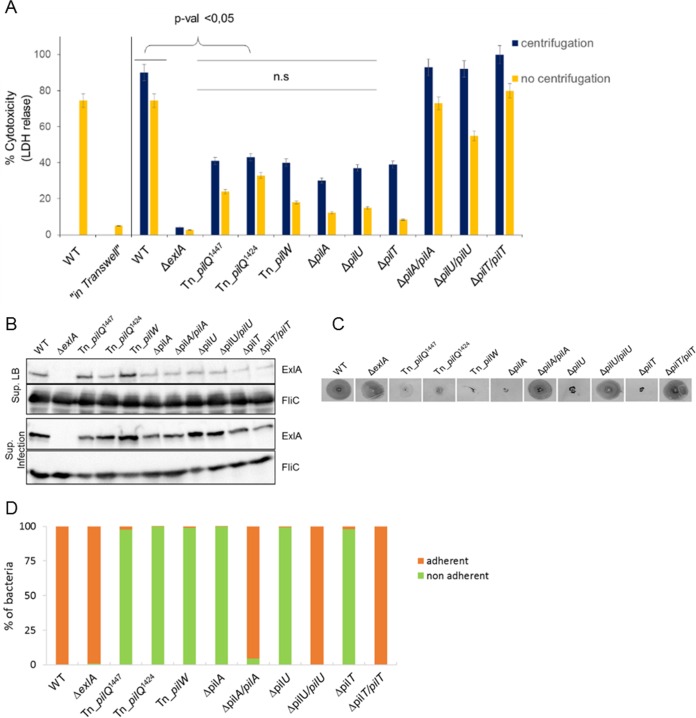
Clinical strains of Pseudomonas aeruginosa lacking the type III secretion system genes employ a toxin, exolysin (ExlA), for host cell membrane disruption. Here, we demonstrated that ExlA export requires a predicted outer membrane protein, ExlB, showing that ExlA and ExlB define a new active two-partner secretion (TPS) system of P. aeruginosa In addition to the TPS signals, ExlA harbors several distinct domains, which include one hemagglutinin domain, five arginine-glycine-aspartic acid (RGD) motifs, and a C-terminal region lacking any identifiable sequence motifs. However, this C-terminal region is important for the toxic activity, since its deletion abolishes host cell lysis. Using lipid vesicles and eukaryotic cells, including red blood cells, we demonstrated that ExlA has a pore-forming activity which precedes cell membrane disruption of nucleated cells. Finally, we developed a high-throughput cell-based live-dead assay and used it to screen a transposon mutant library of an ExlA-producing P. aeruginosa clinical strain for bacterial factors required for ExlA-mediated toxicity. The screen resulted in the identification of proteins involved in the formation of type IV pili as being required for ExlA to exert its cytotoxic activity by promoting close contact between bacteria and the host cell. These findings represent the first example of cooperation between a pore-forming toxin of the TPS family and surface appendages in host cell intoxication.
The course and outcome of acute, toxigenic infections by Pseudomonas aeruginosa clinical isolates rely on the deployment of one of two virulence strategies: delivery of effectors by the well-known type III secretion system or the cytolytic activity of the recently identified two-partner secreted toxin, exolysin. Here, we characterize several features of the mammalian cell intoxication process mediated by exolysin. We found that exolysin requires the outer membrane protein ExlB for export into extracellular medium. Using in vitro recombinant protein and ex vivo assays, we demonstrated a pore-forming activity of exolysin. A cellular cytotoxicity screen of a transposon mutant library, made in an exolysin-producing clinical strain, identified type IV pili as bacterial appendages required for exolysin toxic function. This work deciphers molecular mechanisms underlying the activity of novel virulence factors used by P. aeruginosa clinical strains lacking the type III secretion system, including a requirement for the toxin-producing bacteria to be attached to the targeted cell to induce cytolysis, and defines new targets for developing antivirulence strategies.
缺乏III型分泌系统基因的铜绿假单胞菌临床菌株利用一种毒素——外溶素(ExlA)来破坏宿主细胞膜。在此,我们证明ExlA的输出需要一种预测的外膜蛋白ExlB,这表明ExlA和ExlB定义了铜绿假单胞菌一种新的活性双组分分泌(TPS)系统。除了TPS信号外,ExlA还具有几个不同的结构域,其中包括一个血凝素结构域、五个精氨酸 - 甘氨酸 - 天冬氨酸(RGD)基序以及一个缺乏任何可识别序列基序的C末端区域。然而,这个C末端区域对毒性活性很重要,因为其缺失会消除宿主细胞裂解。利用脂质体和包括红细胞在内的真核细胞,我们证明ExlA具有成孔活性,该活性先于有核细胞的细胞膜破坏。最后,我们开发了一种基于细胞的高通量活死检测方法,并利用它来筛选产生ExlA的铜绿假单胞菌临床菌株的转座子突变文库,以寻找ExlA介导的毒性所需的细菌因子。该筛选结果鉴定出参与IV型菌毛形成的蛋白质是ExlA通过促进细菌与宿主细胞紧密接触发挥细胞毒性活性所必需的。这些发现代表了TPS家族的成孔毒素与宿主细胞中毒过程中的表面附属物之间合作的首个实例。
铜绿假单胞菌临床分离株的急性产毒感染的病程和结果取决于两种毒力策略之一的部署:通过著名的III型分泌系统递送效应器或最近鉴定的双组分分泌毒素外溶素的溶细胞活性。在此,我们描述了外溶素介导的哺乳动物细胞中毒过程的几个特征。我们发现外溶素需要外膜蛋白ExlB才能输出到细胞外培养基中。利用体外重组蛋白和离体检测方法,我们证明了外溶素的成孔活性。在产生外溶素的临床菌株中构建转座子突变文库进行细胞毒性筛选,鉴定出IV型菌毛是外溶素毒性功能所需的细菌附属物。这项工作破译了缺乏III型分泌系统的铜绿假单胞菌临床菌株所使用的新型毒力因子活性的分子机制,包括产毒素细菌需要附着在靶细胞上以诱导细胞溶解,并确定了开发抗毒力策略的新靶点。