Lee Seung Hyun, Cho Yeon Jean, Han Myoungseok, Bae Jong Woon, Park Jung-Woo, Oh So Ra, Kim Sujin
Department of Obstetrics and Gynecology, Dong-A University College of Medicine, Busan, Korea.
Department of Pathology, Dong-A University College of Medicine, Busan, Korea.
J Menopausal Med. 2016 Dec;22(3):180-183. doi: 10.6118/jmm.2016.22.3.180. Epub 2016 Dec 31.
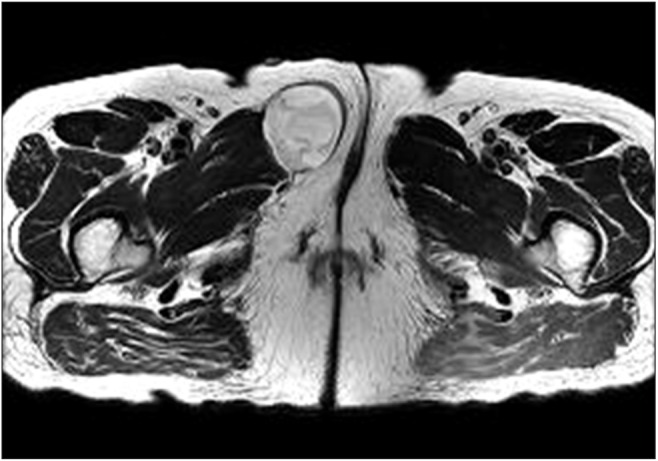
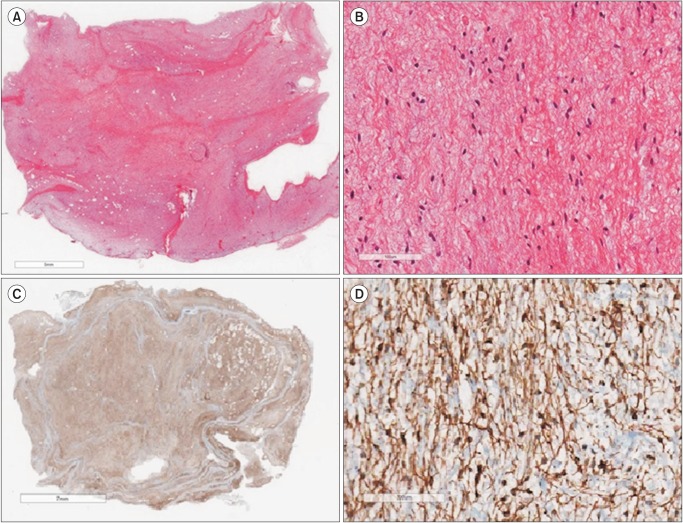
Superficial angiomyxomas (SAMs) are rare benign cutaneous tumors that involve the subcutaneous layer. They are commonly located in the trunk, lower limbs and head or neck of women of reproductive age. SAMs in the vulva of postmenopausal women are especially rare case. Herein, we report a vulvar SAM in a postmenopausal 60-year-old woman. The patient presented with a palpable cutaneous mass in the right labium majora that had appeared 3 months earlier. The mass was slow growing and approximately 5 cm in size and resembled a soft tissue malignancy. It appeared as a well-defined multilocular cystic mass in magnetic resonance images. The preoperative diagnosis was a benign cystic lesion such as an epidermoid cyst. Grossly, the completely excised mass was 6 × 5 cm in size and well circumscribed with a multilocular outer surface, a yellowish-gray gelatinous cut surface, and a smooth rubbery inner surface. Histologic review revealed that the mass contained small to moderate amount of cellular angiomyxoid nodules and bland-looking spindle-shaped to ovoid cells without atypia. Neutrophil infiltration, which is a diagnostic feature of SAMs, was observed. Immunohistochemistry showed expression of CD34, but not of estrogen receptors, progesterone receptors, or desmin in the SAM. The patient has been followed up for 12 months without recurrence.
浅表血管黏液瘤(SAMs)是一种罕见的良性皮肤肿瘤,累及皮下层。它们通常位于育龄女性的躯干、下肢以及头颈部。绝经后女性外阴部的SAMs尤为罕见。在此,我们报告一例60岁绝经后女性的外阴SAMs。患者右侧大阴唇出现一个可触及的皮肤肿物,3个月前出现。肿物生长缓慢,大小约5厘米,类似软组织恶性肿瘤。磁共振成像显示为边界清晰的多房囊性肿物。术前诊断为良性囊性病变,如表皮样囊肿。大体上,完整切除的肿物大小为6×5厘米,边界清楚,外表面多房,切面呈黄灰色胶冻状,内表面光滑似橡胶。组织学检查显示,肿物含有少量至中等量的细胞性血管黏液样结节以及外观温和的梭形至卵圆形细胞,无异型性。观察到中性粒细胞浸润,这是SAMs的一个诊断特征。免疫组化显示SAMs中CD34表达阳性,但雌激素受体、孕激素受体及结蛋白均不表达。该患者已随访12个月,无复发。