Galbiati Alessandro, Beauséjour Christian, d'Adda di Fagagna Fabrizio
IFOM-Foundation, The FIRC Institute of Molecular Oncology Foundation, Via Adamello 16, Milan, 20139, Italy.
Département de Pharmacologie, CHU Ste-Justine, Montréal, QC, H3T 1C5, Canada.
Aging Cell. 2017 Apr;16(2):422-427. doi: 10.1111/acel.12573. Epub 2017 Jan 26.
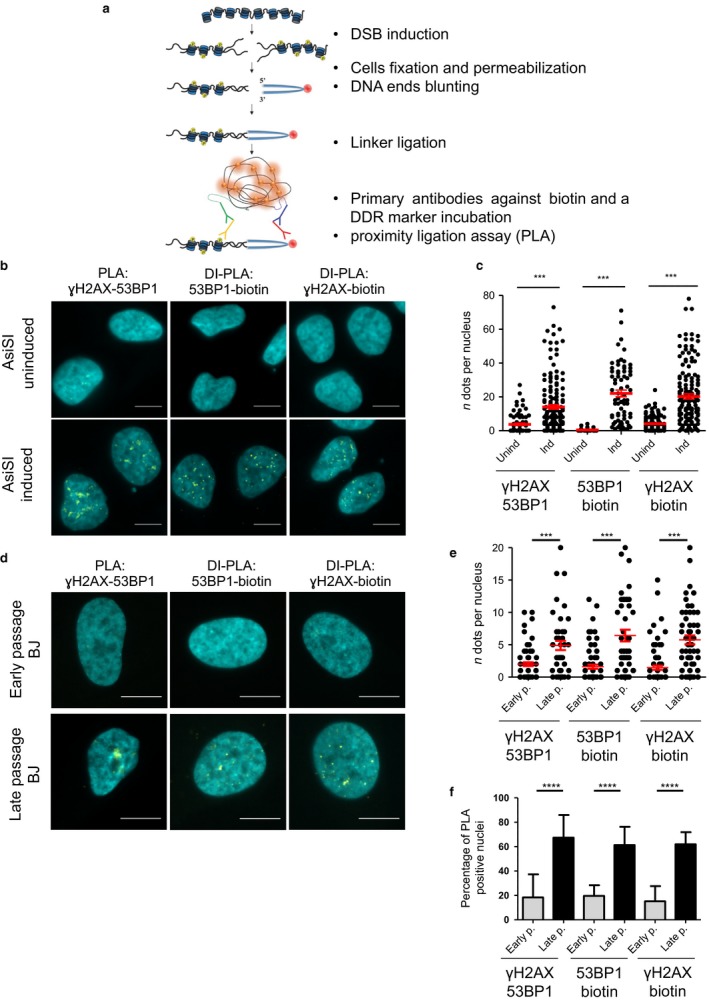
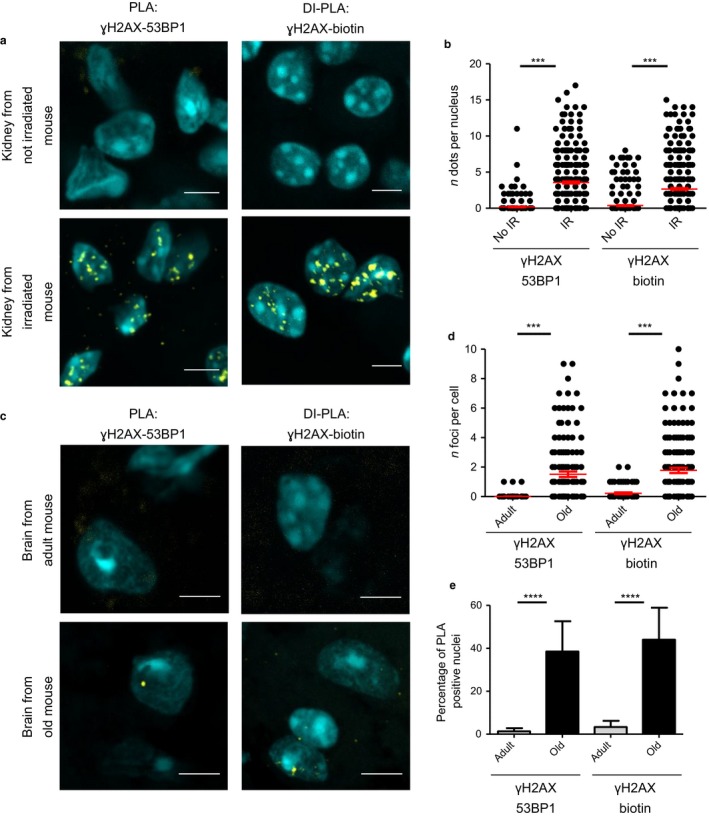
The DNA damage response (DDR) arrests cell cycle progression until DNA lesions, like DNA double-strand breaks (DSBs), are repaired. The presence of DSBs in cells is usually detected by indirect techniques that rely on the accumulation of proteins at DSBs, as part of the DDR. Such detection may be biased, as some factors and their modifications may not reflect physical DNA damage. The dependency on DDR markers of DSB detection tools has left questions unanswered. In particular, it is known that senescent cells display persistent DDR foci, that we and others have proposed to be persistent DSBs, resistant to endogenous DNA repair activities. Others have proposed that these peculiar DDR foci might not be sites of damaged DNA per se but instead stable chromatin modifications, termed DNA-SCARS. Here, we developed a method, named 'DNA damage in situ ligation followed by proximity ligation assay' (DI-PLA) for the detection and imaging of DSBs in cells. DI-PLA is based on the capture of free DNA ends in fixed cells in situ, by ligation to biotinylated double-stranded DNA oligonucleotides, which are next recognized by antibiotin anti-bodies. Detection is enhanced by PLA with a partner DDR marker at the DSB. We validated DI-PLA by demonstrating its ability to detect DSBs induced by various genotoxic insults in cultured cells and tissues. Most importantly, by DI-PLA, we demonstrated that both senescent cells in culture and tissues from aged mammals retain true unrepaired DSBs associated with DDR markers.
DNA损伤反应(DDR)会使细胞周期进程停滞,直到DNA损伤(如DNA双链断裂,DSBs)得到修复。细胞中DSBs的存在通常通过间接技术来检测,这些技术依赖于DDR过程中蛋白质在DSBs处的积累。这种检测可能存在偏差,因为一些因素及其修饰可能无法反映实际的DNA损伤。DSB检测工具对DDR标记物的依赖使得一些问题悬而未决。特别是,已知衰老细胞会显示持续的DDR病灶,我们和其他人曾提出这些病灶是持续存在的DSBs,对内源DNA修复活性具有抗性。其他人则提出,这些特殊的DDR病灶本身可能不是受损DNA的位点,而是稳定的染色质修饰,称为DNA-SCARS。在这里,我们开发了一种名为“原位DNA损伤连接后进行邻近连接分析”(DI-PLA)的方法,用于检测和成像细胞中的DSBs。DI-PLA基于在固定细胞中原位捕获游离DNA末端,通过与生物素化双链DNA寡核苷酸连接,然后由抗生物素抗体识别。通过与DSB处的DDR标记物进行邻近连接分析(PLA)可增强检测效果。我们通过证明其在培养细胞和组织中检测由各种基因毒性损伤诱导的DSBs的能力来验证DI-PLA。最重要的是,通过DI-PLA,我们证明了培养的衰老细胞和老年哺乳动物组织中的衰老细胞都保留了与DDR标记物相关的真正未修复的DSBs。