Medina Iliana, Delhey Kaspar, Peters Anne, Cain Kristal E, Hall Michelle L, Mulder Raoul A, Langmore Naomi E
Division of Ecology and Evolution, Research School of Biology, Australian National University, Canberra, 0200, Australia.
School of Biological Sciences, Monash University, Melbourne, Australia.
BMC Evol Biol. 2017 Jan 26;17(1):35. doi: 10.1186/s12862-016-0861-3.
Both natural and sexual selection may drive the evolution of plumage colouration in birds. This can lead to great variation in plumage not only across species, but also between sexes within species. Australasian fairy-wrens are famous for their brightly coloured males, which exhibit colours ranging from bright blue to red and black. Female plumage in fairy wrens (and in general) has been rarely studied, but it can also be highly variable, including both bright and cryptic plumages. We use a comparative framework to explore the basis for this variation, and test the possibility that female fairy-wrens experience selection for cryptic plumage when they occupy more exposed habitats that offer little concealment from predators. We use spectral measurements of plumage for species and subspecies of Australasian fairy-wrens.
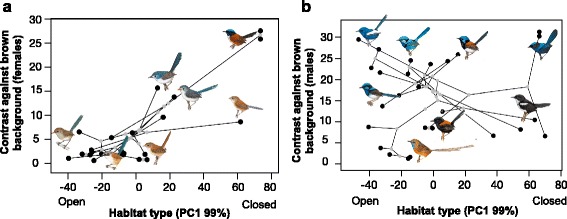
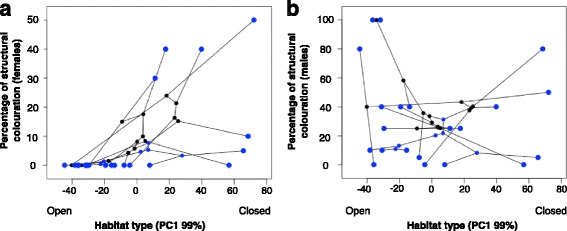
We show that female colouration (contrast against background) is strongly correlated with vegetation cover: females in open habitats show less contrast to background colours than females in closed habitats, while male colouration is not associated with habitat type.
Female plumage appears to be under stronger natural selection than male plumage in fairy-wrens, providing an example of how selection may act differently on males and females of the same species.
自然选择和性选择都可能推动鸟类羽毛颜色的进化。这不仅会导致不同物种之间羽毛差异巨大,同一物种的雌雄个体之间也会如此。澳大拉西亚细尾鹩莺以其色彩鲜艳的雄性个体而闻名,它们的颜色从亮蓝色到红色和黑色不等。细尾鹩莺(总体而言)的雌性羽毛很少被研究,但也可能具有高度变异性,包括鲜艳和隐秘的羽毛。我们使用比较框架来探究这种变异的基础,并测试当雌性细尾鹩莺占据更开阔、几乎没有躲避捕食者隐蔽处的栖息地时,它们是否会因隐秘羽毛而受到选择。我们对澳大拉西亚细尾鹩莺的物种和亚种的羽毛进行光谱测量。
我们发现雌性的颜色(与背景的对比度)与植被覆盖度密切相关:开阔栖息地中的雌性与背景颜色的对比度低于封闭栖息地中的雌性,而雄性的颜色与栖息地类型无关。
在细尾鹩莺中,雌性羽毛似乎比雄性羽毛受到更强的自然选择,这为同一物种的雌雄个体如何受到不同选择作用提供了一个例子。