Choi Mi-Hyun, Kim Hyung-Sik, Yoon Hee-Jeong, Lee Jung-Chul, Baek Ji-Hye, Choi Jin-Seung, Tack Gye-Rae, Min Byung-Chan, Lim Dae-Woon, Chung Soon-Cheol
Department of Biomedical Engineering, Research Institute of Biomedical Engineering, College of Biomedical & Health Science, Konkuk University, Chungju, South Korea.
Department of Industrial and Management Engineering, Hanbat National University, Daejeon, South Korea.
J Physiol Anthropol. 2017 Jan 26;36(1):11. doi: 10.1186/s40101-017-0128-8.
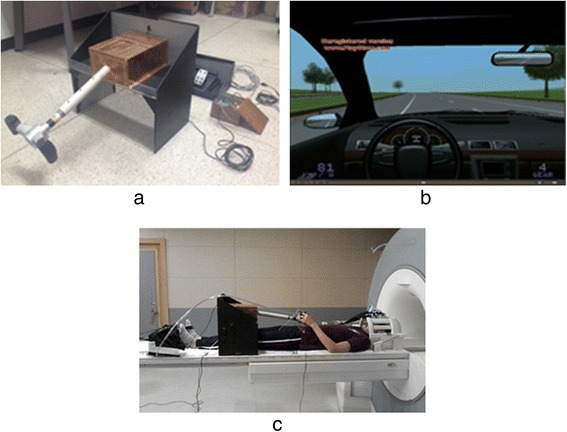
Several studies have used functional magnetic resonance imaging (fMRI) to show that neural activity is associated with driving. fMRI studies have also elucidated the brain responses associated with driving while performing sub-tasks. It is important to note that these studies used computer mouses, trackballs, or joysticks to simulate driving and, thus, were not comparable to real driving situations. In order to overcome these limitations, we used a driving wheel and pedal equipped with an MR-compatible driving simulator (80 km/h). The subjects drove while performing sub-tasks, and we attempted to observe differences in neuronal activation.
The experiments consisted of three blocks and each block consisted of both a control phase (1 min) and a driving phase (2 min). During the control phase, the drivers were instructed to look at the stop screen and to not perform driving tasks. During the driving phase, the drivers either drove (driving only condition) or drove while performing an additional sub-task (driving with sub-task condition) at 80 km/h.
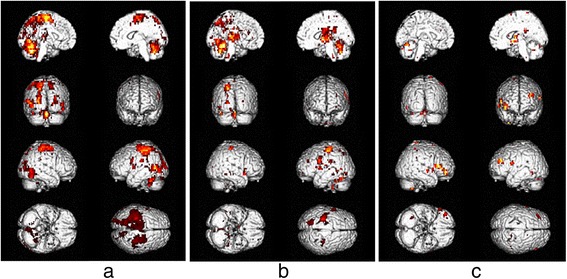
Compared to when the drivers were focused only on driving, when the drivers drove while performing a sub-task, the number of activation voxels greatly decreased in the parietal area, which is responsible for spatial perception. Task-performing areas, such as the inferior frontal gyrus and the superior temporal gyrus, showed increased activation. Performing a sub-task simultaneously while driving had affected the driver's driving. The cingulate gyrus and the sub-lobar region (lentiform nucleus, caudate, insula, and thalamus), which are responsible for error monitoring and control of unnecessary movements (e.g., wheel and pedal movements), showed increased activation during driving with sub-task condition compared to driving only condition.
Unlike simple driving simulators (joysticks, computer mouses, or trackballs) used in previous research, the addition of a driving wheel and pedals (accelerator and brake) to the driving simulator used in this study closely represents real driving. Thus, the number of processed movements was increased, which led to an increased number of unnecessary movements that needed to be controlled. This in turn increased activation in the corresponding brain regions.
多项研究使用功能磁共振成像(fMRI)表明神经活动与驾驶相关。fMRI研究还阐明了在执行子任务时与驾驶相关的大脑反应。需要注意的是,这些研究使用电脑鼠标、轨迹球或操纵杆来模拟驾驶,因此与实际驾驶情况不可比。为了克服这些局限性,我们使用了配备有MR兼容驾驶模拟器(80公里/小时)的方向盘和踏板。受试者在执行子任务时进行驾驶,我们试图观察神经元激活的差异。
实验由三个阶段组成,每个阶段都包括一个对照阶段(1分钟)和一个驾驶阶段(2分钟)。在对照阶段,驾驶员被指示看着停止屏幕且不执行驾驶任务。在驾驶阶段,驾驶员以80公里/小时的速度要么驾驶(仅驾驶条件),要么在执行额外子任务的同时驾驶(执行子任务时驾驶条件)。
与驾驶员仅专注于驾驶时相比,当驾驶员在执行子任务时驾驶,负责空间感知的顶叶区域的激活体素数量大幅减少。执行任务的区域,如下额回和颞上回,显示激活增加。驾驶时同时执行子任务会影响驾驶员的驾驶。负责错误监测和控制不必要动作(如方向盘和踏板动作)的扣带回和脑叶下区域(豆状核、尾状核、岛叶和丘脑),与仅驾驶条件相比,在执行子任务时驾驶条件下驾驶时显示激活增加。
与先前研究中使用的简单驾驶模拟器(操纵杆、电脑鼠标或轨迹球)不同,本研究中使用的驾驶模拟器增加了方向盘和踏板(加速器和刹车),更接近实际驾驶。因此,处理的动作数量增加,这导致需要控制的不必要动作数量增加。这反过来又增加了相应脑区的激活。