Hays Stephanie G, Yan Leo L W, Silver Pamela A, Ducat Daniel C
Department of Systems Biology, Harvard Medical School, Boston, MA USA.
Wyss Institute for Biologically Inspired Engineering, Harvard University, Boston, MA USA.
J Biol Eng. 2017 Jan 23;11:4. doi: 10.1186/s13036-017-0048-5. eCollection 2017.
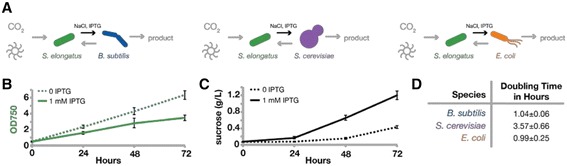
Microbial consortia composed of autotrophic and heterotrophic species abound in nature, yet examples of synthetic communities with mixed metabolism are limited in the laboratory. We previously engineered a model cyanobacterium, PCC 7942, to secrete the bulk of the carbon it fixes as sucrose, a carbohydrate that can be utilized by many other microbes. Here, we tested the capability of sucrose-secreting cyanobacteria to act as a flexible platform for the construction of synthetic, light-driven consortia by pairing them with three disparate heterotrophs: , or . The comparison of these different co-culture dyads reveals general design principles for the construction of robust autotroph/heterotroph consortia.
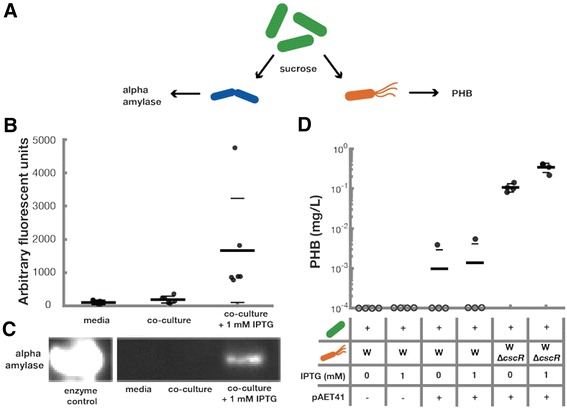
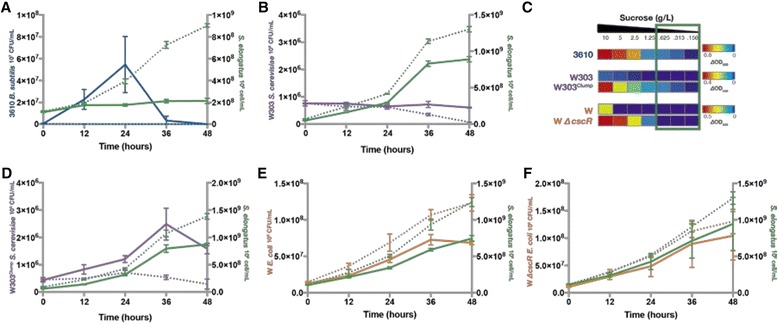
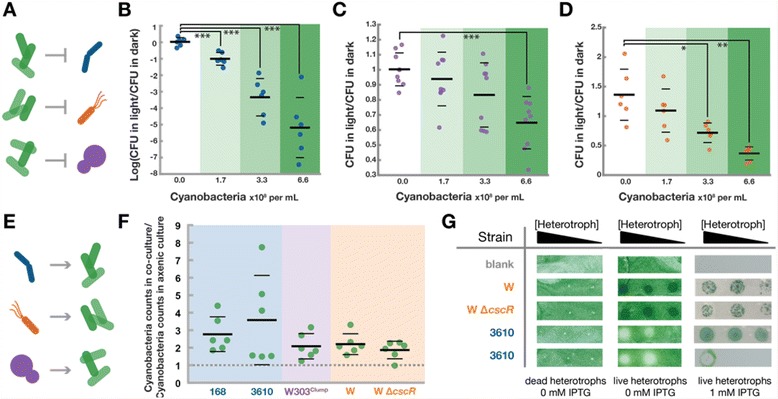
We observed heterotrophic growth dependent upon cyanobacterial photosynthate in each co-culture pair. Furthermore, these synthetic consortia could be stabilized over the long-term (weeks to months) and both species could persist when challenged with specific perturbations. Stability and productivity of autotroph/heterotroph co-cultures was dependent on heterotroph sucrose utilization, as well as other species-independent interactions that we observed across all dyads. One destabilizing interaction we observed was that non-sucrose byproducts of oxygenic photosynthesis negatively impacted heterotroph growth. Conversely, inoculation of each heterotrophic species enhanced cyanobacterial growth in comparison to axenic cultures. Finally, these consortia can be flexibly programmed for photoproduction of target compounds and proteins; by changing the heterotroph in co-culture to specialized strains of or we demonstrate production of alpha-amylase and polyhydroxybutyrate respectively.
Enabled by the unprecedented flexibility of this consortia design, we uncover species-independent design principles that influence cyanobacteria/heterotroph consortia robustness. The modular nature of these communities and their unusual robustness exhibits promise as a platform for highly-versatile photoproduction strategies that capitalize on multi-species interactions and could be utilized as a tool for the study of nascent symbioses. Further consortia improvements via engineered interventions beyond those we show here (i.e., increased efficiency growing on sucrose) could improve these communities as production platforms.
由自养和异养物种组成的微生物群落广泛存在于自然界,但在实验室中,具有混合代谢的合成群落的例子却很有限。我们之前对模式蓝藻集胞藻PCC 7942进行了工程改造,使其将固定的大部分碳以蔗糖的形式分泌出来,蔗糖是一种能被许多其他微生物利用的碳水化合物。在此,我们通过将分泌蔗糖的蓝藻与三种不同的异养生物(大肠杆菌、酿酒酵母或嗜热栖热菌)配对,测试了其作为构建合成光驱动群落的灵活平台的能力。对这些不同共培养二元组的比较揭示了构建强大的自养/异养群落的一般设计原则。
我们观察到在每个共培养对中,异养生物的生长依赖于蓝藻的光合产物。此外,这些合成群落可以长期(数周至数月)保持稳定,并且在受到特定干扰时,两个物种都能持续存在。自养/异养共培养的稳定性和生产力取决于异养生物对蔗糖的利用,以及我们在所有二元组中观察到的其他不依赖物种的相互作用。我们观察到的一种破坏稳定的相互作用是,有氧光合作用的非蔗糖副产物对异养生物的生长产生了负面影响。相反,与无菌培养相比,接种每种异养生物都促进了蓝藻的生长。最后,这些群落可以灵活地进行编程,用于光生产目标化合物和蛋白质;通过将共培养中的异养生物换成大肠杆菌或嗜热栖热菌的特殊菌株,我们分别证明了α-淀粉酶和聚羟基丁酸酯的生产。
由于这种群落设计具有前所未有的灵活性,我们发现了影响蓝藻/异养生物群落稳健性的不依赖物种的设计原则。这些群落的模块化性质及其非凡的稳健性有望成为一个平台,用于高度通用的光生产策略,利用多物种相互作用,并可作为研究新生共生关系的工具。通过超出我们在此展示的工程干预(即提高利用蔗糖生长的效率)进一步改进群落,可能会将这些群落改进为生产平台。