Han Bobby Kwanghoon, Kim Woojin, Niu Jingbo, Basnyat Shristi, Barshay Veniamin, Gaughan John P, Williams Charlene, Kolasinski Sharon L, Felson David T
University of Washington School of Medicine, Seattle.
Perelman School of Medicine at the University of Pennsylvania, Philadelphia.
Arthritis Care Res (Hoboken). 2017 Nov;69(11):1651-1658. doi: 10.1002/acr.23208. Epub 2017 Sep 21.
To evaluate the relationship between chondrocalcinosis and pain or synovitis in knee joints by examining data from the Osteoarthritis Initiative (OAI).
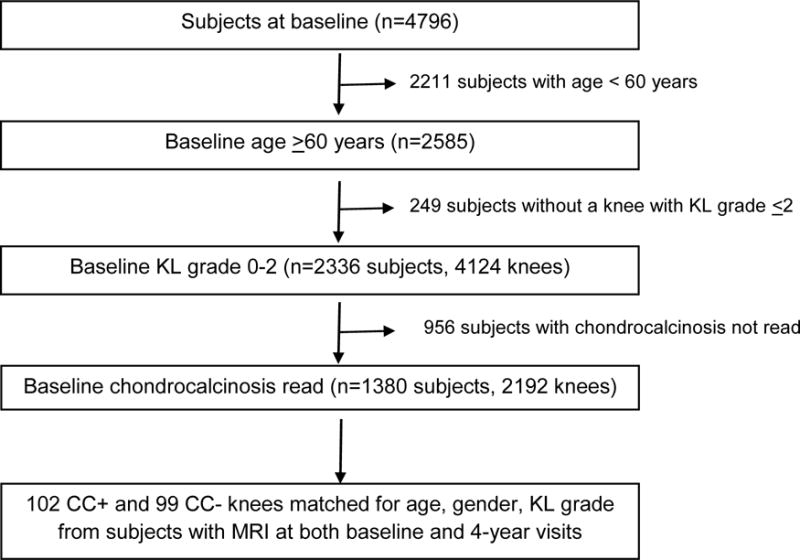
Data were obtained from the OAI public-use data sets. The relationship between chondrocalcinosis on baseline knee radiograph and pain at baseline and at 4 years was examined. Analyses were adjusted for age, sex, body mass index, and Kellgren-Lawrence (K/L) grade and the correlation between 2 knees in a subject was controlled using generalized estimating equations. The relationship between chondrocalcinosis and synovitis on magnetic resonance imaging (MRI) was examined by comparing knees with chondrocalcinosis at baseline and age, sex, and K/L grade-matched knees with no chondrocalcinosis. We read MRIs of a subset of knees for synovitis using the MRI Osteoarthritis Knee Score (MOAKS) on baseline and 4-year MRI.
Knees with chondrocalcinosis (n = 162) more often had pain compared to knees without chondrocalcinosis (n = 2,030) at baseline and had higher Western Ontario and McMaster Universities Osteoarthritis Index pain scores, both at baseline (mean 2.4 [95% confidence interval (95% CI) 1.9, 2.9]) versus mean 1.8 [95% CI 1.7, 1.9]) and at 4 years (mean 2.5 [95% CI 1.9, 3.1] versus mean 1.6 [95% CI 1.5, 1.8]), as well as higher Intermittent and Constant Osteoarthritis Pain intermittent pain scores at 4 years. There was no difference in MOAKS synovitis scores at baseline and at 4 years between the chondrocalcinosis group (n = 102) and the control group (n = 99).
Knees with chondrocalcinosis had increased pain and did not have higher synovitis scores on MRI compared to knees without chondrocalcinosis. The mechanisms by which chondrocalcinosis is associated with increased pain remain to be determined.
通过分析骨关节炎倡议(OAI)的数据,评估膝关节软骨钙质沉着症与疼痛或滑膜炎之间的关系。
数据取自OAI公共数据集。研究了基线膝关节X线片上的软骨钙质沉着症与基线及4年时疼痛之间的关系。分析对年龄、性别、体重指数和凯尔格伦-劳伦斯(K/L)分级进行了校正,并使用广义估计方程控制了受试者双膝之间的相关性。通过比较基线时存在软骨钙质沉着症的膝关节与年龄、性别和K/L分级相匹配的无软骨钙质沉着症的膝关节,研究了磁共振成像(MRI)上软骨钙质沉着症与滑膜炎之间的关系。我们使用MRI骨关节炎膝关节评分(MOAKS)对一部分膝关节的MRI进行基线和4年MRI时滑膜炎的判读。
与无软骨钙质沉着症的膝关节(n = 2,030)相比,有软骨钙质沉着症的膝关节(n = 162)在基线时更常出现疼痛,且西部安大略和麦克马斯特大学骨关节炎指数疼痛评分更高,在基线时(平均2.4 [95%置信区间(95%CI)1.9, 2.9])对比平均1.8 [95%CI 1.7, 1.9])以及4年时(平均2.5 [95%CI 1.9, 3.1])对比平均1.6 [95%CI 1.5, 1.8]),4年时间歇性和持续性骨关节炎疼痛的间歇性疼痛评分也更高。软骨钙质沉着症组(n = 102)和对照组(n = 99)在基线和4年时的MOAKS滑膜炎评分没有差异。
与无软骨钙质沉着症的膝关节相比,有软骨钙质沉着症的膝关节疼痛增加,且MRI上滑膜炎评分没有更高。软骨钙质沉着症与疼痛增加相关的机制仍有待确定。