Al Asmari Abdulrahman K, Al Sadoon Khalid Tariq, Obaid Ali Ahmed, Yesunayagam Deivakadatcham, Tariq Mohammad
Scientific Research Centre, Prince Sultan Military Medical City, Riyadh, Saudi Arabia.
Department of Urology, Prince Sultan Military Medical City, Riyadh, Saudi Arabia.
BMC Nephrol. 2017 Jan 28;18(1):41. doi: 10.1186/s12882-017-0450-8.
Acute kidney injury (AKI) is a serious clinical problem with high rate of mortality and morbidity. Currently used prophylactic and therapeutic strategies to address AKI are limited and warrant further studies. In the present study an attempt was made to investigate the effect of quinacrine, a phospholipase A2 inhibitor against glycerol induced AKI in rats.
Adult female Wistar rats were divided in to five groups. After 24 h of water deprivation rats in groups 3, 4 and 5 received an intraperitoneal injection of quinacrine (3 mg/kg, 10 mg/kg and 30 mg/kg of body weight respectively). Thirty minutes after the first injection of quinacrine animals in groups 3, 4 and 5 received an intramuscular injection of 25% glycerol (10 ml/kg of body weight). The animals in group 2 received 25% glycerol (10 ml/kg of body weight) only whereas rats in group 1 served as control . The quinacrine administration was continued once daily for three days, on the fourth day animals were sacrificed, blood and kidney were collected for various biochemical and histopathological studies.
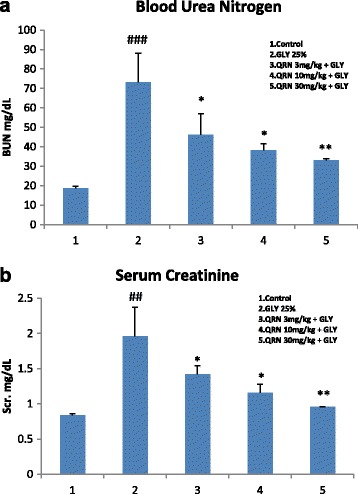
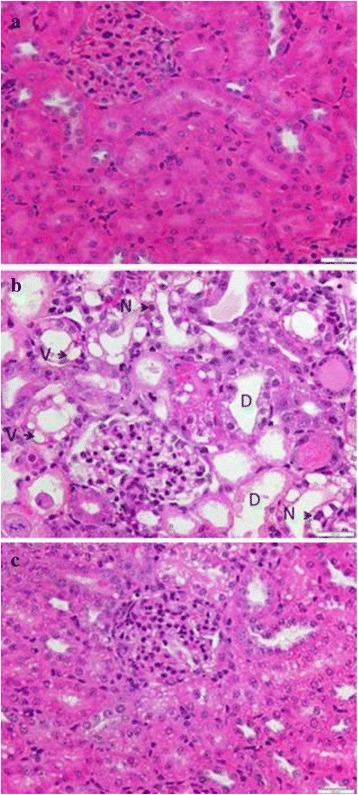
Glycerol treatment produced significant renal structural abnormalities and functional impairment (increased urea and creatinine). Increase in myeloperoxidase (MPO) and malondialdehyde (MDA) clearly suggested the involvement of oxidative stress and neutrophilic activity following glycerol administration. Quinacrine dose dependently attenuated glycerol induced structural and functional changes in kidney.
The reversal of glycerol induced AKI by quinacrine points towards a role of phospholipase A2 (PLA2) in the pathogenesis of renal injury. The result of this study suggests that quinacrine may offer an alternative mode of treatment for AKI.
急性肾损伤(AKI)是一个严重的临床问题,死亡率和发病率都很高。目前用于预防和治疗AKI的策略有限,需要进一步研究。在本研究中,我们试图研究磷酸氯喹(一种磷脂酶A2抑制剂)对甘油诱导的大鼠急性肾损伤的影响。
成年雌性Wistar大鼠分为五组。在禁水24小时后,第3、4和5组的大鼠分别接受腹腔注射磷酸氯喹(分别为3毫克/千克、10毫克/千克和30毫克/千克体重)。在首次注射磷酸氯喹30分钟后,第3、4和5组的动物接受肌肉注射25%甘油(10毫升/千克体重)。第2组的动物仅接受25%甘油(10毫升/千克体重),而第1组的大鼠作为对照。磷酸氯喹每天给药一次,持续三天,第四天处死动物,收集血液和肾脏进行各种生化和组织病理学研究。
甘油处理导致明显的肾脏结构异常和功能损害(尿素和肌酐增加)。髓过氧化物酶(MPO)和丙二醛(MDA)的增加清楚地表明甘油给药后氧化应激和中性粒细胞活性的参与。磷酸氯喹剂量依赖性地减轻了甘油诱导的肾脏结构和功能变化。
磷酸氯喹对甘油诱导的急性肾损伤的逆转表明磷脂酶A2(PLA2)在肾损伤发病机制中的作用。本研究结果表明,磷酸氯喹可能为急性肾损伤提供一种替代治疗模式。