van Kesteren F, Wiegerinck E M A, Rizzo S, Baan J, Planken R N, von der Thüsen J H, Niessen H W M, van Oosterhout M F M, Pucci A, Thiene G, Basso C, Sheppard M N, Wassilew K, van der Wal A C
Heart Centre, Academic Medical Centre, Amsterdam, The Netherlands.
Department of Radiology, Academic Medical Centre, Amsterdam, The Netherlands.
Virchows Arch. 2017 Mar;470(3):331-339. doi: 10.1007/s00428-017-2076-4. Epub 2017 Jan 27.
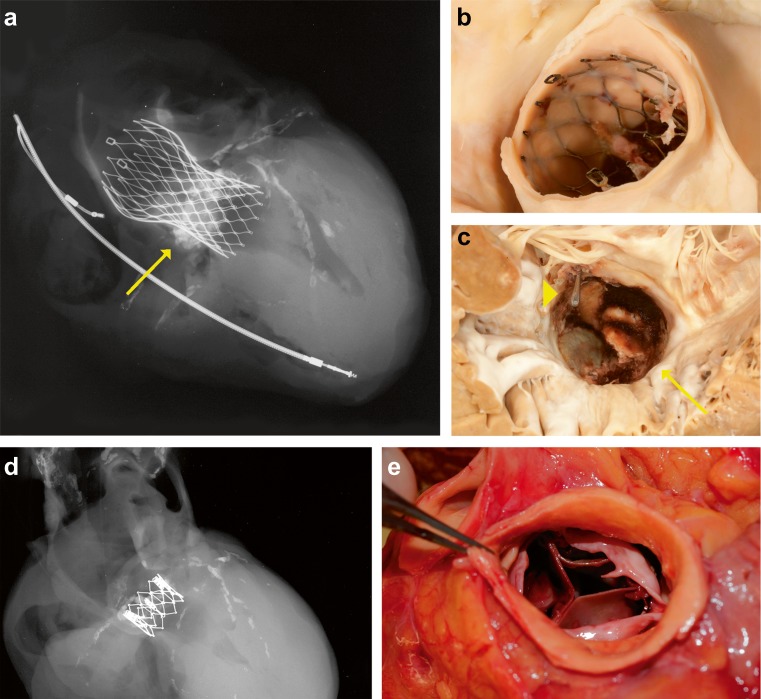
Autopsy after transcatheter aortic valve implantation (TAVI) is a new field of interest in cardiovascular pathology. To identify the cause of death, it is important to be familiar with specific findings related to the time interval between the procedure and death. We aimed to provide an overview of the autopsy findings in patients with TAVI in their medical history divided by the timing of death with specific interest in the added value of autopsy over a solely clinically determined cause of death. In 8 European centres, 72 cases with autopsy reports were available. Autopsies were divided according to the time interval of death and reports were analysed. In 32 patients who died ≤72 h postprocedure, mortality resulted from cardiogenic or haemorrhagic shock in 62.5 and 34.4%, respectively. In 31 patients with mortality >72 h to ≤30 days, cardiogenic shock was the cause of death in 51.6% followed by sepsis (22.6%) and respiratory failure (9.7%). Of the nine patients with death >30 days, 88.9% died of sepsis, caused by infective endocarditis in half of them. At total of 12 patients revealed cerebrovascular complications. Autopsy revealed unexpected findings in 61.1% and resulted in a partly or completely different cause of death as was clinically determined. Autopsy on patients who underwent TAVI reveals specific patterns of cardiovascular pathology that clearly relate to the time interval between TAVI and death and significantly adds to the clinical diagnosis. Our data support the role of autopsy including investigation of the cerebrum in the quickly evolving era of cardiac device technology.
经导管主动脉瓣植入术(TAVI)后的尸检是心血管病理学中一个新的研究领域。为了确定死亡原因,熟悉与手术和死亡时间间隔相关的特定发现很重要。我们旨在概述有TAVI病史患者的尸检结果,按死亡时间进行划分,并特别关注尸检相对于仅通过临床确定的死亡原因所具有的附加价值。在8个欧洲中心,有72例有尸检报告。尸检根据死亡时间间隔进行划分,并对报告进行分析。在术后≤72小时死亡的32例患者中,心源性休克和出血性休克导致死亡的比例分别为62.5%和34.4%。在术后72小时以上至≤30天死亡的31例患者中,心源性休克导致死亡的比例为51.6%,其次是脓毒症(22.6%)和呼吸衰竭(9.7%)。在9例术后30天以上死亡的患者中,88.9%死于脓毒症,其中一半由感染性心内膜炎引起。共有12例患者出现脑血管并发症。尸检发现61.1%的病例有意外发现,导致部分或完全不同于临床确定的死亡原因。对接受TAVI的患者进行尸检可揭示心血管病理学的特定模式,这些模式与TAVI和死亡之间的时间间隔明显相关,并显著补充了临床诊断。我们的数据支持在心脏设备技术快速发展的时代,尸检包括对大脑进行检查的作用。