Mansur Nacime Salomão Barbachan, Faloppa Flávio, Belloti João Carlos, Ingham Sheila J McNeill, Matsunaga Fabio Teruo, Santos Paulo Roberto Dias Dos, Santos Bruno Schiefer Dos, Carrazzone Oreste Lemos, Peixoto Gabriel, Aoyama Bruno Takeshi, Tamaoki Marcel Jun Sugawara
Department of Orthopaedics, Universidade Federal de Sao Paulo, Sao Paulo, SP, Brazil.
Orthopedics and Traumatology-Division of Hand Surgery and Upper Limb, Federal University of São Paulo (UNIFESP/EPM), São Paulo, SP, Brazil.
BMJ Open. 2017 Jan 27;7(1):e013332. doi: 10.1136/bmjopen-2016-013332.
There is no consensus regarding the treatment of Achilles insertional tendinopathies. Eccentric training remains the main choice in the conservative treatment of this illness; however, the good results in the management of non-insertional Achilles tendinopathy were not replicated in the insertional condition. Low energy shock wave therapy has been described as an alternative to these patients, but has yet to be empirically tested.
Shock wave therapy, adjunctive to the eccentric strengthening protocol, will improve measures of pain and function.
Double blind, placebo-controlled, parallel groups, randomised clinical trial.
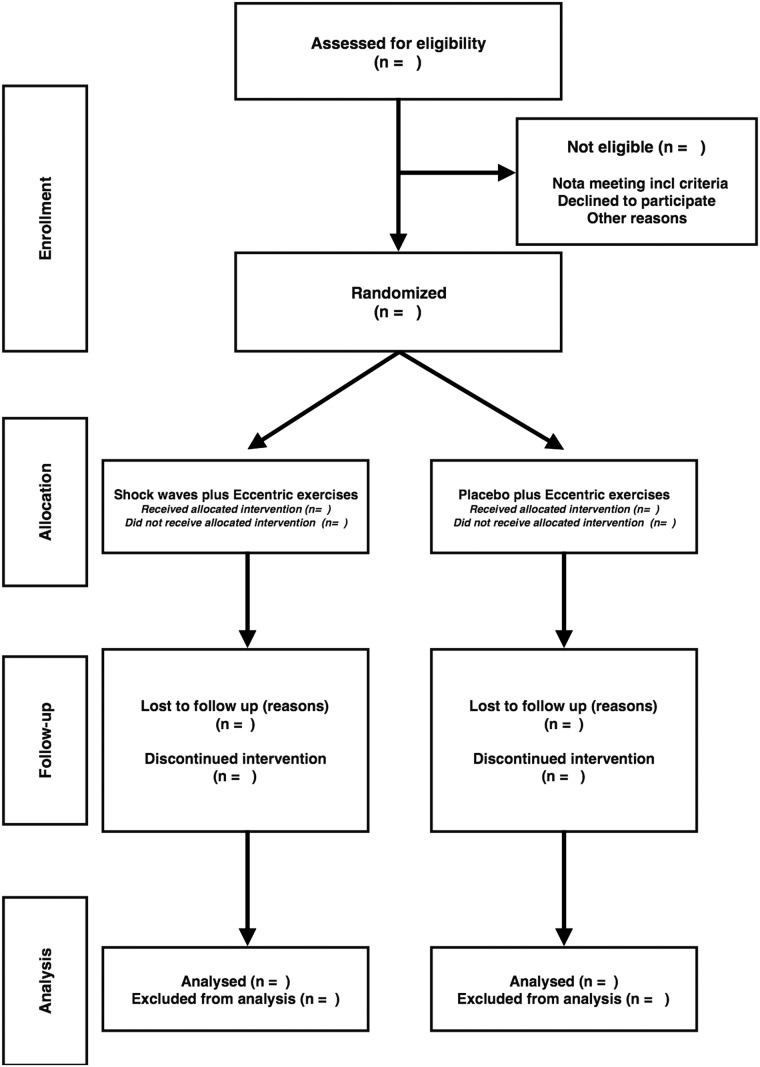
93 patients with a diagnosis of chronic insertional tendinopathy, referred from primary or secondary healthcare services, will be assessed and enrolled in this study. They will be divided into two groups (randomised by sequentially numbered identical envelopes, which will be administered serially to participants), one containing the combination of low energy shock wave and eccentric exercises, as treatment and the other comprehending the exercises and the placebo treatment (an apparatus placed in the therapeutic head). The assessments will occur in 2, 4, 6, 12 and 24 weeks. Patients will be evaluated primarily by the Victorian Institute of Sport Assessment-Achilles questionnaire and secondarily by the visual analogue scale, Algometry, the American Orthopedic Foot and Ankle Society scale, the Foot and Ankle Outcome Score and the 12-item Short Form Health Survey. We will use comparison of two proportions via relative frequency analysis, the Pearson Correlation the χ test and the analysis of variance for statistical analyses.
This study intends to demonstrate if the association of the eccentric exercise programme with the shock wave therapy can produce good results regarding the treatment of the Achilles insertional tendinopathy. In an attempt to prevent the high costs and complications associated with the surgical intervention, we will try to prove this combination as a viable therapeutic option in the conservative management of this prevalent condition. The strengths of the study are the design and the novelty of the combination of methods. The main limitation is the short follow-up course.
The study is registered in the Clinical Trials database (protocol number: 8094833648737701) and was approved by the University Ethics Committee (number: 1373481).
8094833648737701 (NCT02757664); Pre-results.
关于跟腱止点性肌腱病的治疗尚无共识。离心训练仍然是这种疾病保守治疗的主要选择;然而,非止点性跟腱病治疗中的良好效果在止点性情况下并未得到重现。低能量冲击波疗法已被描述为这些患者的一种替代方法,但尚未经过实证检验。
冲击波疗法辅助离心强化方案将改善疼痛和功能指标。
双盲、安慰剂对照、平行组随机临床试验。
93名诊断为慢性止点性肌腱病的患者,由初级或二级医疗服务机构转诊而来,将接受评估并纳入本研究。他们将被分为两组(通过按顺序编号的相同信封随机分组,信封将依次分发给参与者),一组接受低能量冲击波与离心运动的联合治疗,另一组接受运动和安慰剂治疗(置于治疗头上的一种装置)。评估将在2周、4周、6周、12周和24周进行。患者将主要通过维多利亚运动评估-跟腱问卷进行评估,其次通过视觉模拟量表、压痛计、美国矫形足踝协会量表、足踝结果评分和12项简短健康调查问卷进行评估。我们将通过相对频率分析、皮尔逊相关性χ检验和方差分析进行两个比例的比较以进行统计分析。
本研究旨在证明离心运动方案与冲击波疗法的联合应用在跟腱止点性肌腱病治疗中是否能产生良好效果。为了避免与手术干预相关的高成本和并发症,我们将试图证明这种联合治疗是这种常见疾病保守治疗中的一种可行治疗选择。本研究的优势在于设计和方法组合的新颖性。主要局限性是随访时间短。
本研究已在临床试验数据库注册(方案编号:8094833648737701),并获得大学伦理委员会批准(编号:1373481)。
8094833648737701(NCT02757664);预结果。