Hamasima N, Takahashi T, Taguchi O, Nishizuka Y, Stockert E, Old L J, Obata Y
Aichi Cancer Center Research Institute, Nagoya, Japan.
Proc Natl Acad Sci U S A. 1989 Oct;86(20):7995-9. doi: 10.1073/pnas.86.20.7995.
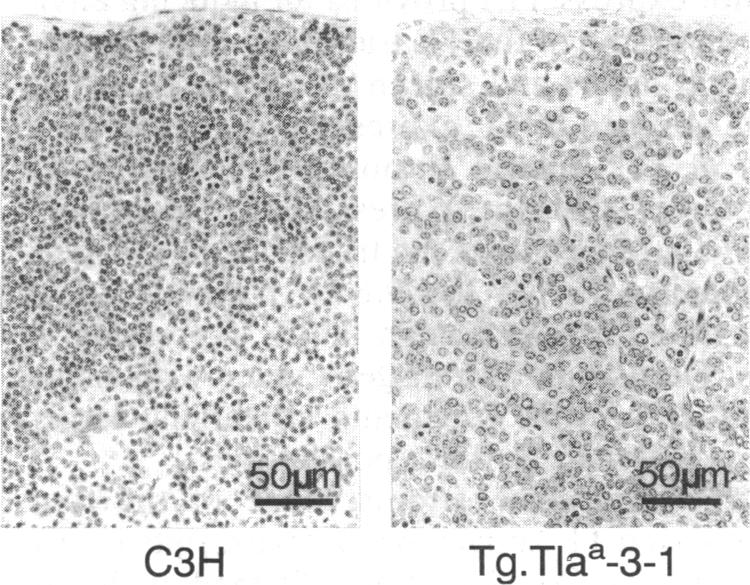
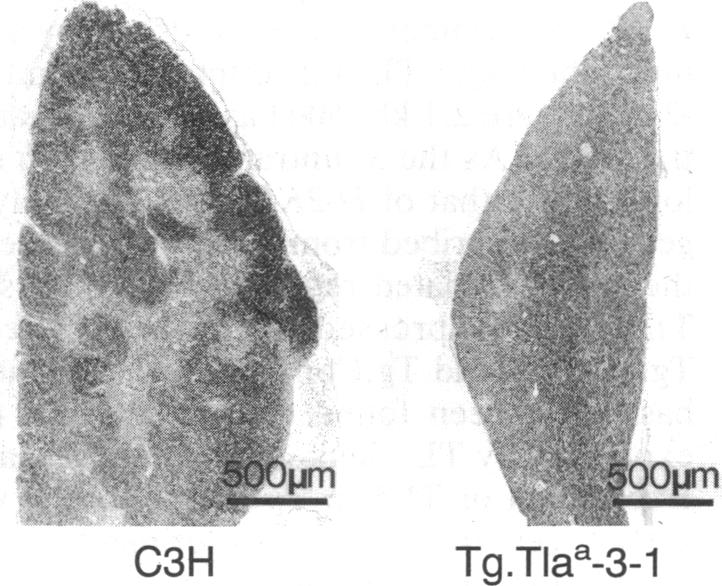
To investigate the genetic regulation of TL expression, 12 transgenic mouse strains on a C3H (TL-nonexpressing) background have been derived: two Tg.Tlaa-3 strains with Tlaa-3 isolated from A-strain TL+ thymocytes, four Tg.T3b strains with T3b from a TL+ leukemia arising in a C57BL/6 (TL-) mouse, three Tg.Con.3 strains with an H-2Kb/T3b chimeric gene (construct 3,5'flanking region and exon 1 of H-2Kb and exons 2-6 of T3b), one Tg.Con.4 strain with a T3b/H-2Kb chimeric gene (construct 4, 5' flanking region and exon 1 of T3b and exons 2-8 of H-2Kb), and two Tg.H-2Kb strains with H-2Kb. Expression of the transgenes was determined by the presence of TL or H-2Kb products or transcripts. Both Tg.Tlaa-3 strains expressed high levels of TL antigen in thymus, indicating that (i) the 9.6-kilobase Tlaa-3 DNA fragment contains sufficient information for correct tissue-specific expression in thymocytes and (ii) TL- thymocytes of C3H provide conditions for the transcriptional activation of Tlaa-3. In contrast, neither the four Tg.T3b strains nor the Tg.Con.4 strain expressed transgenes, indicating that (i) T3b lacks elements necessary for TL expression in normal thymocytes and (ii) the corresponding endogenous TL genes of C3H mice also lack these elements. The pattern of TL expression in two of the three Tg.Con.3 strains was similar to that of H-2Kb expression, indicating that transcription of this H-2Kb/T3b chimeric gene was driven by the regulatory sequences of H-2Kb. The thymuses of mice derived from the Tg.Tlaa-3-1 strain were smaller than C3H thymuses, and the surface phenotype of Tg.Tlaa-3-1 thymocytes resembled thymocyte precursors (TL+L3T4-Lyt-2-Thy-1+H-2+). These mice developed a high incidence of lymphomas with the same thymocyte precursor phenotype. The study of TL transgenic strains should prove useful in defining the role of TL in normal and abnormal T-cell differentiation.
为了研究TL表达的遗传调控,已培育出12种以C3H(不表达TL)为背景的转基因小鼠品系:两种Tg.Tlaa - 3品系,其Tlaa - 3是从A系TL + 胸腺细胞中分离得到;四种Tg.T3b品系,其T3b来自于C57BL/6(TL - )小鼠中产生的TL + 白血病细胞;三种Tg.Con.3品系,带有H - 2Kb/T3b嵌合基因(构建体3,H - 2Kb的5'侧翼区和外显子1以及T3b的外显子2 - 6);一种Tg.Con.4品系,带有T3b/H - 2Kb嵌合基因(构建体4,T3b的5'侧翼区和外显子1以及H - 2Kb的外显子2 - 8);以及两种Tg.H - 2Kb品系,带有H - 2Kb。通过TL或H - 2Kb产物或转录本的存在来确定转基因的表达。两种Tg.Tlaa - 3品系在胸腺中均高水平表达TL抗原,这表明:(i)9.6千碱基的Tlaa - 3 DNA片段包含在胸腺细胞中进行正确组织特异性表达的足够信息;(ii)C3H的TL - 胸腺细胞为Tlaa - 3的转录激活提供了条件。相反,四种Tg.T3b品系和Tg.Con.4品系均未表达转基因,这表明:(i)T3b缺乏在正常胸腺细胞中表达TL所需的元件;(ii)C3H小鼠相应的内源性TL基因也缺乏这些元件。三个Tg.Con.3品系中的两个品系的TL表达模式与H - 2Kb表达模式相似,这表明该H -