Cardiology Service, Alicante University General Hospital, Alicante Institute for Health and Biomedical Research (ISABIAL - FISABIO Foundation), Alicante, Spain.
Department of Hematology and Clinical Oncology, Morales Meseguer University Hospital, University of Murcia, Biohealth Research Institute Virgen de la Arrixaca, IMIB-Arrixaca, Murcia, Spain.
Sci Rep. 2017 Jan 30;7:41565. doi: 10.1038/srep41565.
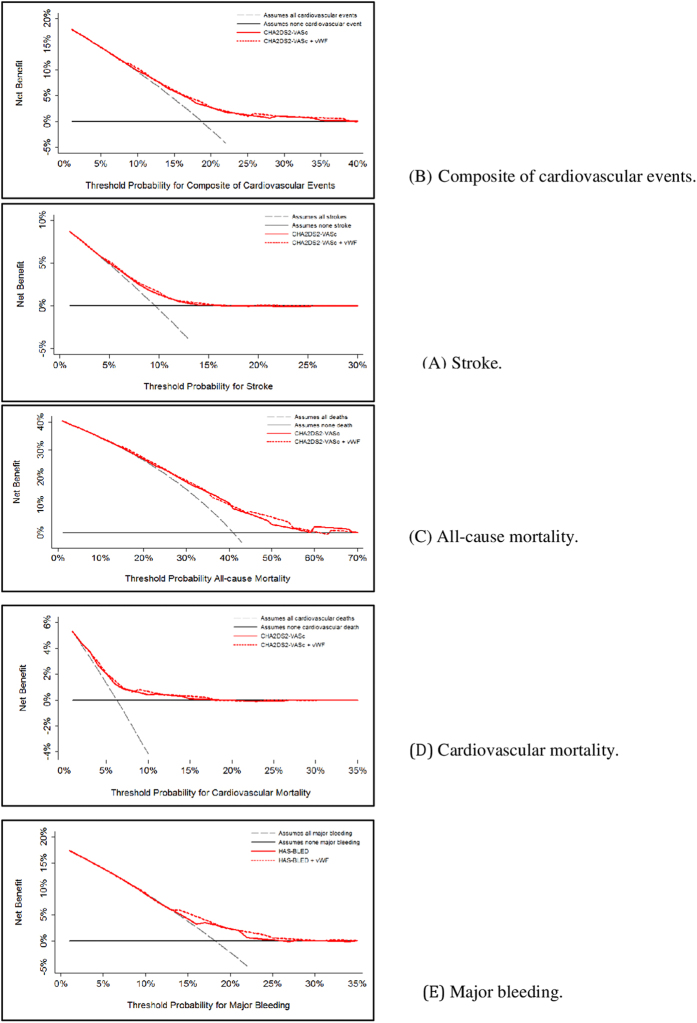
Von Willebrand factor (vWF) is a biomarker of endothelial dysfunction. We investigated its role on prognosis in anticoagulated atrial fibrillation (AF) patients and determined whether its addition to clinical risk stratification schemes improved event-risk prediction. Consecutive outpatients with non-valvular AF were recruited and rates of thrombotic/cardiovascular events, major bleeding and mortality were recorded. The effect of vWF on prognosis was calculated using a Cox regression model. Improvements in predictive accuracy over current scores were determined by calculating the integrated discrimination improvement (IDI), net reclassification improvement (NRI), comparison of receiver-operator characteristic (ROC) curves and Decision Curve Analysis (DCA). 1215 patients (49% males, age 76 (71-81) years) were included. Follow-up was almost 7 years. Significant associations were found between vWF and cardiovascular events, stroke, mortality and bleeding. Based on IDI and NRI, addition of vWF to CHADS-VASc statistically improved its predictive value, but c-indexes were not significantly different. For major bleeding, the addition of vWF to HAS-BLED improved the c-index but not IDI or NRI. DCA showed minimal net benefit. vWF acts as a simple prognostic biomarker in AF and, whilst its addition to current scores statistically improves prediction for some endpoints, absolute changes and impact on clinical decision-making are marginal.
血管性血友病因子 (vWF) 是血管内皮功能障碍的生物标志物。我们研究了其在抗凝治疗的心房颤动 (AF) 患者中的预后作用,并确定其是否可用于改善临床风险分层方案的事件风险预测。连续招募了非瓣膜性 AF 的门诊患者,并记录了血栓形成/心血管事件、大出血和死亡率的发生率。使用 Cox 回归模型计算 vWF 对预后的影响。通过计算综合判别改善 (IDI)、净重新分类改善 (NRI)、比较接收者操作特征 (ROC) 曲线和决策曲线分析 (DCA),确定了当前评分的预测准确性的提高。共纳入 1215 例患者(49%为男性,年龄 76(71-81)岁)。随访时间近 7 年。vWF 与心血管事件、中风、死亡率和出血之间存在显著相关性。基于 IDI 和 NRI,vWF 与 CHADS-VASc 的联合使用从统计学上提高了其预测价值,但 c 指数没有显著差异。对于大出血,将 vWF 添加到 HAS-BLED 可提高 c 指数,但不会提高 IDI 或 NRI。DCA 显示净获益最小。vWF 在 AF 中作为一种简单的预后生物标志物,尽管其在某些终点的当前评分中的添加从统计学上改善了预测,但绝对变化和对临床决策的影响是微不足道的。