Department of Electrocardiology, The John Paul II Hospital, Kraków, Poland.
Institute of Cardiology, Jagiellonian University Medical College, 80 Prądnicka Street, 31-202, Kraków, Poland.
Clin Res Cardiol. 2020 Apr;109(4):426-434. doi: 10.1007/s00392-019-01522-x. Epub 2019 Jul 6.
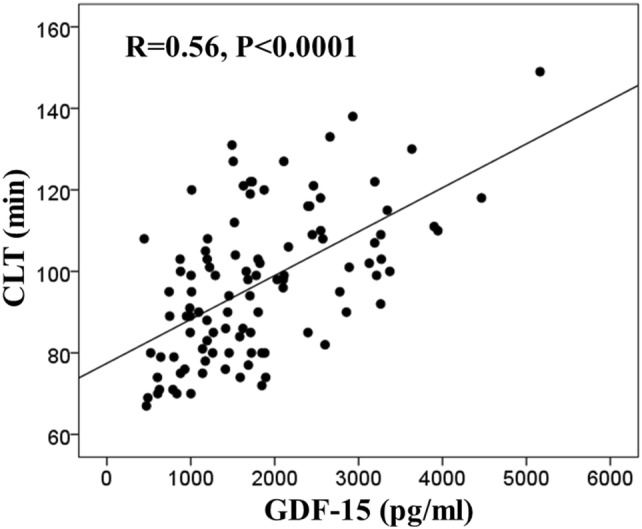
We investigated whether growth differentiation factor-15 (GDF-15), also known as macrophage inhibitory cytokine-1 (MIC-1), levels are associated with a prothrombotic state in atrial fibrillation (AF) as compared to N-terminal pro-B-type natriuretic peptide (NT-proBNP) and high-sensitivity cardiac troponin I (cTnI-hs). In 103 patients with AF assessed off anticoagulation (age: 71.0 [65.0-76.0] years; CHADS-VASc score: 4.6 ± 1.7), we measured endogenous thrombin potential (ETP), plasma fibrin clot permeability (K, a measure of clot density) and clot lysis time (CLT) and other hemostatic parameters, along with GDF-15, NT-proBNP, and cTnI-hs. GDF-15 positively correlated with ETP and CLT (r = 0.25, P = 0.01 and R = 0.56, P < 0.0001, respectively) but not with K, von Willebrand factor, thrombin-activatable fibrinolysis inhibitor, plasminogen, antiplasmin or tissue-type plasminogen activator antigen. NT-proBNP showed a stronger association with ETP (r = 0.60, P < 0.0001) and a similar correlation with CLT (R = 0.53, P < 0.0001), while cTnI-hs correlated solely with CLT (R = 0.25, P = 0.01). After adjustment for clinical and laboratory parameters, GDF-15 was a better independent predictor of CLT (unstandardized coefficient B 0.009; 95% confidence interval [CI] 0.006-0.012) than NT-proBNP (B 0.007; 95% CI 0.004-0.010, R (2) = 0.51; P < 0.0001); while among the three biomarkers, only NT-proBNP was an independent predictor of ETP. Elevated GDF-15 and NT-proBNP independently predict impaired fibrin clot lysability, while NT-proBNP is a key predictor of heightened thrombin formation in AF. Our findings suggest that a predictive value of NT-proBNP and GDF-15 in AF could be in part attributed to their association with prothrombotic blood alterations.
我们研究了生长分化因子-15(GDF-15),也称为巨噬细胞抑制因子-1(MIC-1),在心房颤动(AF)患者中与 N 端脑钠肽前体(NT-proBNP)和高敏心肌肌钙蛋白 I(cTnI-hs)相比,其水平是否与促血栓状态相关。在 103 例接受抗凝治疗的 AF 患者(年龄:71.0[65.0-76.0]岁;CHA2DS2-VASc 评分:4.6±1.7)中,我们测量了内源性凝血酶潜力(ETP)、血浆纤维蛋白凝块通透性(K,反映凝块密度的指标)和凝块溶解时间(CLT)以及其他止血参数,同时还测量了 GDF-15、NT-proBNP 和 cTnI-hs。GDF-15 与 ETP 和 CLT 呈正相关(r=0.25,P=0.01 和 r=0.56,P<0.0001),但与 K、血管性血友病因子、凝血酶激活的纤溶抑制物、纤溶酶原、抗纤溶酶或组织型纤溶酶原激活物抗原无关。NT-proBNP 与 ETP 相关性更强(r=0.60,P<0.0001),与 CLT 相关性相似(r=0.53,P<0.0001),而 cTnI-hs 仅与 CLT 相关(r=0.25,P=0.01)。在调整临床和实验室参数后,GDF-15 是 CLT 的更好独立预测因子(未标准化系数 B 0.009;95%置信区间 [CI] 0.006-0.012),优于 NT-proBNP(B 0.007;95%CI 0.004-0.010,R2=0.51;P<0.0001);而在这三种生物标志物中,只有 NT-proBNP 是 ETP 的独立预测因子。升高的 GDF-15 和 NT-proBNP 独立预测纤维蛋白凝块溶解能力受损,而 NT-proBNP 是 AF 中凝血酶形成增加的关键预测因子。我们的研究结果表明,NT-proBNP 和 GDF-15 在 AF 中的预测价值部分归因于它们与促血栓血液改变的关联。