Goryachev Andrew B, Leda Marcin
Center for Synthetic and Systems Biology, School of Biological Sciences, University of Edinburgh, Edinburgh EH9 3BF, United Kingdom
Center for Synthetic and Systems Biology, School of Biological Sciences, University of Edinburgh, Edinburgh EH9 3BF, United Kingdom.
Mol Biol Cell. 2017 Feb 1;28(3):370-380. doi: 10.1091/mbc.E16-10-0739.
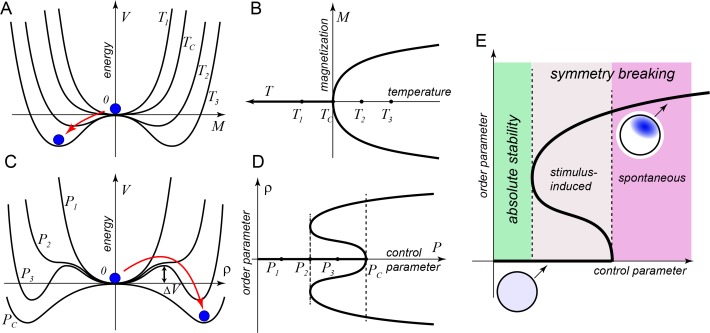
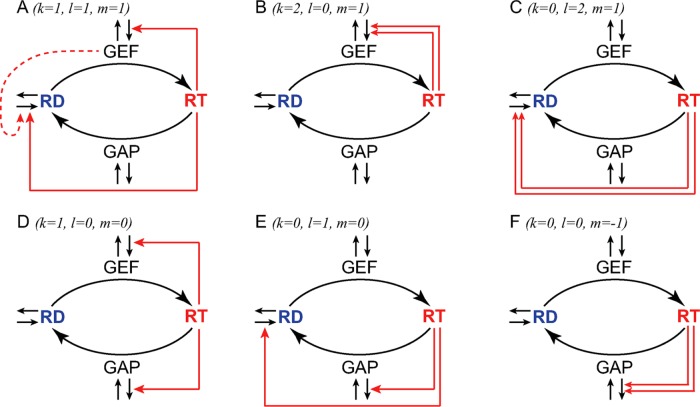
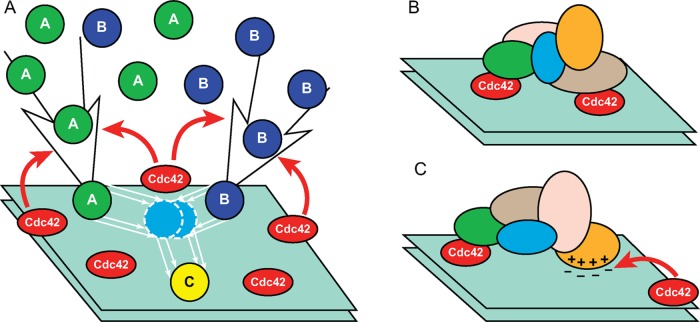
Mathematical modeling has been instrumental in identifying common principles of cell polarity across diverse systems. These principles include positive feedback loops that are required to destabilize a spatially uniform state of the cell. The conserved small G-protein Cdc42 is a master regulator of eukaryotic cellular polarization. Here we discuss recent developments in studies of Cdc42 polarization in budding and fission yeasts and demonstrate that models describing symmetry-breaking polarization can be classified into six minimal classes based on the structure of positive feedback loops that activate and localize Cdc42. Owing to their generic system-independent nature, these model classes are also likely to be relevant for the G-protein-based symmetry-breaking systems of higher eukaryotes. We review experimental evidence pro et contra different theoretically plausible models and conclude that several parallel and non-mutually exclusive mechanisms are likely involved in cellular polarization of yeasts. This potential redundancy needs to be taken into consideration when interpreting the results of recent cell-rewiring studies.
数学建模在识别不同系统中细胞极性的共同原理方面发挥了重要作用。这些原理包括破坏细胞空间均匀状态所需的正反馈回路。保守的小G蛋白Cdc42是真核细胞极化的主要调节因子。在这里,我们讨论了芽殖酵母和裂殖酵母中Cdc42极化研究的最新进展,并证明基于激活和定位Cdc42的正反馈回路结构,描述对称性破缺极化的模型可分为六个最小类别。由于其通用的系统无关性质,这些模型类别也可能与高等真核生物基于G蛋白的对称性破缺系统相关。我们回顾了支持和反对不同理论上合理模型的实验证据,并得出结论,酵母细胞极化可能涉及几种并行且非相互排斥的机制。在解释最近细胞重连研究的结果时,需要考虑这种潜在的冗余性。