Su Chun-Wen, Su Bo-Feng, Chiang Whei-Ling, Yang Shun-Fa, Chen Mu-Kuan, Lin Chiao-Wen
Institute of Medicine, Chung Shan Medical University, Taichung, Taiwan.
Department of Orthopedics, Changhua Christian Hospital, Changhua, Taiwan.
Int J Med Sci. 2017 Jan 1;14(1):37-44. doi: 10.7150/ijms.17024. eCollection 2017.
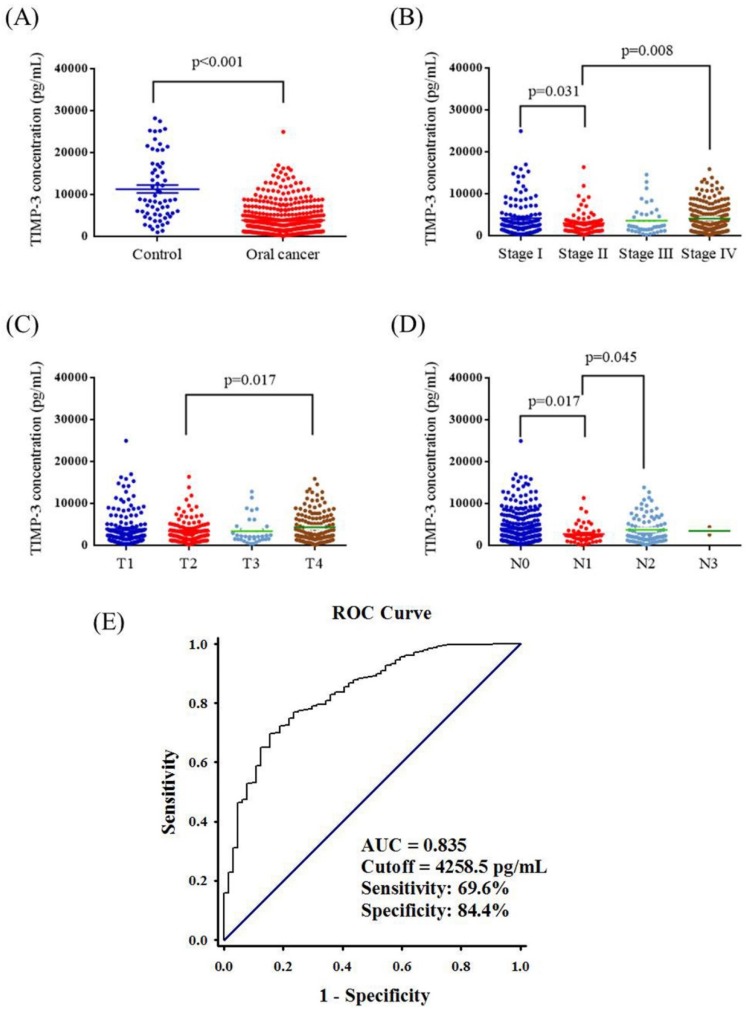
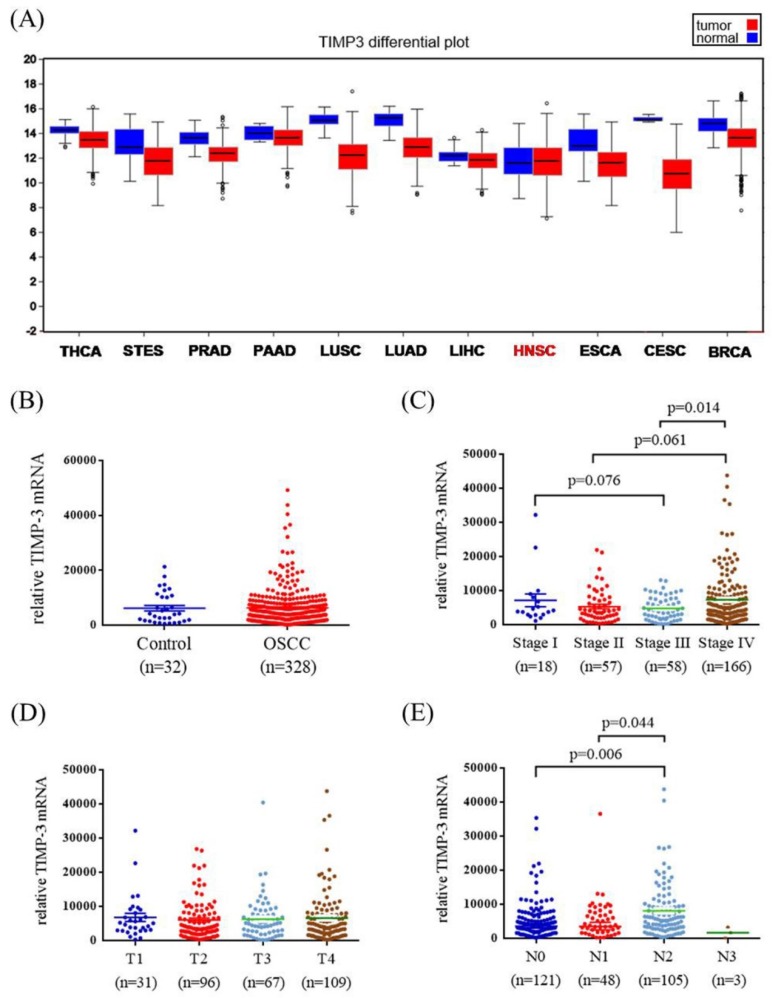
Oral cancer is the most common malignancy with poor prognosis and is the fourth most common cancer in men in Taiwan. The tissue inhibitor of metalloproteinase-3 (TIMP3) acts as a tumor suppressor gene by inhibiting the growth, angiogenesis, migration, and invasion of cancer cells. However, few studies have examined the association of plasma TIMP3 levels with oral squamous cell carcinoma (OSCC), and the role of plasma TIMP3 levels in OSCC progression is still unclear. We measured the plasma TIMP3 levels of 450 OSCC patients and 64 healthy controls by using a commercial enzyme-linked immunosorbent assay. We also analyzed TIMP3 mRNA levels of 328 OSCC patients and 32 normal tissues from The Cancer Genome Atlas (TCGA) dataset. Our results revealed that plasma TIMP3 levels were significantly lower in patients with OSCC than in healthy controls (p < 0.001). Moreover, plasma TIMP3 levels in patients with OSCC were significantly associated with the tumor stage and tumor status but not with the lymph node status, metastasis, and cell differentiation. To verify our findings, we also examined TCGA bioinformatics database and discovered similar results for the association with the pathological stage of OSCC. In conclusion, our results suggest that plasma TIMP3 is a potential biomarker for predicting the tumor stage and T status in patients with OSCC.
口腔癌是预后较差的最常见恶性肿瘤,在台湾是男性中第四大常见癌症。金属蛋白酶组织抑制剂-3(TIMP3)通过抑制癌细胞的生长、血管生成、迁移和侵袭发挥肿瘤抑制基因的作用。然而,很少有研究探讨血浆TIMP3水平与口腔鳞状细胞癌(OSCC)的关联,血浆TIMP3水平在OSCC进展中的作用仍不清楚。我们使用商用酶联免疫吸附测定法测量了450例OSCC患者和64例健康对照者的血浆TIMP3水平。我们还分析了来自癌症基因组图谱(TCGA)数据集的328例OSCC患者和32个正常组织的TIMP3 mRNA水平。我们的结果显示,OSCC患者的血浆TIMP3水平显著低于健康对照者(p < 0.001)。此外,OSCC患者的血浆TIMP3水平与肿瘤分期和肿瘤状态显著相关,但与淋巴结状态、转移和细胞分化无关。为了验证我们的发现,我们还检查了TCGA生物信息学数据库,并发现了与OSCC病理分期相关的类似结果。总之,我们的结果表明,血浆TIMP3是预测OSCC患者肿瘤分期和T状态的潜在生物标志物。