Beijing National Laboratory for Molecular Sciences, State Key Laboratory for Structural Chemistry of Unstable and Stable Species, College of Chemistry and Molecular Engineering, Peking University, Beijing 100871, China.
Institute for Molecular Design and Synthesis, School of Pharmaceutical Science and Technology, Tianjin University, Tianjin 300072, China.
Sci Adv. 2016 Nov 25;2(11):e1601113. doi: 10.1126/sciadv.1601113. eCollection 2016 Nov.
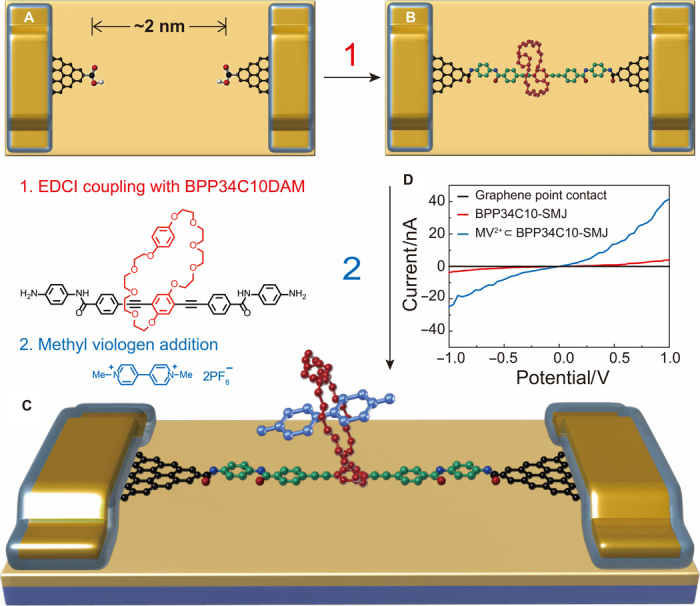
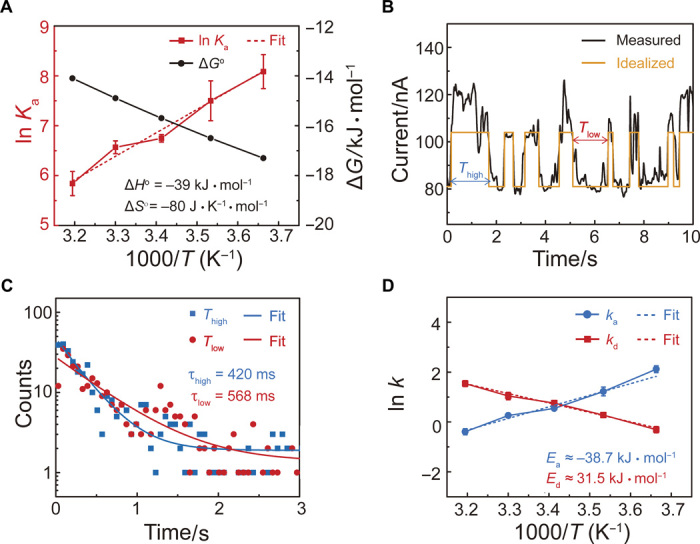
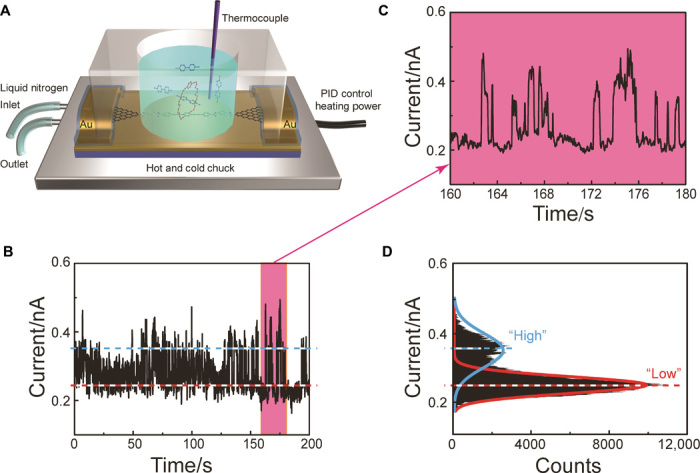
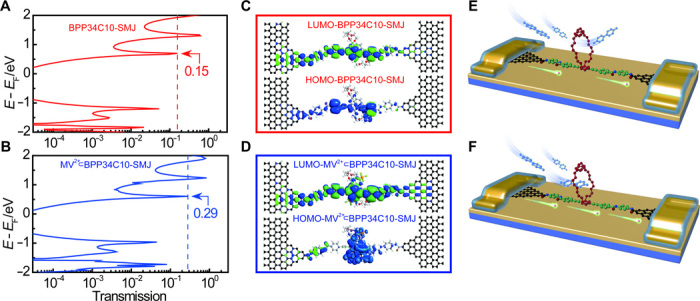
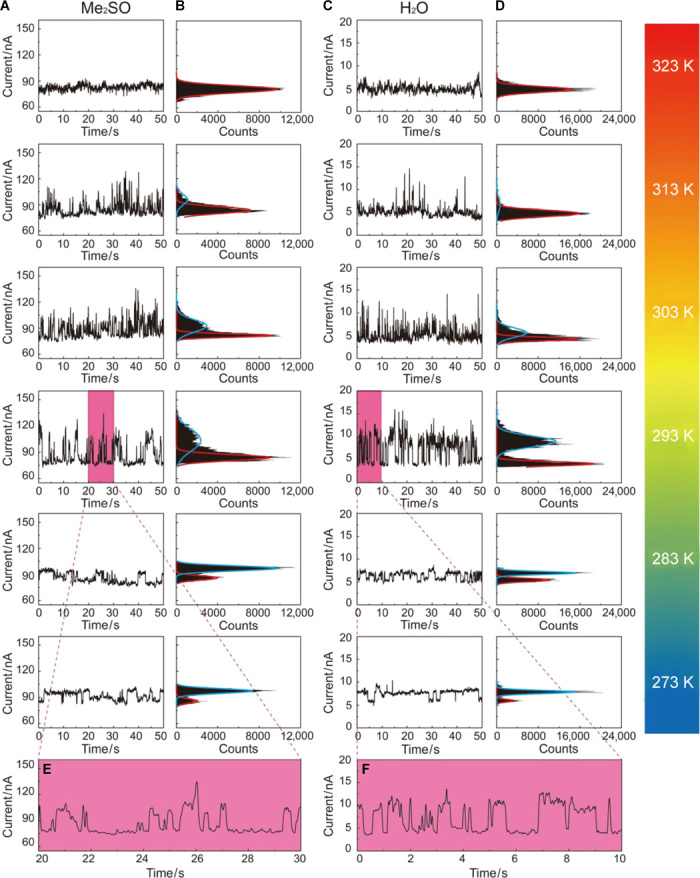
Single-molecule electronic devices offer unique opportunities to investigate the properties of individual molecules that are not accessible in conventional ensemble experiments. However, these investigations remain challenging because they require (i) highly precise device fabrication to incorporate single molecules and (ii) sufficient time resolution to be able to make fast molecular dynamic measurements. We demonstrate a graphene-molecule single-molecule junction that is capable of probing the thermodynamic and kinetic parameters of a host-guest complex. By covalently integrating a conjugated molecular wire with a pendent crown ether into graphene point contacts, we can transduce the physical [2]pseudorotaxane (de)formation processes between the electron-rich crown ether and a dicationic guest into real-time electrical signals. The conductance of the single-molecule junction reveals two-level fluctuations that are highly dependent on temperature and solvent environments, affording a nondestructive means of quantitatively determining the binding and rate constants, as well as the activation energies, for host-guest complexes. The thermodynamic processes reveal the host-guest binding to be enthalpy-driven and are consistent with conventional H nuclear magnetic resonance titration experiments. This electronic device opens up a new route to developing single-molecule dynamics investigations with microsecond resolution for a broad range of chemical and biochemical applications.
单分子电子器件为研究单个分子的性质提供了独特的机会,这些性质在传统的整体实验中是无法获得的。然而,这些研究仍然具有挑战性,因为它们需要(i)高度精确的器件制造来结合单个分子,以及(ii)足够的时间分辨率,以便能够进行快速的分子动力学测量。我们展示了一种石墨烯-分子单分子结,它能够探测主体-客体配合物的热力学和动力学参数。通过将共轭分子线与悬垂冠醚共价集成到石墨烯点接触中,我们可以将富电子冠醚和二价客体之间的[2]假轮烷(形成和解离)物理过程转化为实时电信号。单分子结的电导揭示了高度依赖于温度和溶剂环境的两能级涨落,为定量确定主体-客体配合物的结合和速率常数以及活化能提供了一种非破坏性的方法。热力学过程表明主体-客体结合是焓驱动的,与传统的 H 核磁共振滴定实验一致。这种电子器件为广泛的化学和生化应用开辟了一条新途径,可实现具有微秒分辨率的单分子动力学研究。