Leung Jacky K, Sadar Marianne D
Department of Genome Sciences Centre, British Columbia Cancer Agency , Vancouver, BC , Canada.
Front Endocrinol (Lausanne). 2017 Jan 17;8:2. doi: 10.3389/fendo.2017.00002. eCollection 2017.
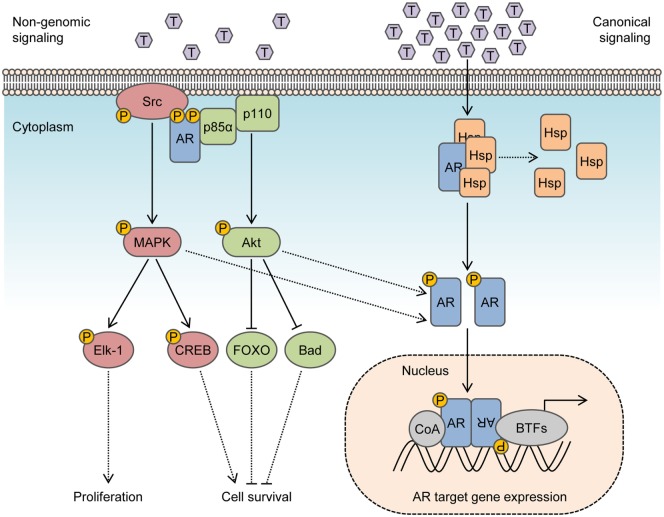
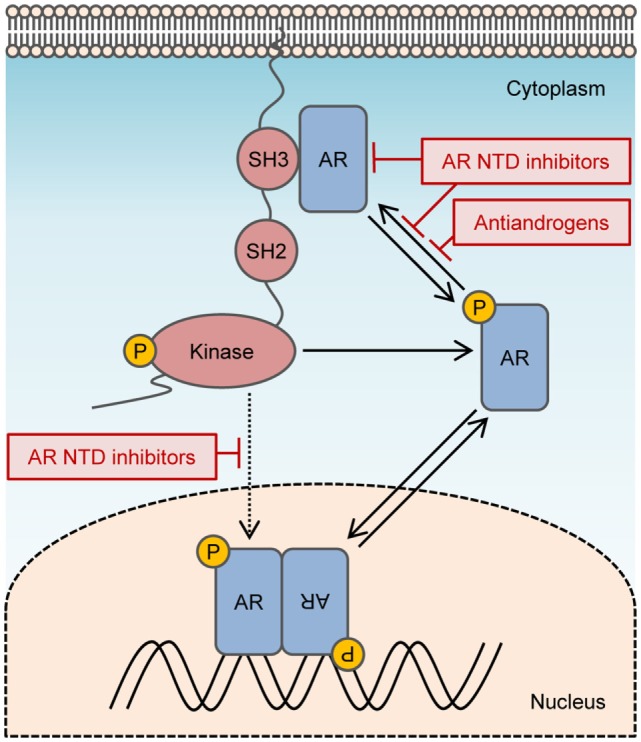
Androgen receptor (AR) is a validated drug target for prostate cancer based on its role in proliferation, survival, and metastases of prostate cancer cells. Unfortunately, despite recent improvements to androgen deprivation therapy and the advent of better antiandrogens with a superior affinity for the AR ligand-binding domain (LBD), most patients with recurrent disease will eventually develop lethal metastatic castration-resistant prostate cancer (CRPC). Expression of constitutively active AR splice variants that lack the LBD contribute toward therapeutic resistance by bypassing androgen blockade and antiandrogens. In the canonical pathway, binding of androgen to AR LBD triggers the release of AR from molecular chaperones which enable conformational changes and protein-protein interactions to facilitate its nuclear translocation where it regulates the expression of target genes. However, preceding AR function in the nucleus, initial binding of androgen to AR LBD in the cytoplasm may already initiate signal transduction pathways to modulate cellular proliferation and migration. In this article, we review the significance of signal transduction pathways activated by rapid, non-genomic signaling of the AR during the progression to metastatic CRPC and put into perspective the implications for current and novel therapies that target different domains of AR.
雄激素受体(AR)因其在前列腺癌细胞增殖、存活和转移中的作用,是已被验证的前列腺癌药物靶点。不幸的是,尽管最近雄激素剥夺疗法有所改进,且出现了对AR配体结合域(LBD)具有更高亲和力的更好的抗雄激素药物,但大多数复发疾病患者最终仍会发展为致命的转移性去势抵抗性前列腺癌(CRPC)。缺乏LBD的组成型活性AR剪接变体的表达通过绕过雄激素阻断和抗雄激素药物导致治疗耐药。在经典途径中,雄激素与AR LBD结合会触发AR从分子伴侣中释放出来,从而使构象发生变化并促进蛋白质 - 蛋白质相互作用,以利于其核转位,在核内它调节靶基因的表达。然而,在AR在细胞核中发挥功能之前,雄激素在细胞质中与AR LBD的初始结合可能已经启动信号转导途径来调节细胞增殖和迁移。在本文中,我们综述了在进展为转移性CRPC过程中由AR的快速非基因组信号激活的信号转导途径的重要性,并阐述了针对AR不同结构域的当前和新型疗法的意义。