Institute of Biological Chemistry, Washington State University, Pullman, 99164, WA, USA.
Department of Genetics and Cytology, National Research Center, Giza, Egypt.
Sci Rep. 2017 Feb 1;7:39069. doi: 10.1038/srep39069.
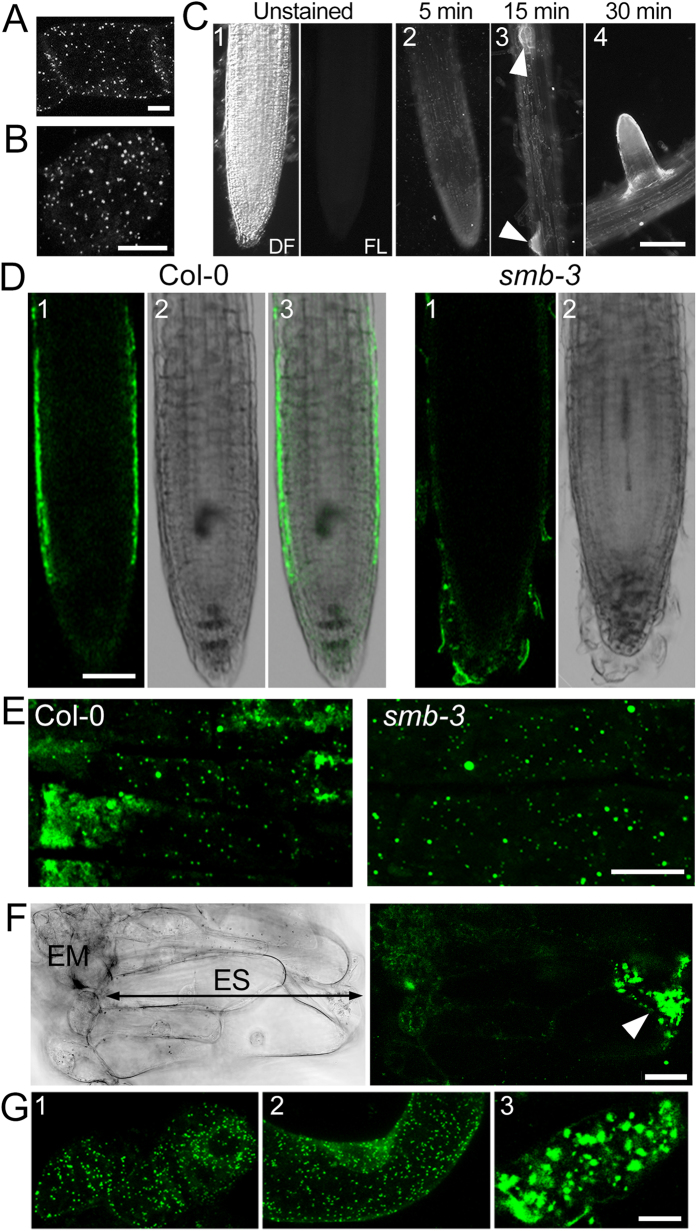
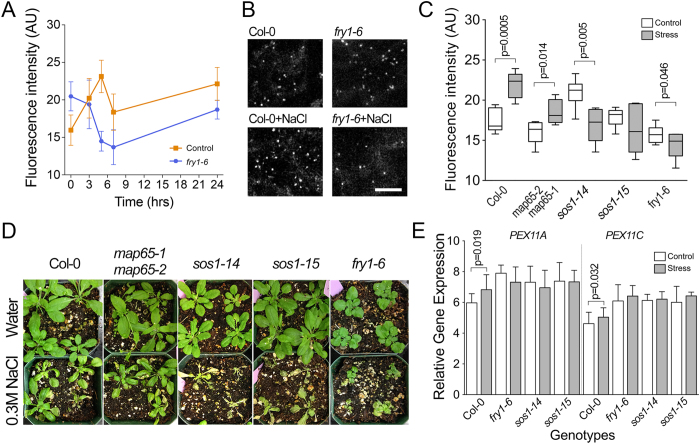
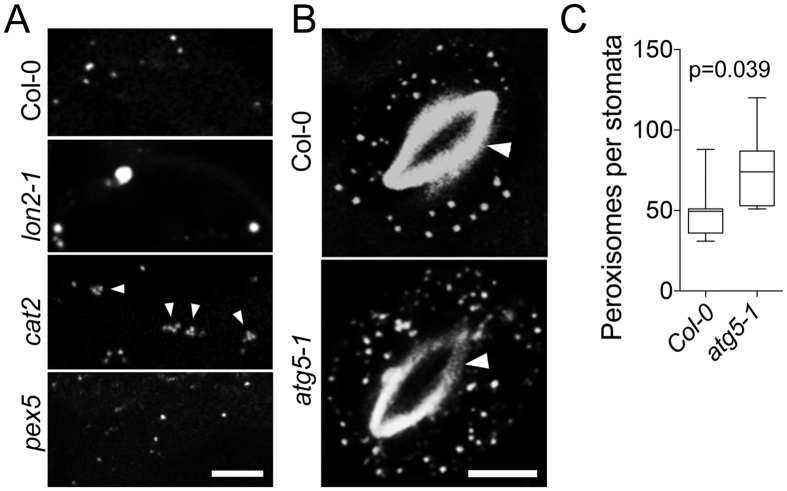
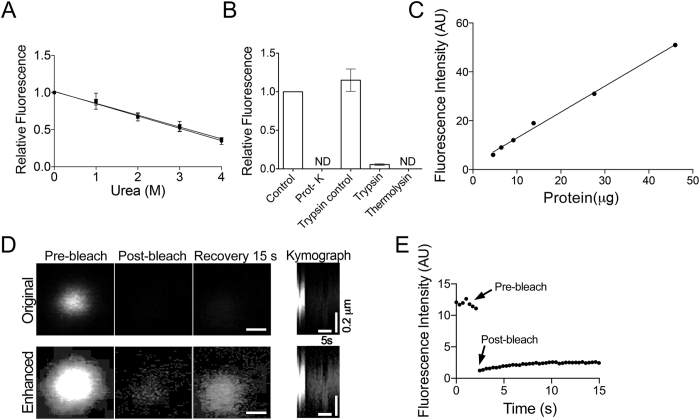
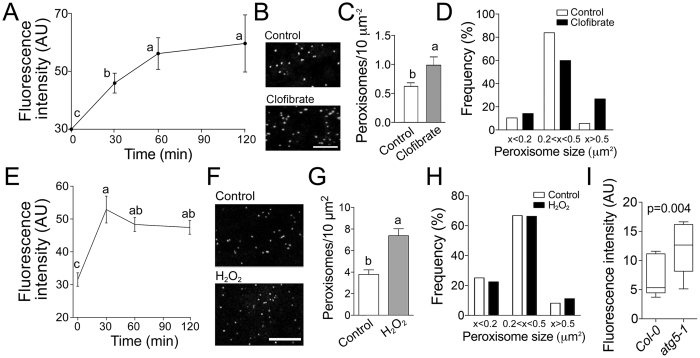
Plant peroxisomes maintain a plethora of key life processes including fatty acid β-oxidation, photorespiration, synthesis of hormones, and homeostasis of reactive oxygen species (ROS). Abundance of peroxisomes in cells is dynamic; however mechanisms controlling peroxisome proliferation remain poorly understood because measuring peroxisome abundance is technically challenging. Counting peroxisomes in individual cells of complex organs by electron or fluorescence microscopy is expensive and time consuming. Here we present a simple technique for quantifying peroxisome abundance using the small probe Nitro-BODIPY, which in vivo fluoresces selectively inside peroxisomes. The physiological relevance of our technique was demonstrated using salinity as a known inducer of peroxisome proliferation. While significant peroxisome proliferation was observed in wild-type Arabidopsis leaves following 5-hour exposure to NaCl, no proliferation was detected in the salt-susceptible mutants fry1-6, sos1-14, and sos1-15. We also found that N-BODIPY detects aggregation of peroxisomes during final stages of programmed cell death and can be used as a marker of this stage. Furthermore, accumulation of peroxisomes in an autophagy-deficient Arabidopsis mutant atg5 correlated with N-BODIPY labeling. In conclusion, the technique reported here enables quantification of peroxisomes in plant material at various physiological settings. Its potential applications encompass identification of genes controlling peroxisome homeostasis and capturing stress-tolerant genotypes.
植物过氧化物酶体维持着许多关键的生命过程,包括脂肪酸 β-氧化、光呼吸、激素合成和活性氧(ROS)的动态平衡。细胞中过氧化物酶体的丰度是动态的;然而,控制过氧化物酶体增殖的机制仍知之甚少,因为测量过氧化物酶体的丰度在技术上具有挑战性。通过电子显微镜或荧光显微镜对复杂器官的单个细胞中的过氧化物酶体进行计数既昂贵又耗时。在这里,我们提出了一种使用小型探针 Nitro-BODIPY 定量过氧化物酶体丰度的简单技术,该探针在体内选择性地在过氧化物酶体内荧光。我们的技术的生理相关性通过盐度作为过氧化物酶体增殖的已知诱导剂来证明。虽然在 NaCl 处理 5 小时后,野生型拟南芥叶片中观察到显著的过氧化物酶体增殖,但在盐敏感突变体 fry1-6、sos1-14 和 sos1-15 中未检测到增殖。我们还发现,N-BODIPY 在程序性细胞死亡的最后阶段检测到过氧化物酶体的聚集,并可用作该阶段的标志物。此外,自噬缺陷型拟南芥突变体 atg5 中过氧化物酶体的积累与 N-BODIPY 标记相关。总之,这里报道的技术使我们能够在各种生理环境下定量植物材料中的过氧化物酶体。其潜在的应用包括鉴定控制过氧化物酶体动态平衡的基因和捕获耐受应激的基因型。