Cho Soo Hyun, Park Kyo Hoon, Jung Eun Young, Joo Jung Kyung, Jang Ji Ae, Yoo Ha Na
Department of Obstetrics and Gynecology, Seoul National University College of Medicine, Seoul National University Bundang Hospital, Seongnam, Korea.
J Korean Med Sci. 2017 Mar;32(3):488-494. doi: 10.3346/jkms.2017.32.3.488.
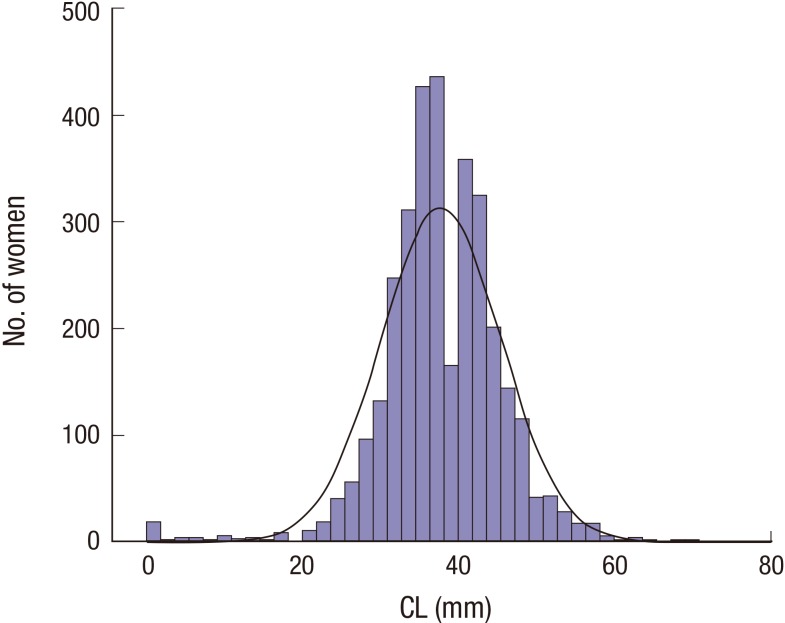
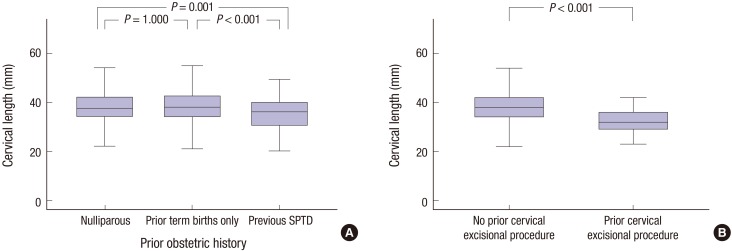
We aimed to determine the maternal characteristics (demographics, an obstetric history, and prior cervical excisional procedure) associated with a short mid-trimester cervical length (CL, defined as a CL of ≤ 25 mm) and whether having a short cervix explains the association between these maternal characteristics and spontaneous preterm delivery (SPTD, defined as a delivery before 34 weeks). This is a single-center retrospective cohort study of 3,296 consecutive women with a singleton pregnancy who underwent routine CL measurement between 20 and 24 weeks. Data were collected on maternal age, weight, height, parity, obstetric history (nulliparity; a history of at least 1 SPTD; and at least 1 term birth and no preterm birth [low-risk history group]), and prior cervical excisional procedure. In the multivariate regression analysis, an obstetric history, prior cervical excisional procedure, and gestational age at measurement were the variables significantly associated with short CL. In contrast, maternal weight, height, age, and parity were not significantly associated with short CL. By using the likelihood of SPTD as an outcome variable, logistic regression indicated that short CL and obstetric history, but not prior cervical excisional procedure, were significantly associated with SPTD after adjustment for potential confounders. A history of SPTD and prior cervical excisional procedure were associated with an increased risk of a short mid-trimester CL. A history of SPTD, but not prior cervical excisional procedure, is associated with an increased risk of SPTD, independent of a short CL.
我们旨在确定与孕中期宫颈长度短(宫颈长度[CL],定义为≤25mm)相关的母体特征(人口统计学、产科病史和既往宫颈切除手术),以及宫颈短是否能解释这些母体特征与自发性早产(SPTD,定义为在34周前分娩)之间的关联。这是一项单中心回顾性队列研究,纳入了3296例连续的单胎妊娠妇女,她们在孕20至24周期间接受了常规宫颈长度测量。收集了产妇年龄、体重、身高、产次、产科病史(未生育;至少1次自发性早产病史;以及至少1次足月分娩且无早产病史[低风险病史组])和既往宫颈切除手术的数据。在多变量回归分析中,产科病史、既往宫颈切除手术和测量时的孕周是与宫颈长度短显著相关的变量。相比之下,产妇体重、身高、年龄和产次与宫颈长度短无显著关联。以自发性早产的可能性作为结果变量,逻辑回归表明,在调整潜在混杂因素后,宫颈长度短和产科病史与自发性早产显著相关,但既往宫颈切除手术与自发性早产无显著关联。自发性早产病史和既往宫颈切除手术与孕中期宫颈长度短的风险增加相关。自发性早产病史而非既往宫颈切除手术与自发性早产风险增加相关,且独立于宫颈长度短。