Carroll Suzanne J, Paquet Catherine, Howard Natasha J, Coffee Neil T, Adams Robert J, Taylor Anne W, Niyonsenga Theo, Daniel Mark
Spatial Epidemiology and Evaluation Research Group, School of Health Sciences and Centre for Population Health Research, University of South Australia, IPC CWE-48, GPO Box 2471, Adelaide, South Australia, 5001, Australia.
Research Centre of the Douglas Mental Health University Institute, Verdun, Québec, Canada.
BMC Public Health. 2017 Feb 2;17(1):149. doi: 10.1186/s12889-017-4068-3.
Individual-level health outcomes are shaped by environmental risk conditions. Norms figure prominently in socio-behavioural theories yet spatial variations in health-related norms have rarely been investigated as environmental risk conditions. This study assessed: 1) the contributions of local descriptive norms for overweight/obesity and dietary behaviour to 10-year change in glycosylated haemoglobin (HbA), accounting for food resource availability; and 2) whether associations between local descriptive norms and HbA were moderated by food resource availability.
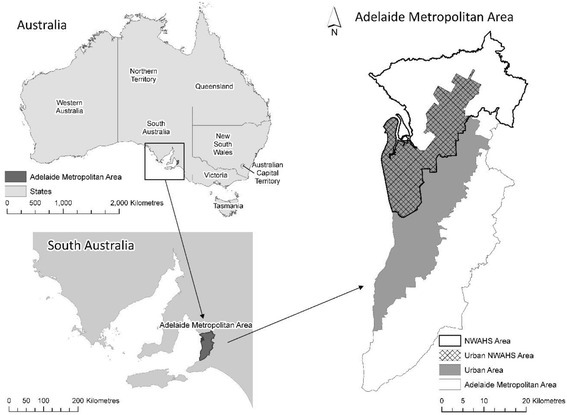
HbA, representing cardiometabolic risk, was measured three times over 10 years for a population-based biomedical cohort of adults in Adelaide, South Australia. Residential environmental exposures were defined using 1600 m participant-centred road-network buffers. Local descriptive norms for overweight/obesity and insufficient fruit intake (proportion of residents with BMI ≥ 25 kg/m [n = 1890] or fruit intake of <2 serves/day [n = 1945], respectively) were aggregated from responses to a separate geocoded population survey. Fast-food and healthful food resource availability (counts) were extracted from a retail database. Separate sets of multilevel models included different predictors, one local descriptive norm and either fast-food or healthful food resource availability, with area-level education and individual-level covariates (age, sex, employment status, education, marital status, and smoking status). Interactions between local descriptive norms and food resource availability were tested.
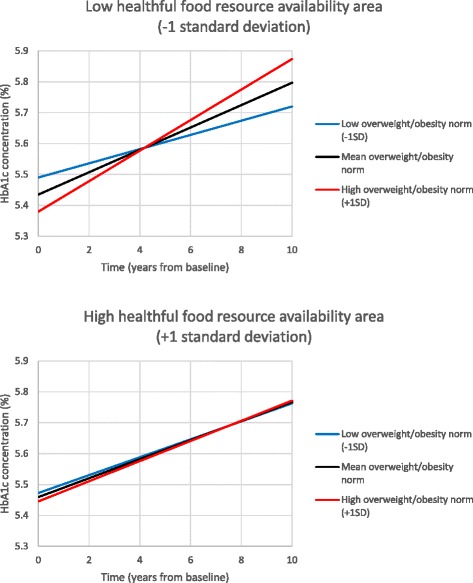
HbA concentration rose over time. Local descriptive norms for overweight/obesity and insufficient fruit intake predicted greater rates of increase in HbA. Neither fast-food nor healthful food resource availability were associated with change in HbA. Greater healthful food resource availability reduced the rate of increase in HbA concentration attributed to the overweight/obesity norm.
Local descriptive health-related norms, not food resource availability, predicted 10-year change in HbA. Null findings for food resource availability may reflect a sufficiency or minimum threshold level of resources such that availability poses no barrier to obtaining healthful or unhealthful foods for this region. However, the influence of local descriptive norms varied according to food resource availability in effects on HbA. Local descriptive health-related norms have received little attention thus far but are important influences on individual cardiometabolic risk. Further research is needed to explore how local descriptive norms contribute to chronic disease risk and outcomes.
个体层面的健康结果受环境风险状况的影响。规范在社会行为理论中占据重要地位,但与健康相关的规范的空间差异作为环境风险状况却很少被研究。本研究评估了:1)当地关于超重/肥胖和饮食行为的描述性规范对糖化血红蛋白(HbA)十年变化的贡献,并考虑食物资源的可及性;2)当地描述性规范与HbA之间的关联是否受食物资源可及性的调节。
对于南澳大利亚阿德莱德一个基于人群的成年生物医学队列,在十年间对糖化血红蛋白(代表心血管代谢风险)进行了三次测量。使用以参与者为中心的1600米道路网络缓冲区来定义居住环境暴露。通过对一项单独的地理编码人口调查的回复汇总得出当地关于超重/肥胖和水果摄入不足的描述性规范(分别为BMI≥25kg/m²的居民比例[n = 1890]或每天水果摄入量<2份的居民比例[n = 1945])。从零售数据库中提取快餐和健康食品资源的可及性(数量)。单独的多层次模型包括不同的预测因素,一个是当地描述性规范,以及快餐或健康食品资源的可及性,同时纳入地区层面的教育程度和个体层面的协变量(年龄、性别、就业状况、教育程度、婚姻状况和吸烟状况)。检验了当地描述性规范与食物资源可及性之间的相互作用。
HbA浓度随时间上升。当地关于超重/肥胖和水果摄入不足的描述性规范预测HbA有更高的上升速率。快餐和健康食品资源的可及性均与HbA的变化无关。更高的健康食品资源可及性降低了归因于超重/肥胖规范导致的HbA浓度上升速率。
当地与健康相关的描述性规范而非食物资源可及性预测了HbA的十年变化。食物资源可及性的零结果可能反映了资源的充足性或最低阈值水平,以至于可及性对该地区获取健康或不健康食品不构成障碍。然而,当地描述性规范的影响在对HbA的作用方面因食物资源可及性而异。当地与健康相关的描述性规范迄今为止很少受到关注,但对个体心血管代谢风险有重要影响。需要进一步研究以探索当地描述性规范如何影响慢性病风险和结果。