Carroll Suzanne J, Niyonsenga Theo, Coffee Neil T, Taylor Anne W, Daniel Mark
Centre for Research and Action in Public Health, Health Research Institute, University of Canberra, University Drive, Bruce 2617, Australia.
Spatial Epidemiology & Evaluation Research Group, School of Health Sciences and Centre for Population Health Research, University of South Australia, North Terrace, Adelaide 5001, Australia.
Int J Environ Res Public Health. 2017 Aug 23;14(9):953. doi: 10.3390/ijerph14090953.
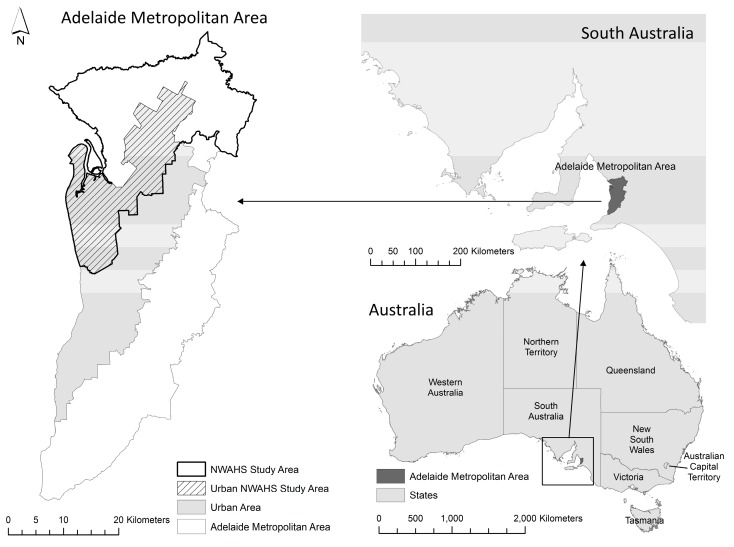
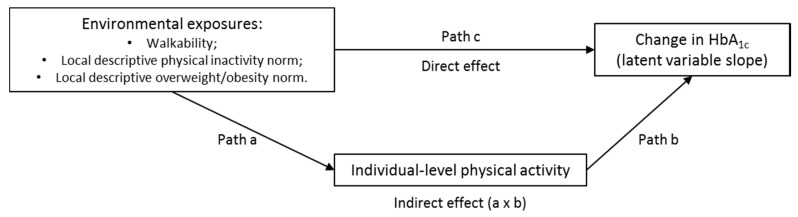
Associations between local-area residential features and glycosylated hemoglobin (HbA) may be mediated by individual-level health behaviors. Such indirect effects have rarely been tested. This study assessed whether individual-level self-reported physical activity mediated the influence of local-area descriptive norms and objectively expressed walkability on 10-year change in HbA. HbA was assessed three times for adults in a 10-year population-based biomedical cohort ( = 4056). Local-area norms specific to each participant were calculated, aggregating responses from a separate statewide surveillance survey for 1600 m road-network buffers centered on participant addresses (local prevalence of overweight/obesity (body mass index ≥25 kg/m²) and physical inactivity (<150 min/week)). Separate latent growth models estimated direct and indirect (through physical activity) effects of local-area exposures on change in HbA, accounting for spatial clustering and covariates (individual-level age, sex, smoking status, marital status, employment and education, and area-level median household income). HbA worsened over time. Local-area norms directly and indirectly predicted worsening HbA trajectories. Walkability was directly and indirectly protective of worsening HbA. Local-area descriptive norms and walkability influence cardiometabolic risk trajectory through individual-level physical activity. Efforts to reduce population cardiometabolic risk should consider the extent of local-area unhealthful behavioral norms and walkability in tailoring strategies to improve physical activity.
局部地区居住特征与糖化血红蛋白(HbA)之间的关联可能由个体层面的健康行为介导。这种间接影响很少得到检验。本研究评估了个体层面自我报告的身体活动是否介导了局部地区描述性规范和客观表达的步行便利性对HbA十年变化的影响。在一个基于人群的10年生物医学队列(n = 4056)中,对成年人的HbA进行了三次评估。计算了每个参与者特定的局部地区规范,汇总了来自一项单独的全州监测调查的回复,该调查针对以参与者地址为中心的1600米道路网络缓冲区(超重/肥胖(体重指数≥25 kg/m²)和身体不活动(<150分钟/周)的局部患病率)。分别采用潜在增长模型估计局部地区暴露对HbA变化的直接和间接(通过身体活动)影响,同时考虑空间聚类和协变量(个体层面的年龄、性别、吸烟状况、婚姻状况、就业和教育,以及地区层面的家庭收入中位数)。HbA随时间恶化。局部地区规范直接和间接地预测了HbA轨迹的恶化。步行便利性对HbA恶化具有直接和间接的保护作用。局部地区描述性规范和步行便利性通过个体层面的身体活动影响心脏代谢风险轨迹。降低人群心脏代谢风险的努力应在制定改善身体活动的策略时考虑局部地区不健康行为规范的程度和步行便利性。