Dirnberger Johannes, Wiesinger Hans-Peter, Wiemer Nicolas, Kösters Alexander, Müller Erich
Department of Sport Science and Kinesiology, University of Salzburg, Austria.
J Hum Kinet. 2016 Apr 13;50:15-25. doi: 10.1515/hukin-2015-0137. eCollection 2016 Apr 1.
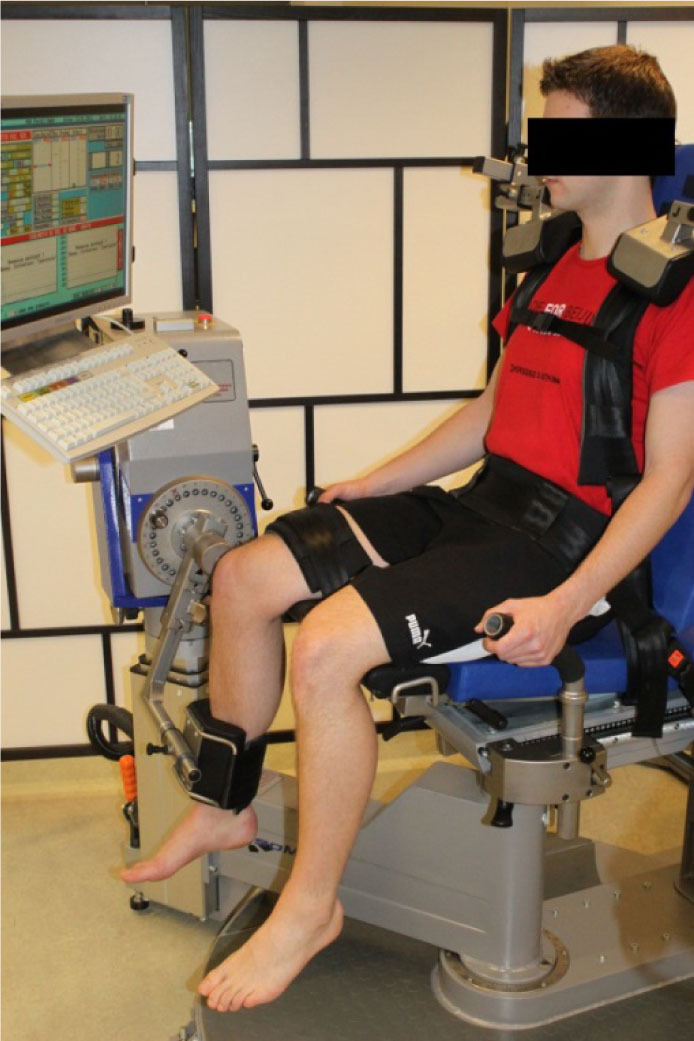
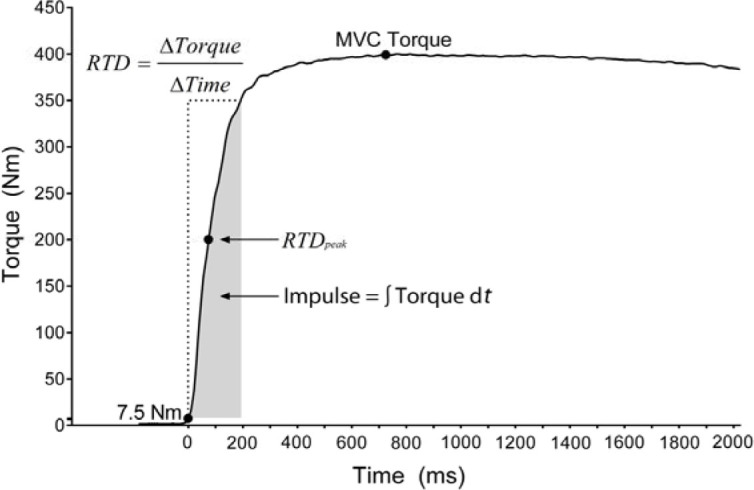
The present study was conducted to assess test-retest reproducibility of explosive strength measurements during single-joint isometric knee extension using the IsoMed 2000 dynamometer. Thirty-one physically active male subjects (mean age: 23.7 years) were measured on two occasions separated by 48-72 h. The intraclass correlation coefficient (ICC 2,1) and the coefficient of variation (CV) were calculated for (i) maximum torque (MVC), (ii) the peak rate of torque development (RTD) as well as for (iii) the average rate of torque development (RTD) and the impulse taken at several predefined time intervals (0-30 to 0-300 ms); thereby explosive strength variables were derived in two conceptually different versions: on the one hand from the MVC-trial (version I), on the other hand from the trial showing the RTD (version II). High ICC-values (0.80-0.99) and acceptable CV-values (1.9-8.7%) could be found for MVC as well as for the RTD and the impulse taken at time intervals of ≥100 ms, regardless of whether version I or II was used. In contrast, measurements of the RTD as well as the RTD and the impulse taken during the very early contraction phase (i.e. RTD/impulse and RTD/impulse) showed clearly weaker reproducibility results (ICC: 0.53-0.84; CV: 7.3-16.4%) and gave rise to considerable doubts as to clinical usefulness, especially when derived using version I. However, if there is a need to measure explosive strength for earlier time intervals in practice, it is, in view of stronger reproducibility results, recommended to concentrate on measures derived from version II, which is based on the RTD-trial.
本研究旨在使用IsoMed 2000测力计评估单关节等长伸膝过程中爆发力测量的重测信度。31名身体活跃的男性受试者(平均年龄:23.7岁)在相隔48 - 72小时的两个时间段进行测量。计算了组内相关系数(ICC 2,1)和变异系数(CV),用于(i)最大扭矩(MVC),(ii)扭矩发展峰值速率(RTD),以及(iii)扭矩发展平均速率(RTD)和在几个预定义时间间隔(0 - 30至0 - 300毫秒)获取的冲量;由此,爆发力变量有两种概念上不同的版本:一方面来自MVC试验(版本I),另一方面来自显示RTD的试验(版本II)。无论使用版本I还是版本II,MVC以及RTD和在≥100毫秒时间间隔获取的冲量都具有较高的ICC值(0.80 - 0.99)和可接受的CV值(1.9 - 8.7%)。相比之下,在非常早期收缩阶段测量的RTD以及RTD和冲量(即RTD/冲量和RTD/冲量)显示出明显较弱的重测信度结果(ICC:0.53 - 0.84;CV:7.3 - 16.4%),并引发了对其临床实用性的严重质疑,尤其是当使用版本I推导时。然而,如果在实践中需要测量更早时间间隔的爆发力,鉴于更强的重测信度结果,建议专注于基于RTD试验的版本II所推导的测量方法。