Carter Rebecca R, Montpetite Michelle M, Jump Robin L P
Department of Epidemiology and Biostatistics, School of Medicine, Case Western Reserve University, Cleveland, Ohio.
Interprofessional Improvement Research, Education and Clinical Center, Louis Stokes Cleveland Department of Veterans Affairs Medical Center, Cleveland, Ohio.
J Am Geriatr Soc. 2017 May;65(5):1073-1078. doi: 10.1111/jgs.14766. Epub 2017 Feb 2.
To identify features of community nursing home (NH) environments associated with lower rates of overall antibiotic use.
This pilot study used an explanatory sequential design that incorporated comparative feedback about antibiotic use to inform a discussion about antimicrobial stewardship practices in community NHs.
NHs.
Clinical leadership of five NHs.
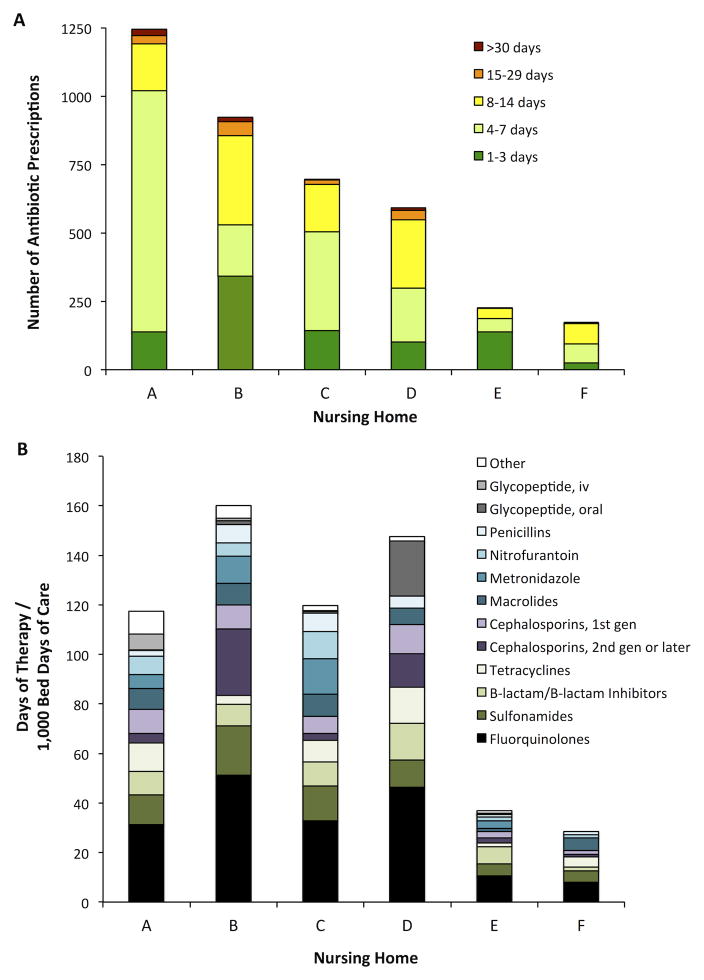
For the quantitative phase, the number of antibiotic prescriptions, length of therapy, and days of therapy/1,000 days of care were measured at six NHs. For the qualitative phase, semistructured interviews were conducted with healthcare workers in leadership positions at five community NHs. Transcripts from the recorded interviews were assessed using emergent thematic analysis. For the triangulation phase, themes from the semistructured interviews were evaluated in the context of each NH's antibiotic use.
The number of antibiotic prescriptions ranged from 172 to 1,244, with 50% to 83% written for 7 days or fewer. All NHs reported a similar proportion of fluoroquinolone use (27-32% of days of therapy). Triangulation yielded six themes for which the environment at each facility ranged from less- to more-supportive antimicrobial stewardship: practice patterns, external influences, infection control, leadership, communication, and facility culture. All NHs reported pressure from well-intentioned family members to prescribe antibiotics. NHs with shorter lengths of therapy and lower overall antibiotic use were consonant with an environment more supportive of antimicrobial stewardship.
These findings suggest several features of NHs that are supportive of antimicrobial stewardship: practice patterns grounded in established diagnostic criteria, proactive infection control and prevention, open communication and interconnectedness among staff.
确定与总体抗生素使用率较低相关的社区疗养院(NH)环境特征。
这项试点研究采用了解释性序列设计,纳入了关于抗生素使用的比较反馈,以促进关于社区NH抗菌药物管理实践的讨论。
NHs。
五家NHs的临床负责人。
在定量阶段,测量了六家NHs的抗生素处方数量、治疗时长以及每1000天护理天数的治疗天数。在定性阶段,对五家社区NHs担任领导职务的医护人员进行了半结构式访谈。使用新出现的主题分析法对访谈记录进行评估。在三角验证阶段,在每家NH的抗生素使用背景下评估半结构式访谈的主题。
抗生素处方数量从172到1244不等,其中50%至83%的处方开具时长为7天或更短。所有NHs报告的氟喹诺酮类药物使用比例相似(占治疗天数的27%-32%)。三角验证得出了六个主题,每个机构的环境在支持抗菌药物管理方面的程度从低到高:实践模式、外部影响、感染控制、领导力、沟通和机构文化。所有NHs都报告了来自善意家庭成员要求开具抗生素的压力。治疗时长较短且总体抗生素使用量较低的NHs与更支持抗菌药物管理的环境一致。
这些发现表明了NHs中支持抗菌药物管理的几个特征:基于既定诊断标准的实践模式、积极的感染控制和预防、员工之间的开放沟通和相互联系。