Zhang Li, Liu Dan, Li Lei, Pu Dan, Zhou Ping, Jing Yuting, Yu He, Wang Yanwen, Zhu Yihan, He Yanqi, Li Yalun, Zhao Shuang, Qiu Zhixin, Li Weimin
Lab of Pathology, West China Hospital, Sichuan University, Chengdu, Sichuan Province, 610041, People's Republic of China.
Department of Respiratory Medicine, West China Hospital, Sichuan University, Chengdu, Sichuan Province, 610041, People's Republic of China.
BMC Cancer. 2017 Feb 2;17(1):96. doi: 10.1186/s12885-017-3070-6.
The roles of carcinoembryonic antigen (CEA), cytokeratin 19 fragments (CYFRA21-1) and neuron-specific enolase (NSE) in metastases occurrence and poor diagnosis in specific histological classifications of lung cancer need further exploring. In this study, we investigated relationship between elevated levels of three biomarkers of CEA, CYFRA21-1 and NSE (individually and in combination) and metastasis, survival status and prognosis in lung cancer patients.
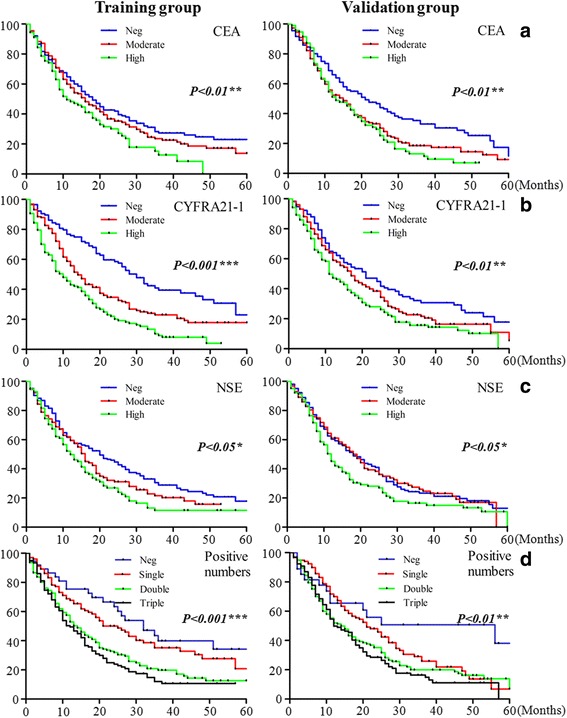
Eight hundred and sixty eight lung cancer patients including adenocarcinoma (ADC, N = 445), squamous cell carcinoma (SCC, N = 215), small cell lung cancer (SCLC, N = 159) and other types (N = 49) were categorized into negative, moderate and high groups according to serum levels of biomarkers, and were then categorized into negative, single, double and triple groups according to any positive combination of three biomarkers. The cutoff values of three biomarkers for groupings were developed on the training group (N = 432) and verified in a validation group (N = 436). Clinical and laboratory characteristics were then assessed for correlation with occurrence of metastasis, survival status and prognosis between the two groups. Further correlation analyses were also conducted by different subtypes (ADC, SCC and SCLC) and tumor stages (I + II, III and IV) of lung cancers.
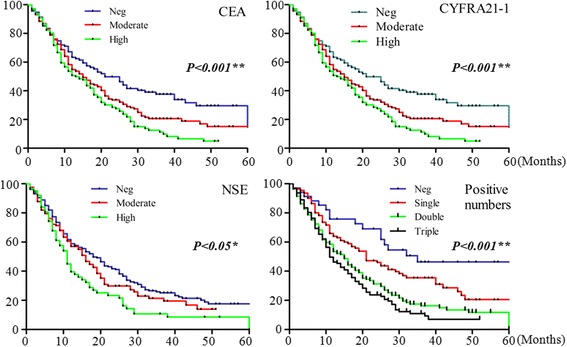
The consistent results between training and validation group confirmed the rationality of grouping methods. CYFRA21-1 levels had stronger association with metastases and survival status than CEA and NSE in all lung cancer patients. When stratified by subtypes, these significances only existed in ADC patients for CYFRA21-1. Cox regression analyses showed that CYFRA21-1 and NSE were independent prognostic factors for lung cancer patients. However, only CYFRA21-1 was an independent prognostic factor in ADC and SCLC patients subtypes. Cox-regression results also indicated that CYFRA21-1 could act as independent prognostic factor in different stages (I + II, III and IV) of lung cancer.
CYFRA21-1 was more important in metastasis occurrence and in predicting poor prognosis in lung cancer patients than CEA, NSE and positive numbers of biomarkers.
癌胚抗原(CEA)、细胞角蛋白19片段(CYFRA21-1)和神经元特异性烯醇化酶(NSE)在肺癌特定组织学分类中的转移发生及诊断不佳方面的作用有待进一步探索。在本研究中,我们调查了CEA、CYFRA21-1和NSE这三种生物标志物水平升高(单独及联合)与肺癌患者转移、生存状态及预后之间的关系。
868例肺癌患者,包括腺癌(ADC,N = 445)、鳞状细胞癌(SCC,N = 215)、小细胞肺癌(SCLC,N = 159)和其他类型(N = 49),根据生物标志物的血清水平分为阴性、中度和高度组,然后根据三种生物标志物的任何阳性组合分为阴性、单项、双项和三项组。三种生物标志物分组的临界值在训练组(N = 432)中确定,并在验证组(N = 436)中进行验证。然后评估两组患者的临床和实验室特征与转移发生、生存状态及预后的相关性。还对肺癌的不同亚型(ADC、SCC和SCLC)和肿瘤分期(I + II、III和IV)进行了进一步的相关性分析。
训练组和验证组之间的一致结果证实了分组方法的合理性。在所有肺癌患者中,CYFRA21-1水平与转移和生存状态的关联比CEA和NSE更强。按亚型分层时,这些显著性仅在ADC患者的CYFRA21-1中存在。Cox回归分析表明,CYFRA21-1和NSE是肺癌患者的独立预后因素。然而,在ADC和SCLC患者亚型中,只有CYFRA21-1是独立预后因素。Cox回归结果还表明,CYFRA21-1可作为肺癌不同分期(I + II、III和IV)的独立预后因素。
CYFRA21-1在肺癌患者转移发生及预测不良预后方面比CEA、NSE及生物标志物阳性数量更重要。