Li Ranran, Lai Youzhi, Zhang Yumei, Yao Li, Wu Xia
College of Information Science and Technology, Beijing Normal University , Beijing , China.
Neurology Department, Beijing Tiantan Hospital Affiliated with Capital Medical University , Beijing , China.
Front Neurol. 2017 Jan 19;8:2. doi: 10.3389/fneur.2017.00002. eCollection 2017.
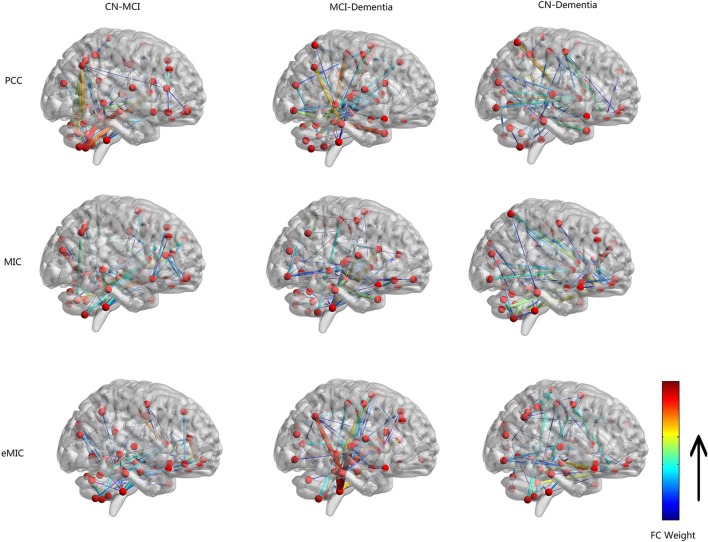
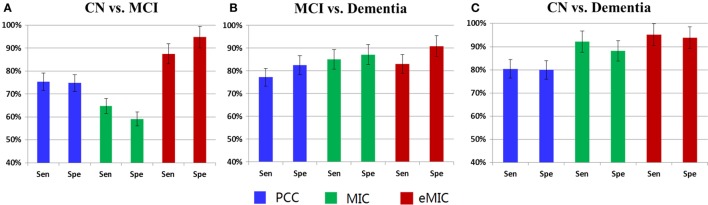
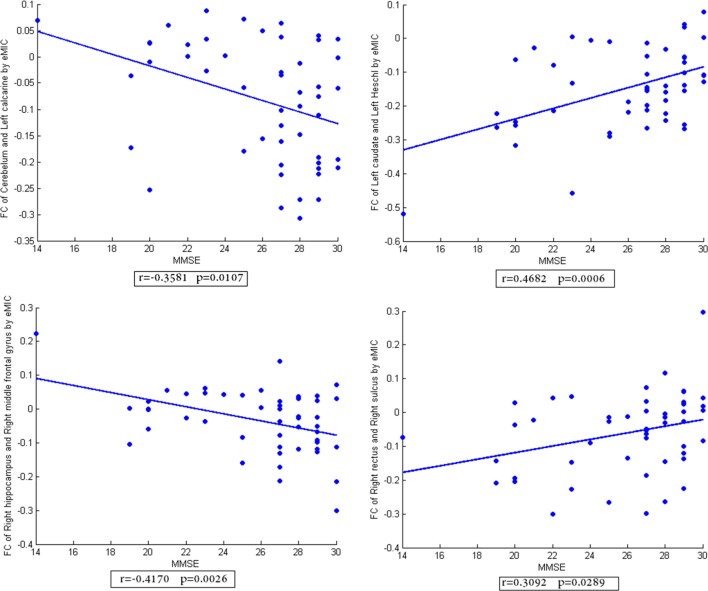
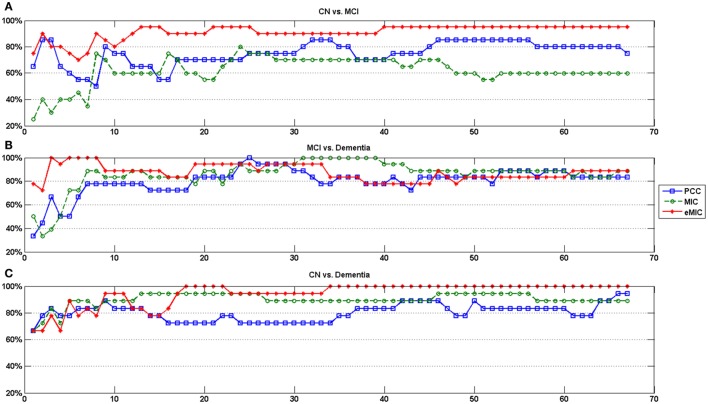
Leukoaraiosis (LA) describes diffuse white matter abnormalities apparent in computed tomography (CT) or magnetic resonance (MR) brain scans. Patients with LA generally show varying degrees of cognitive impairment, which can be classified as cognitively normal (CN), mild cognitive impairment (MCI), and dementia. However, a consistent relationship between the degree of LA and the level of cognitive impairment has not yet been established. We used functional magnetic resonance imaging (fMRI) to explore possible neuroimaging biomarkers for classification of cognitive level in LA. Functional connectivity (FC) between brain regions was calculated using Pearson's correlation coefficient (PCC), maximal information coefficient (MIC), and extended maximal information coefficient (eMIC). Next, FCs with high discriminative power for different cognitive levels in LA were used as features for classification based on support vector machine. CN and MCI were classified with accuracies of 75.0, 61.9, and 91.1% based on features from PCC, MIC, and eMIC, respectively. MCI and dementia were classified with accuracies of 80.1, 86.2, and 87.4% based on features from PCC, MIC, and eMIC, respectively. CN and dementia were classified with accuracies of 80.1, 89.9, and 94.4% based on features from PCC, MIC, and eMIC, respectively. Our results suggest that features extracted from fMRI were efficient for classification of cognitive impairment level in LA, especially, when features were based on a non-linear method (eMIC).
脑白质疏松(LA)是指在计算机断层扫描(CT)或磁共振(MR)脑部扫描中出现的弥漫性白质异常。LA患者通常表现出不同程度的认知障碍,可分为认知正常(CN)、轻度认知障碍(MCI)和痴呆。然而,LA程度与认知障碍水平之间的一致关系尚未确立。我们使用功能磁共振成像(fMRI)来探索可能用于LA认知水平分类的神经影像生物标志物。使用皮尔逊相关系数(PCC)、最大信息系数(MIC)和扩展最大信息系数(eMIC)计算脑区之间的功能连接(FC)。接下来,将对LA中不同认知水平具有高判别力的FC用作基于支持向量机的分类特征。基于PCC、MIC和eMIC的特征,CN和MCI的分类准确率分别为75.0%、61.9%和91.1%。基于PCC、MIC和eMIC的特征,MCI和痴呆的分类准确率分别为80.1%、86.2%和87.4%。基于PCC、MIC和eMIC的特征,CN和痴呆的分类准确率分别为80.1%、89.9%和94.4%。我们的结果表明,从fMRI中提取的特征对于LA认知障碍水平的分类是有效的,特别是当特征基于非线性方法(eMIC)时。