
精神分裂症的非线性脑连接的判别分析:一项 fMRI 研究。
Discriminative analysis of non-linear brain connectivity in schizophrenia: an fMRI Study.
机构信息
College of Mechatronics and Automation, National University of Defense Technology Changsha, China.
出版信息
Front Hum Neurosci. 2013 Oct 22;7:702. doi: 10.3389/fnhum.2013.00702. eCollection 2013.
BACKGROUND
Dysfunctional integration of distributed brain networks is believed to be the cause of schizophrenia, and resting-state functional connectivity analyses of schizophrenia have attracted considerable attention in recent years. Unfortunately, existing functional connectivity analyses of schizophrenia have been mostly limited to linear associations.
OBJECTIVE
The objective of the present study is to evaluate the discriminative power of non-linear functional connectivity and identify its changes in schizophrenia.
METHOD
A novel measure utilizing the extended maximal information coefficient was introduced to construct non-linear functional connectivity. In conjunction with multivariate pattern analysis, the new functional connectivity successfully discriminated schizophrenic patients from healthy controls with relative higher accuracy rate than the linear measure.
RESULT
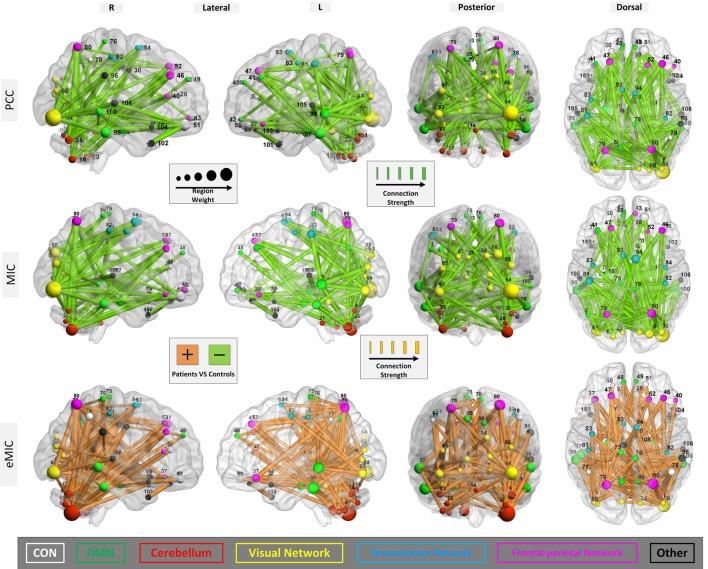
We found that the strength of the identified non-linear functional connections involved in the classification increased in patients with schizophrenia, which was opposed to its linear counterpart. Further functional network analysis revealed that the changes of the non-linear and linear connectivity have similar but not completely the same spatial distribution in human brain.
CONCLUSION
The classification results suggest that the non-linear functional connectivity provided useful discriminative power in diagnosis of schizophrenia, and the inverse but similar spatial distributed changes between the non-linear and linear measure may indicate the underlying compensatory mechanism and the complex neuronal synchronization underlying the symptom of schizophrenia.
背景
分布式脑网络的功能整合障碍被认为是精神分裂症的病因,近年来,对精神分裂症的静息态功能连接分析引起了相当大的关注。不幸的是,现有的精神分裂症功能连接分析大多局限于线性关联。
目的
本研究旨在评估非线性功能连接的判别能力,并确定其在精神分裂症中的变化。
方法
引入了一种利用扩展最大信息系数的新方法来构建非线性功能连接。结合多变量模式分析,新的功能连接成功地以相对较高的准确率区分了精神分裂症患者和健康对照组,优于线性测量。
结果
我们发现,参与分类的确定的非线性功能连接的强度在精神分裂症患者中增加,这与线性对应物相反。进一步的功能网络分析表明,非线性和线性连接的变化在人脑中有相似但不完全相同的空间分布。
结论
分类结果表明,非线性功能连接在精神分裂症的诊断中提供了有用的判别能力,非线性和线性测量之间的反向但相似的空间分布变化可能表明了潜在的补偿机制和精神分裂症症状背后的复杂神经元同步。


 Zotero 插件