Jang Suyoung, Jeong Myung Ho, Lim Kyung Seob, Bae In Ho, Park Jun-Kyu, Park Dae Sung, Shim Jae Won, Kim Jung Ha, Kim Hyun Kuk, Sim Doo Sun, Hong Young Joon, Ahn Youngkeun, Kang Jung Chaee
Korea Cardiovascular Stent Research Institute, Jangsung, Korea.; Cardiovascular Convergence Research Center Nominated by Korea Ministry of Health and Welfare, Gwangju, Korea.; Cardiovascular Research Center, Chonnam National University Hospital, Gwangju, Korea.
Korea Cardiovascular Stent Research Institute, Jangsung, Korea.; Cardiovascular Convergence Research Center Nominated by Korea Ministry of Health and Welfare, Gwangju, Korea.; Cardiovascular Research Center, Chonnam National University Hospital, Gwangju, Korea.; Regeneromics Research Center, Chonnam National University, Gwangju, Gwangju, Korea.
Korean Circ J. 2017 Jan;47(1):115-122. doi: 10.4070/kcj.2016.0278. Epub 2016 Dec 27.
Artemisinin and dihydroartemisinin are drugs used to treat malaria. These drugs suppress inflammatory reactions. The aim of this study was to examine the anti-intima hyperplasia effect of a novel drug-eluting stent with artemisinin or dihydroartemisinin in a porcine coronary restenosis model.
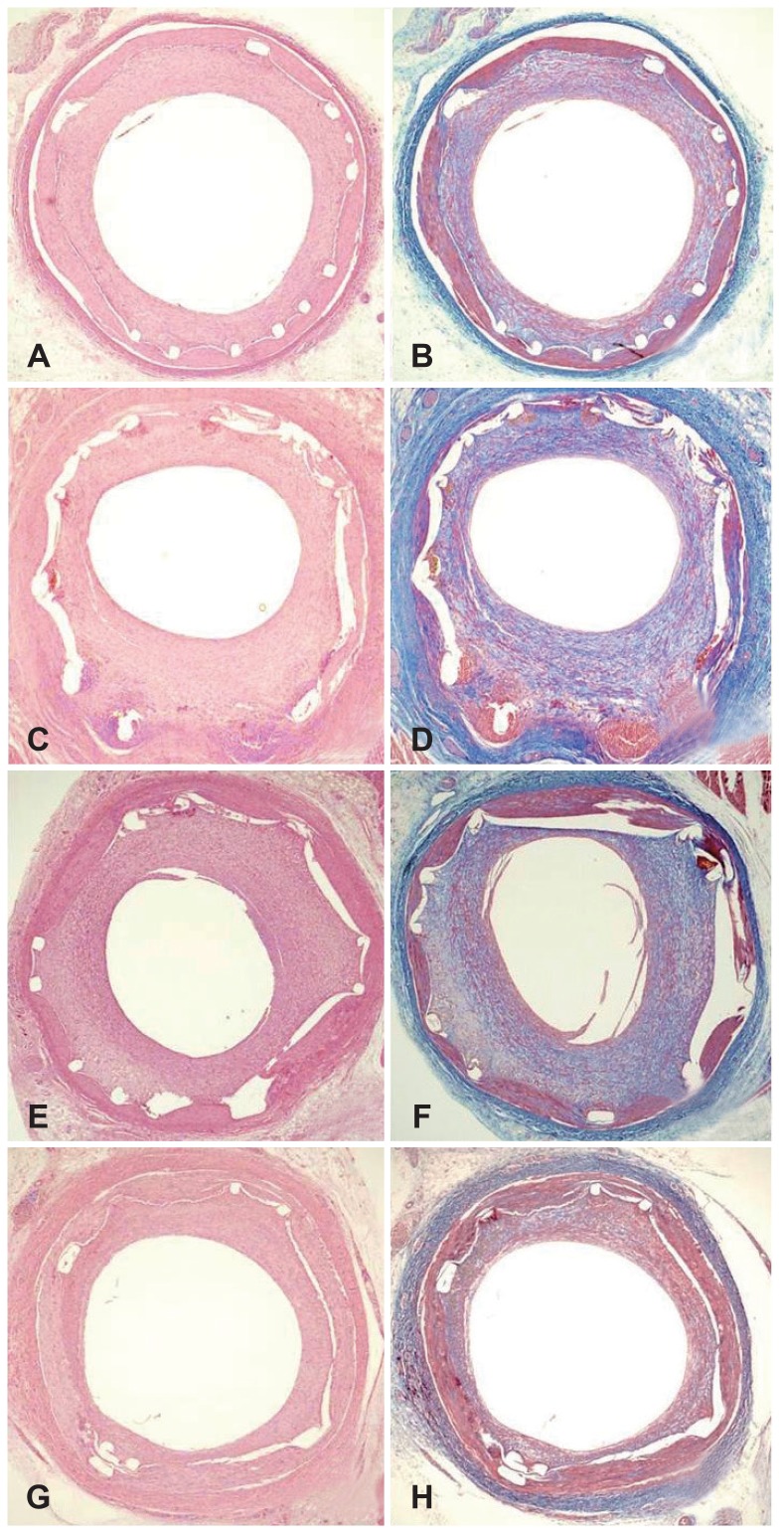
Pigs were randomized into four groups; in the first, the coronary arteries (20 pigs, a total of 40 coronary arteries, with 10 coronary arteries in each group) was implanted with bare metal stents (BMS, n=10); the second group was given polymer-coated stents (PCS, n=10); the third group was treated with artemisinin-eluting stents (AES, n=10); and the fourth group was given dihydroartemisinin-eluting stents (DAES, n=10). Histopathologic analysis was performed 28 days after stenting.
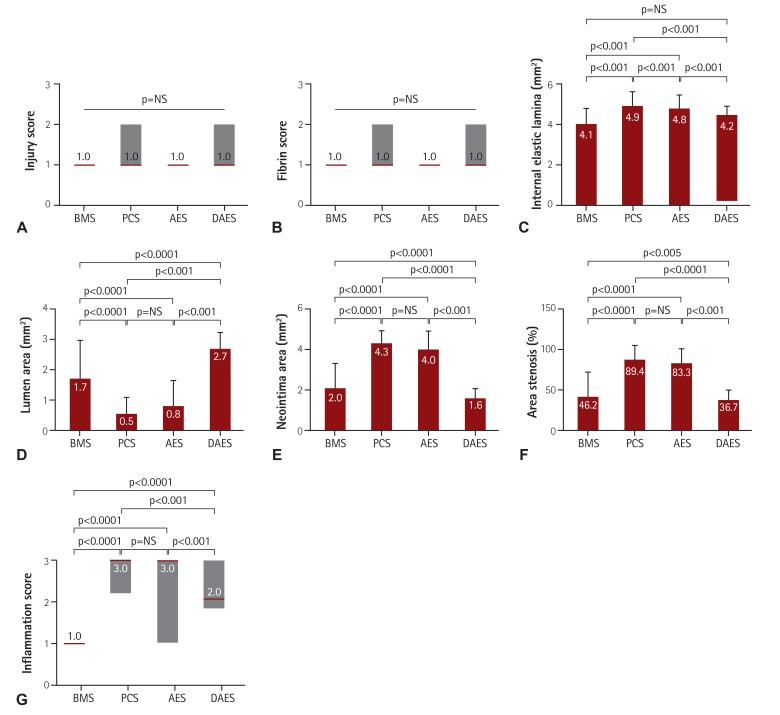
The injury and fibrin scores among the four groups were not significantly different. However, the internal elastic lamina, lumen area, and neointima area were significantly different. Moreover, the percent area of stenosis (46.2±18.66% in BMS vs. 89.4±10.92% in PCS vs. 83.3±17.07% in AES vs. 36.7±11.20% in DAES, p<0.0001) and inflammation score (1.0 [range: 1.0-1.0] vs. 3.0 [range: 2.25-3.0] vs. 3.0 [range: 1.0-3.0] vs. 2.0 [range: 1.75-3.0] in BMS, PCS, AES, and DAES, respectively; p<0.001) were markedly decreased in the DAES group compared to the PCS group.
DES, which uses a natural substance, dihydroartemisinin, showed a neointima and inflammatory suppressive effect in a porcine coronary restenosis model.
青蒿素和双氢青蒿素是用于治疗疟疾的药物。这些药物可抑制炎症反应。本研究的目的是在猪冠状动脉再狭窄模型中,研究一种新型含青蒿素或双氢青蒿素的药物洗脱支架的抗内膜增生作用。
将猪随机分为四组;第一组,冠状动脉(20头猪,共40条冠状动脉,每组10条冠状动脉)植入裸金属支架(BMS,n = 10);第二组给予聚合物涂层支架(PCS,n = 10);第三组用青蒿素洗脱支架(AES,n = 10)治疗;第四组给予双氢青蒿素洗脱支架(DAES,n = 10)。支架置入28天后进行组织病理学分析。
四组之间的损伤和纤维蛋白评分无显著差异。然而,内弹力膜、管腔面积和新生内膜面积有显著差异。此外,狭窄面积百分比(BMS组为46.2±18.66%,PCS组为89.4±10.92%,AES组为83.3±17.07%,DAES组为36.7±11.20%,p<0.0001)和炎症评分(BMS组为1.0[范围:1.0 - 1.0],PCS组为3.0[范围:2.25 - 3.0],AES组为3.0[范围:1.0 - 3.0],DAES组为2.0[范围:1.75 - 3.0];p<0.001)在DAES组与PCS组相比明显降低。
使用天然物质双氢青蒿素的药物洗脱支架在猪冠状动脉再狭窄模型中显示出新生内膜和炎症抑制作用。