Morgan Katherine M, Riedlinger Gregory M, Rosenfeld Jeffrey, Ganesan Shridar, Pine Sharon R
Rutgers Cancer Institute of New Jersey, Rutgers, The State University of New Jersey, New Brunswick, NJ, USA; Department of Pharmacology, Robert Wood Johnson Medical School, Rutgers, The State University of New Jersey, New Brunswick, NJ, USA.
Rutgers Cancer Institute of New Jersey, Rutgers, The State University of New Jersey, New Brunswick, NJ, USA; Department of Pathology and Laboratory Medicine, Robert Wood Johnson Medical School, Rutgers, The State University of New Jersey, New Brunswick, NJ, USA.
Front Oncol. 2017 Jan 19;7:2. doi: 10.3389/fonc.2017.00002. eCollection 2017.
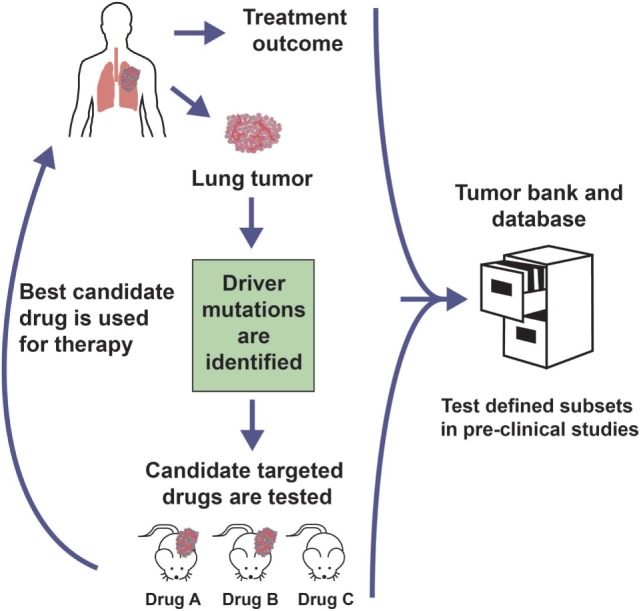
Traditional preclinical studies of cancer therapeutics have relied on the use of established human cell lines that have been adapted to grow in the laboratory and, therefore, may deviate from the cancer they were meant to represent. With the emphasis of cancer drug development shifting from non-specific cytotoxic agents to rationally designed molecularly targeted therapies or immunotherapy comes the need for better models with predictive value regarding therapeutic activity and response in clinical trials. Recently, the diversity and accessibility of immunodeficient mouse strains has greatly enhanced the production and utility of patient-derived xenograft (PDX) models for many tumor types, including non-small cell lung cancer (NSCLC). Combined with next-generation sequencing, NSCLC PDX mouse models offer an exciting tool for drug development and for studying targeted therapies while utilizing patient samples with the hope of eventually aiding in clinical decision-making. Here, we describe NSCLC PDX mouse models generated by us and others, their ability to reflect the parental tumors' histomorphological characteristics, as well as the effect of clonal selection and evolution on maintaining genomic integrity in low-passage PDXs compared to the donor tissue. We also raise vital questions regarding the practical utility of PDX and humanized PDX models in predicting patient response to therapy and make recommendations for addressing those questions. Once collaborations and standardized xenotransplantation and data management methods are established, NSCLC PDX mouse models have the potential to be universal and invaluable as a preclinical tool that guides clinical trials and standard therapeutic decisions.
癌症治疗的传统临床前研究依赖于使用已建立的人类细胞系,这些细胞系已适应在实验室中生长,因此可能与它们原本要代表的癌症有所偏差。随着癌症药物开发的重点从非特异性细胞毒性药物转向合理设计的分子靶向疗法或免疫疗法,需要更好的模型来预测临床试验中的治疗活性和反应。最近,免疫缺陷小鼠品系的多样性和可及性极大地提高了多种肿瘤类型(包括非小细胞肺癌(NSCLC))患者来源异种移植(PDX)模型的产生和实用性。结合下一代测序,NSCLC PDX小鼠模型为药物开发和研究靶向疗法提供了一个令人兴奋的工具,同时利用患者样本,希望最终有助于临床决策。在这里,我们描述了我们和其他人生成的NSCLC PDX小鼠模型、它们反映亲代肿瘤组织形态学特征的能力,以及与供体组织相比,克隆选择和进化对维持低传代PDX基因组完整性的影响。我们还提出了关于PDX和人源化PDX模型在预测患者对治疗反应方面实际效用的关键问题,并对解决这些问题提出了建议。一旦建立合作以及标准化的异种移植和数据管理方法,NSCLC PDX小鼠模型有可能成为一种通用且极有价值的临床前工具,用于指导临床试验和标准治疗决策。