Eickmeier Olaf, Fussbroich Daniela, Mueller Klaus, Serve Friederike, Smaczny Christina, Zielen Stefan, Schubert Ralf
Department for Children and Adolescents, Division of Allergology, Pulmonology, and Cystic Fibrosis, Goethe-University, Frankfurt, Germany.
Department of Food Technology, University of Applied Sciences, Fulda, Germany.
PLoS One. 2017 Feb 3;12(2):e0171249. doi: 10.1371/journal.pone.0171249. eCollection 2017.
Cystic fibrosis (CF) is an autosomal recessive genetic disorder that affects multiple organs, including the lungs, pancreas, liver and intestine. Mutations in the cystic fibrosis transmembrane conductance regulator (CFTR) locus lead to defective proteins and reduced Cl- secretion and Na+ hyperabsorption in the affected organs. In addition, patients suffering from CF display chronic inflammation that contributes to the pathogenesis of CF. Recent work suggests that CF patients have a reduced capacity to biosynthesize specialized pro-resolving lipid mediators (SPMs), which contributes to the development and duration of the unwanted inflammation. Alterations in the metabolism of arachidonic acid (AA) and docosahexaenoic acid (DHA) to specialized pro-resolving mediators (SPMs), like lipoxins (LXs), maresins (MaRs), protectins (PDs) and resolvins (Rvs), may play a major role on clinical impact of airway inflammation in CF.
In this study, our aims were to detect and quantitate Resolvin D1 (RvD1) in sputum and plasma from patients with CF and compare levels of RvD1 with biomarkers of inflammation and lung function. We studied 27 CF patients aged 6 to 55 years (median 16 years) in a prospective approach.
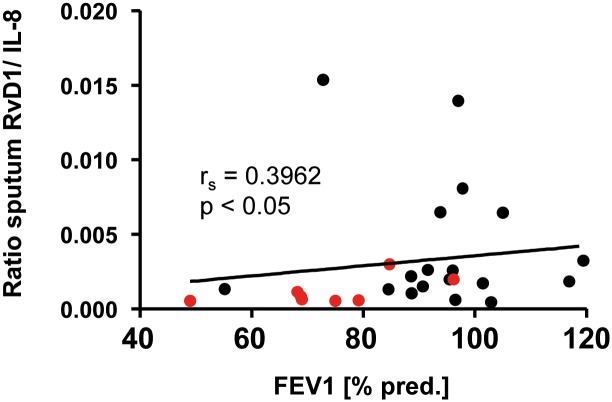
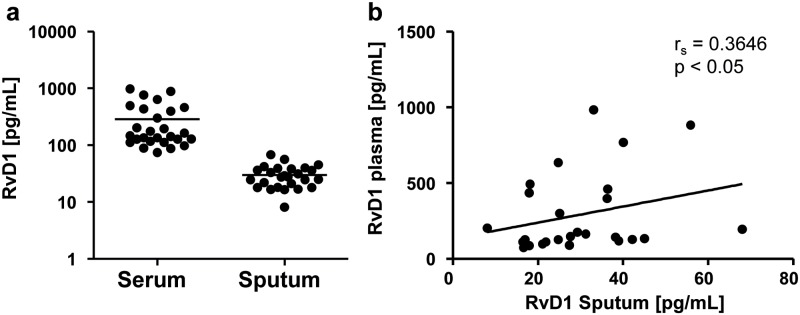
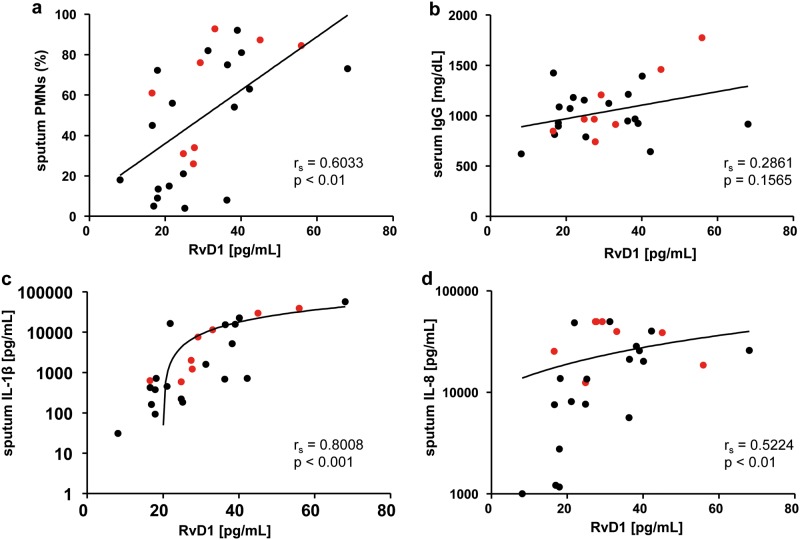
DHA can be found in the plasma of our CF patients in the milligram range and is decreased in comparison to a healthy control group. The DHA-derived pro-resolving mediator Resolvin D1 (RvD1) was also present in the plasma (286.4 ± 50 pg/ mL, mean ± SEM) and sputum (30.0 ± 2.6 pg/ mL, mean ± SEM) samples from our patients with CF and showed a positive correlation with sputum inflammatory markers. The plasma concentrations of RvD1 were ten times higher than sputum concentrations. Interestingly, sputum RvD1/ IL-8 levels showed a positive correlation with FEV1 (rs = 0.3962, p< 0.05).
SPMs, like RvD1, are well known to down-regulate inflammatory pathways. Our study shows that the bioactive lipid mediator RvD1, derived from DHA, was present in sputum and plasma of CF patients and may serve as a representative peripheral biomarker of the lung resolution program for CF patients.
囊性纤维化(CF)是一种常染色体隐性遗传病,会影响多个器官,包括肺、胰腺、肝脏和肠道。囊性纤维化跨膜传导调节因子(CFTR)基因座的突变会导致蛋白质缺陷,并使受影响器官中的氯离子分泌减少和钠离子过度吸收。此外,CF患者会出现慢性炎症,这会促进CF的发病机制。最近的研究表明,CF患者生物合成特异性促消退脂质介质(SPM)的能力降低,这会导致不必要炎症的发展和持续时间延长。花生四烯酸(AA)和二十二碳六烯酸(DHA)代谢为特异性促消退介质(如脂氧素(LXs)、maresins(MaRs)、保护素(PDs)和消退素(Rvs))的改变,可能在CF气道炎症的临床影响中起主要作用。
在本研究中,我们的目的是检测和定量CF患者痰液和血浆中的消退素D1(RvD1),并将RvD1水平与炎症生物标志物和肺功能进行比较。我们以前瞻性的方法研究了27名年龄在6至55岁(中位数16岁)的CF患者。
我们的CF患者血浆中可检测到毫克级的DHA,与健康对照组相比有所降低。源自DHA的促消退介质消退素D1(RvD1)也存在于我们CF患者的血浆(286.4±50 pg/mL,平均值±标准误)和痰液(30.0±2.6 pg/mL,平均值±标准误)样本中,并与痰液炎症标志物呈正相关。RvD1的血浆浓度比痰液浓度高10倍。有趣的是,痰液RvD1/IL-8水平与第一秒用力呼气容积(FEV1)呈正相关(rs = 0.3962,p < 0.05)。
众所周知,像RvD1这样的SPM会下调炎症途径。我们的研究表明,源自DHA的生物活性脂质介质RvD1存在于CF患者的痰液和血浆中,可能作为CF患者肺消退程序的代表性外周生物标志物。