Tai Chun-San, Lin Yan-Ren, Teng Tsung-Han, Lin Ping-Yi, Tu Siang-Jyun, Chou Chih-Hung, Huang Ya-Rong, Huang Wei-Chih, Weng Shun-Long, Huang Hsien-Da, Chen Yao-Li, Chen Wen Liang
Department of Biological Science and Technology, National Chiao Tung University, Hsinchu, Taiwan.
Institute of Molecular Medicine and Bioengineering, National Chiao Tung University, Hsinchu, Taiwan.
PLoS One. 2017 Feb 3;12(2):e0171269. doi: 10.1371/journal.pone.0171269. eCollection 2017.
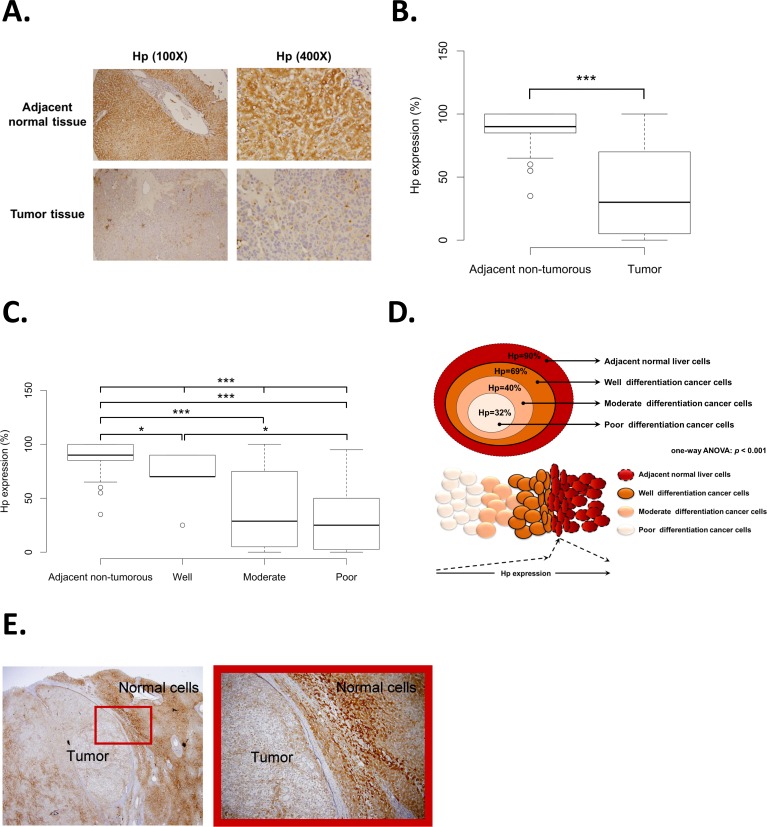
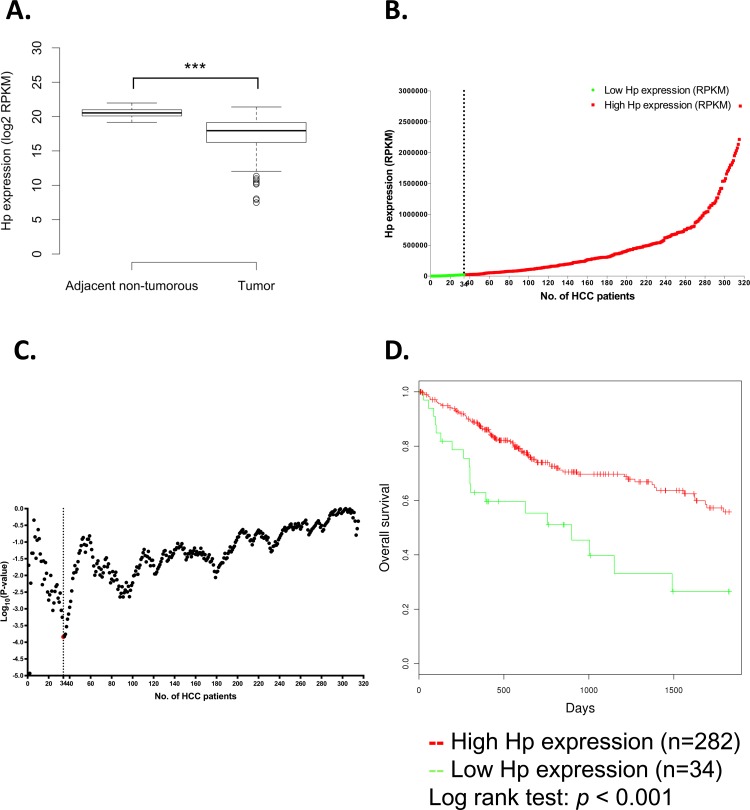
Elevated serum haptoglobin (Hp) is identified as a prognostic marker in multiple types of solid tumors, which is correlated with poor prognosis. HCC is one of the major causes of cancer deaths in worldwide, which remains poor prognosis and is clinically urgent for discovering early diagnostic markers. However, except for serum Hp, the correlation of tumor Hp expression with hepatocellular carcinoma (HCC) progression is still unclear. In this study, we evaluated and identified the tissue Hp expression as a prognostic marker to predict the survival rate of HCC patients. To evaluate the prognostic value of Hp expression for HCC, two cohorts were enrolled in our study, including total 130 matched pair tissue sections (both adjacent non-tumorous and tumor tissue derived from same patient) of HCC patients from Changhua Christian Hospital (CCH) and total 316 RNA-seq data with clinical information of HCC patients from The Cancer Genome Atlas (TCGA) database. In contrast to other types of cancers, HCC tumor tissues have lower Hp protein expression in CCH cohort and have lower Hp mRNA expression in TCGA cohort as compared with adjacent non-tumorous tissues (p < 0.001). Moreover, lower Hp expression is significantly correlated with different stages of HCC cancer differentiation in CCH cohort (one-way ANOVA, p < 0.001). Most importantly, lower Hp expression is highly correlated with poor five-year overall survival rate in TCGA cohort (p < 0.01). Based on our data, we conclude that tissue Hp expression positively correlates with better HCC tumor differentiation and increased five-year overall survival rate of HCC patients. The results indicated that tissue Hp is potentially a prognostic marker for HCC patients. Our findings may further provide a new insight of effective treatments along with biopsy diagnosis of HCC patients.
血清触珠蛋白(Hp)升高被认为是多种实体瘤的预后标志物,与不良预后相关。肝癌是全球癌症死亡的主要原因之一,其预后仍然较差,临床上迫切需要发现早期诊断标志物。然而,除血清Hp外,肿瘤Hp表达与肝细胞癌(HCC)进展的相关性仍不清楚。在本研究中,我们评估并确定组织Hp表达作为预测HCC患者生存率的预后标志物。为了评估Hp表达对HCC的预后价值,我们的研究纳入了两个队列,包括彰化基督教医院(CCH)的130对匹配的HCC患者组织切片(来自同一患者的相邻非肿瘤组织和肿瘤组织),以及来自癌症基因组图谱(TCGA)数据库的316例具有临床信息的HCC患者RNA测序数据。与其他类型的癌症相比,在CCH队列中,HCC肿瘤组织的Hp蛋白表达低于相邻非肿瘤组织,在TCGA队列中,HCC肿瘤组织的Hp mRNA表达低于相邻非肿瘤组织(p<0.001)。此外,在CCH队列中,较低的Hp表达与HCC癌症分化的不同阶段显著相关(单因素方差分析,p<0.001)。最重要的是,在TCGA队列中,较低的Hp表达与较差的五年总生存率高度相关(p<0.01)。基于我们的数据,我们得出结论,组织Hp表达与更好的HCC肿瘤分化和HCC患者五年总生存率的提高呈正相关。结果表明,组织Hp可能是HCC患者的预后标志物。我们的发现可能进一步为HCC患者的活检诊断及有效治疗提供新的见解。