Key Laboratory of Glycoconjugate Research Ministry of Public Health, Department of Biochemistry and Molecular Biology, Shanghai Medical College, Fudan University, Shanghai 200032, China.
Department of Gastroenterology and Hepatology, Zhongshan Hospital, Fudan University, Shanghai 200032, China.
Int J Mol Sci. 2016 Mar 1;17(3):320. doi: 10.3390/ijms17030320.
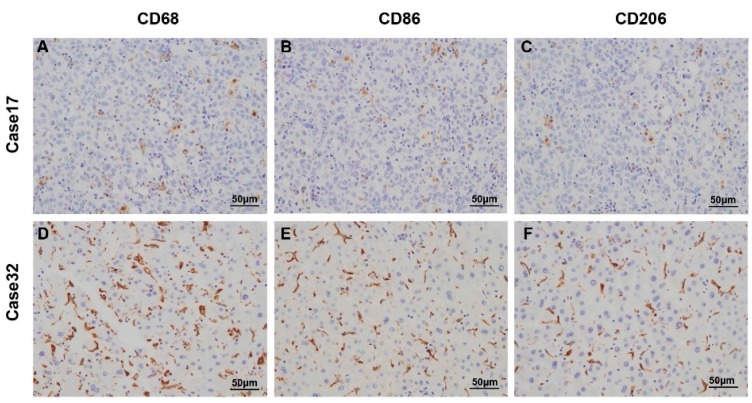
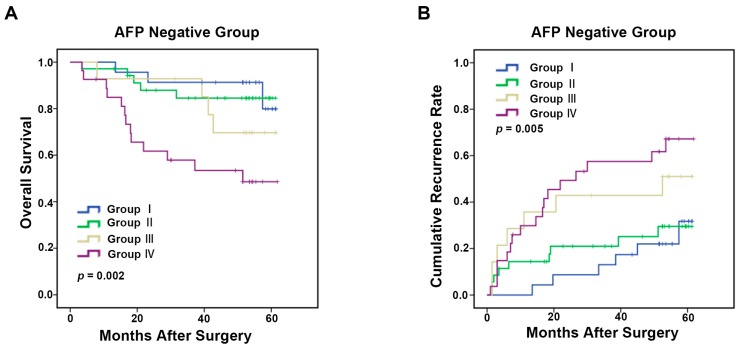
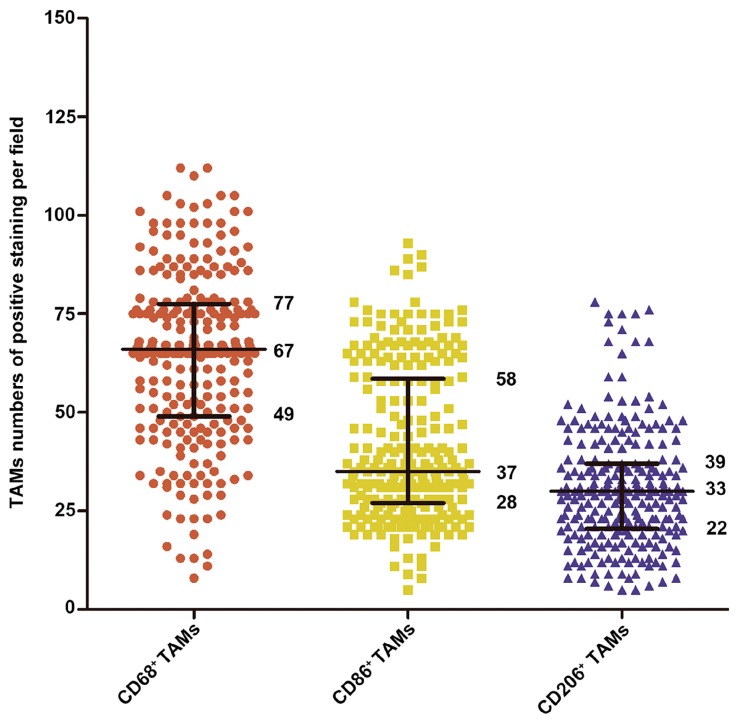
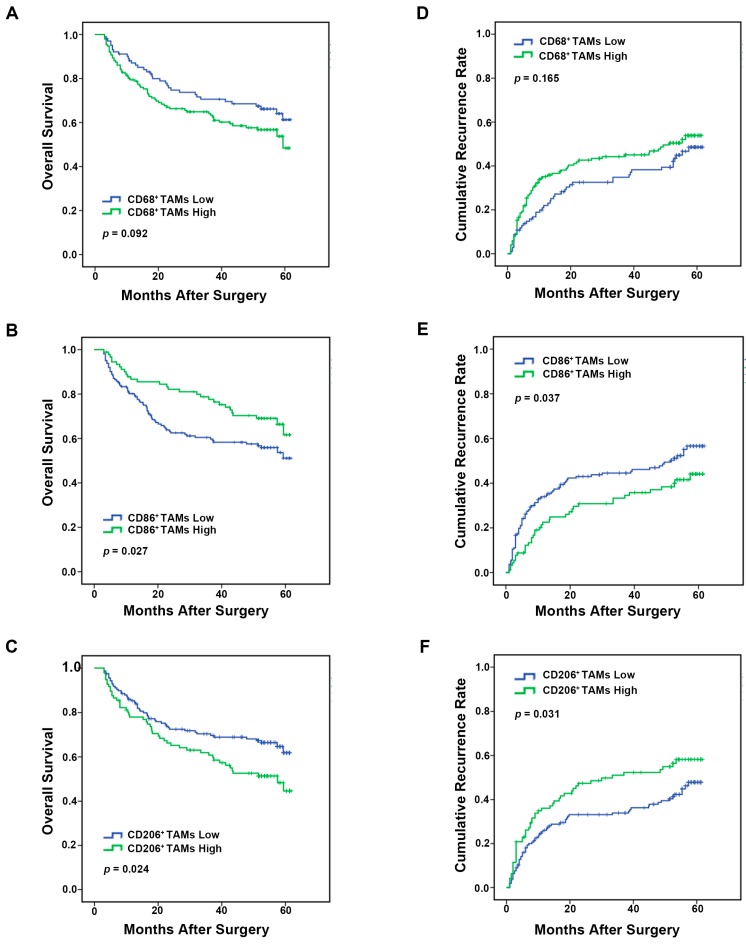
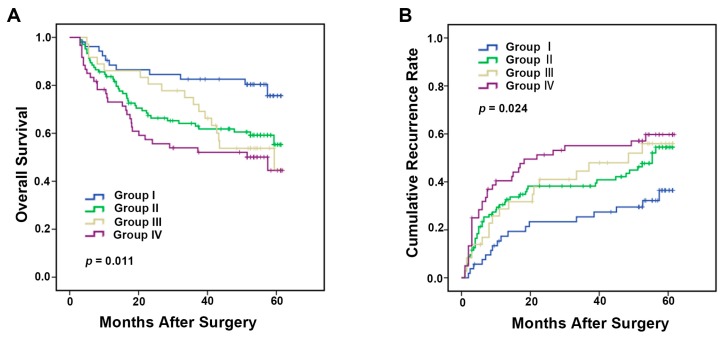
Tumor-associated macrophages (TAMs), the most abundant infiltrating immune cells in tumor microenvironment, have distinct functions in hepatocellular carcinoma (HCC) progression. CD68⁺ TAMs represent multiple polarized immune cells mainly containing CD86⁺ antitumoral M1 macrophages and CD206⁺ protumoral M2 macrophages. TAMs expression and density were assessed by immunohistochemical staining of CD68, CD86, and CD206 in tissue microarrays from 253 HCC patients. Clinicopathologic features and prognostic value of these markers were evaluated. We found that CD68⁺ TAMs were not associated with clinicopathologic characteristics and prognosis in HCC. Low presence of CD86⁺ TAMs and high presence of CD206⁺ TAMs were markedly correlated with aggressive tumor phenotypes, such as multiple tumor number and advanced tumor-node-metastasis (TNM) stage; and were associated with poor overall survival (OS) (p = 0.027 and p = 0.024, respectively) and increased time to recurrence (TTR) (p = 0.037 and p = 0.031, respectively). In addition, combined analysis of CD86 and CD206 provided a better indicator for OS (p = 0.011) and TTR (p = 0.024) in HCC than individual analysis of CD86 and CD206. Moreover, CD86⁺/CD206⁺ TAMs predictive model also had significant prognosis value in α-fetoprotein (AFP)-negative patients (OS: p = 0.002, TTR: p = 0.005). Thus, these results suggest that combined analysis of immune biomarkers CD86 and CD206 could be a promising HCC prognostic biomarker.
肿瘤相关巨噬细胞(TAMs)是肿瘤微环境中最丰富的浸润免疫细胞,在肝细胞癌(HCC)进展中具有不同的功能。CD68+TAMs 代表多种极化的免疫细胞,主要包含 CD86+抗肿瘤 M1 巨噬细胞和 CD206+促肿瘤 M2 巨噬细胞。通过对 253 例 HCC 患者组织微阵列中 CD68、CD86 和 CD206 的免疫组织化学染色,评估 TAMs 的表达和密度。评估了这些标志物的临床病理特征和预后价值。我们发现 CD68+TAMs 与 HCC 的临床病理特征和预后无关。低水平的 CD86+TAMs 和高水平的 CD206+TAMs 与侵袭性肿瘤表型明显相关,如多个肿瘤数目和晚期肿瘤-淋巴结-转移(TNM)分期;并与总生存期(OS)(p=0.027 和 p=0.024)和复发时间(TTR)(p=0.037 和 p=0.031)缩短相关。此外,与单独分析 CD86 和 CD206 相比,CD86 和 CD206 的联合分析为 HCC 的 OS(p=0.011)和 TTR(p=0.024)提供了更好的指标。此外,在 AFP 阴性患者中,CD86+/CD206+TAMs 预测模型也具有显著的预后价值(OS:p=0.002,TTR:p=0.005)。因此,这些结果表明,联合分析免疫生物标志物 CD86 和 CD206 可能是一种有前途的 HCC 预后生物标志物。