Kuwahata Masashi, Hasegawa Mari, Kobayashi Yukiko, Wada Yasuaki, Kido Yasuhiro
Departments of Nutrition Science, Graduate School of Life and Environmental Sciences, Kyoto Prefectural University, 1-5 Shimogamo-hangi-cho, Sakyo, Kyoto 606-8522, Japan.
Nutritional Science Institute, Morinaga Milk Industry Co., Ltd., 5-1-83 Higashihara, Zama, Kanagawa 252-8583, Japan.
J Clin Biochem Nutr. 2017 Jan;60(1):70-75. doi: 10.3164/jcbn.16-33. Epub 2017 Jan 1.
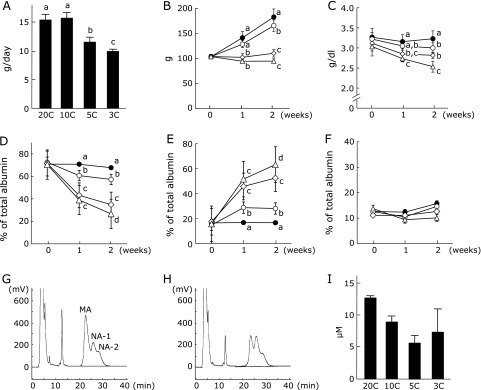
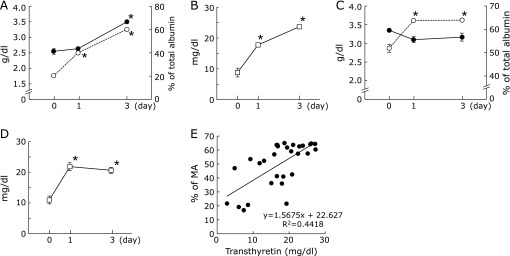
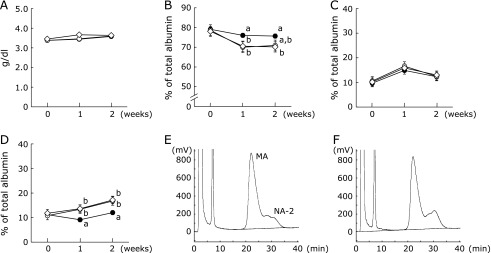
We examined whether protein- and food-intake restrictions modulate the oxidized/reduced state of plasma albumin in Sprague-Dawley rats. Rats were fed a 3%, 5%, 10% or 20% casein diet for 2 weeks. The plasma albumin concentration significantly decreased with decreasing protein intake. However, no significant difference in plasma albumin concentration was seen between rats fed the 5% or 10% casein diet. In rats fed the 5% casein diet, the percentage of mercaptalbumin within total plasma albumin was significantly lower and that of nonmercaptalbumin-1 was significantly higher than in rats fed the 10% casein diet. In experiments with food-intake restriction for 2 weeks, rats were fed 50% or 75% of the amount of a 20% casein diet consumed by control rats. The percentage of mercaptalbumin was significantly lower and that of nonmercaptalbumin-2 was significantly higher in rats with food-intake restriction than in control rats. When rats with malnutrition were refed with the 20% casein diet , the percentage of mercaptalbumin rapidly increased. The change in the percentage of mercaptalbumin was correlated with the plasma transthyretin concentration. These results indicate that the oxidized/reduced state of plasma albumin may be applied as a sensitive marker of nutritional status reflecting dietary pattern.
我们研究了蛋白质和食物摄入量限制是否会调节斯普拉格-道利大鼠血浆白蛋白的氧化/还原状态。将大鼠分别喂食含3%、5%、10%或20%酪蛋白的饮食2周。血浆白蛋白浓度随蛋白质摄入量的减少而显著降低。然而,喂食5%或10%酪蛋白饮食的大鼠之间血浆白蛋白浓度没有显著差异。在喂食5%酪蛋白饮食的大鼠中,总血浆白蛋白中巯基白蛋白的百分比显著低于喂食10%酪蛋白饮食的大鼠,而非巯基白蛋白-1的百分比则显著高于后者。在食物摄入量限制2周的实验中,给大鼠喂食对照大鼠所消耗的20%酪蛋白饮食量的50%或75%。食物摄入量受限的大鼠中巯基白蛋白的百分比显著低于对照大鼠,而非巯基白蛋白-2的百分比则显著高于对照大鼠。当营养不良的大鼠重新喂食20%酪蛋白饮食时,巯基白蛋白的百分比迅速增加。巯基白蛋白百分比的变化与血浆转甲状腺素蛋白浓度相关。这些结果表明,血浆白蛋白的氧化/还原状态可作为反映饮食模式的营养状况的敏感标志物。