Shah Amit, Nautiyal Vijay, Gupta Arti, Ramola Vikas
Department of Dentistry, Veer Chandra Singh Garhwali Government Institute of Medical Science and Research, Srinagar, Pauri, Garhwal, India.
Department of Oral and Maxillofacial Surgery, Seema Dental College, Dehradun, Uttarakhand, India.
Natl J Maxillofac Surg. 2016 Jan-Jun;7(1):80-85. doi: 10.4103/0975-5950.196139.
Evaluation of Maxillofacial fractures in hilly region of Garhwal Himalyas and its relation with age, gender, anatomical location, seasonal variation and treatment provided.
The aim of the present study is to analyze the pattern of maxillofacial fractures in the Garhwal Himalayan region of India and to compare the results with similar studies in India and the rest of the world.
This was a prospective study conducted on 102 patients with 128 facial fractures.
This study was conducted on 102 patients who were admitted for the treatment of maxillofacial fractures in the Department of Dentistry at Government Medical College, Srinagar, Uttarakhand, India.
All analyses were performed using Chi-square test and level of significance.
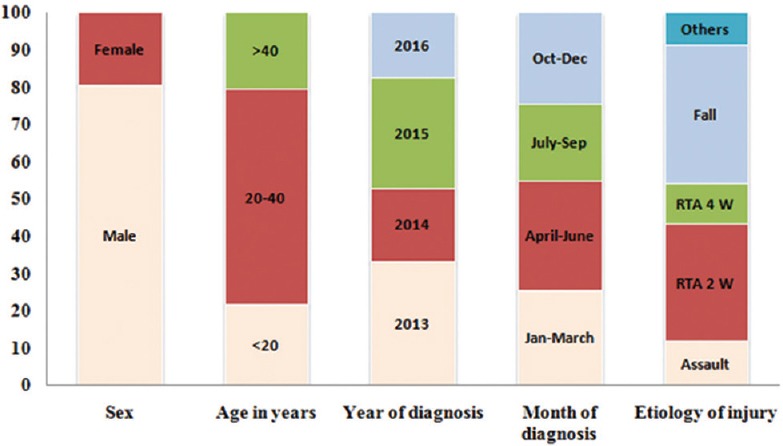
Peak incidence was noted in the second to fourth decades of life. Male: female ratio was 4:1. Road traffic accident was the main etiology (42.2%), followed by fall (37.2%) and assault (11.8%). Among other etiology of injury, distinguishing feature was bear bite, which was only seen in winters causing 5.9% of total injury. Fall was reported high in females whereas road traffic accident in males. Mandible was fractured in 73.5% of patients while mid-face in 26.5% of patients. Open reduction with internal fixation was the choice of treatment in 60.8% of cases. Nearly 79.4% of patients were treated under local anesthesia. The mean duration of hospitalization was (standard deviation 5.2 days) 5.3 days.
Road traffic accidents still remain the main cause of maxillofacial fractures in developing countries such as India. In hilly area, road traffic accident can be minimized by better wide roads with guide walls/parapet, strict law enforcement for overspeed, overload, and to use seat belts while driving, and use of helmet while riding two-wheeler. Open reduction internal fixation remains the first choice of treatment in facial fractures due to early return of function with minimal morbidity and better nutritional status in patients compared to closed reduction.
评估印度北阿坎德邦加瓦尔喜马拉雅山区的颌面骨折情况及其与年龄、性别、解剖位置、季节变化和所提供治疗的关系。
本研究的目的是分析印度加瓦尔喜马拉雅地区颌面骨折的模式,并将结果与印度及世界其他地区的类似研究进行比较。
这是一项对102例患有128处面部骨折患者进行的前瞻性研究。
本研究针对印度北阿坎德邦斯利那加政府医学院牙科收治的102例颌面骨折患者展开。
所有分析均采用卡方检验和显著性水平。
发病高峰出现在20至40岁。男女比例为4:1。道路交通事故是主要病因(42.2%),其次是跌倒(37.2%)和袭击(11.8%)。在其他损伤病因中,独特之处是熊咬伤,仅在冬季出现,占总损伤的5.9%。女性跌倒发生率高而男性道路交通事故发生率高。73.5%的患者下颌骨骨折,26.5%的患者中面部骨折。60.8%的病例选择切开复位内固定治疗。近79.4%的患者在局部麻醉下接受治疗。平均住院时间为5.3天(标准差5.2天)。
在印度等发展中国家,道路交通事故仍是颌面骨折的主要原因。在山区,通过修建更好的带防护墙/护墙的宽阔道路、严格执行关于超速、超载的法律以及驾车时系安全带、骑两轮车时戴头盔等措施,可以将道路交通事故降至最低。与闭合复位相比,切开复位内固定由于功能恢复早、发病率低且患者营养状况更好,仍然是面部骨折治疗的首选。